Economic Observer Follow
2026-08-04 09:48


Economic Observer reporter Liu Xiaonuo
On July 26, Xiao Qing, who worked in Beijing, gradually felt dizzy, weak, throat uncomfortable, and had a fever. The COVID-19 antigen test reagent showed that she was "positive again".
She wants to buy COVID-19 medicine, but offline pharmacies do not have any medicine, nor can she buy from pharmacies on the takeaway platform.
She found that there are only two kinds of channels to buy COVID-19 medicine: first, to see a doctor in the hospital; Secondly, purchasing from self operated pharmacies on e-commerce platforms such as JD.com and Meituan cannot be delivered immediately and requires a wait of 1-2 days.
The monitoring by the China Center for Disease Control and Prevention shows that the positive rate of COVID-19 detection has been on the rise recently from July 20 to July 26, and it is generally at a moderate epidemic level.
Li Dong, chief physician of the Department of Respiratory and Infectious Diseases of Beijing You'an Hospital affiliated to Capital Medical University, predicted that the number of COVID-19 infections may still rise in the next 1-2 weeks.
Many innovative drugs have been approved to treat COVID-19 in China, but most retail pharmacies across the country are still unable to buy COVID-19 drugs. The Economic Observer learned from the management of chain drugstores and a number of COVID-19 pharmaceutical enterprises that retail drugstores are still unable to sell COVID-19 drugs in compliance with the relevant policies issued a few years ago.
In the absence of terminal channels of COVID-19, staff of pharmacies often recommend oseltamivir and other influenza drugs to COVID-19 patients. The sales director of COVID-19 Pharmaceutical estimated that at least half of COVID-19 patients took other drugs by mistake.
A number of doctors, practitioners of pharmaceutical enterprises and drugstores all believe that allowing drugstores to sell COVID-19 drugs is conducive to improving the accessibility of drugs. Especially for high-risk groups, early use of drugs is conducive to rapid disease control and reducing related risks.
The drugstore doesn't sell COVID-19 medicine
Li Dong has recently felt that the number of COVID-19 patients in the hospital has changed this year. "Last year, when it was popular, there were only two or three people a week, but now there are two or three people every day. There are some big third class hospitals in Beijing that have more than 20 patients a day, and now there is a rising trend. Maybe people used to carry the burden when they felt uncomfortable, but now they know that COVID-19 is popular, so they take the initiative to screen when they feel uncomfortable."
People's demand for drugs is growing rapidly. Pioneer Pharmaceutical (02096. HK), Junshi Biological (01877. HK/688180. SH) and Zhongsheng Pharmaceutical (002317. SZ) all told the Economic Observer that they are increasing the production of COVID-19 drugs to ensure supply.
At present, the main channel for people to buy COVID-19 medicine is still hospitals; Next is e-commerce platforms, where the delivery time is usually 1-2 days, and in remote areas it may take 5 days. In most pharmacies across the country, people cannot buy COVID-19 medicine.
The limited channels for purchasing drugs have affected the efficiency of some patients in obtaining medication.
In the middle of July, a COVID-19 patient in Jiangsu wanted to buy COVID-19 medicine, and found that the nearby hospital only had nimotevir/ritonavir, with a price of more than 1700 yuan. After considering the price, she bought the domestic COVID-19 drug Loretvir tablets on a platform, and paid 445 yuan in full. The platform expects the medication to be delivered by express delivery the next day, but the patient has not received it on the fifth day after placing the order. The instructions of many COVID-19 drugs suggest that the drug should be taken within 2-3 days after symptoms appear.
The drugstore does not sell COVID-19 drugs, which may also allow COVID-19 patients who come to the drugstore to get the wrong drugs.
On the evening of July 26, Economic Observer visited many pharmacies in Beijing as a patient and found that there was no COVID-19 drug. The clerk of a local chain drugstore said, "If you want (COVID-19), it is generally oseltamivir and mabaloxavir."
Oseltamivir and Mabaloxavir are two commonly used flu drugs. When the reporter asked "whether it is useful for COVID-19", the shop assistant seemed uncertain: "It is useful. We only have these two kinds, nothing else."
"COVID-19 medicine and influenza medicine cannot replace each other," Li Dong once pointed out that influenza virus and COVID-19 are different, and the target of antiviral drugs is also different. For example, oseltamivir is used as a neuraminidase for influenza virus, but COVID-19 does not have this structure, so oseltamivir and other influenza drugs cannot be used to treat COVID-19, and vice versa.
Liu Shuang, vice president of Zhongsheng Pharmaceutical, estimated that after the normalization and prevalence of COVID-19, there are about several million patients every year, but more than half of COVID-19 patients may be intercepted by inappropriate drugs.
"Many people think it is flu after they have a fever, and they go directly to buy oseltamivir or ibuprofen. COVID-19's testing in pharmacies has not been popularized, and the professional ability of the staff in pharmacies is mixed. Some staff may directly recommend oseltamivir when they hear the patient has a fever." Liu Shuang said.
Historical policies continue to persist
Yin Yue is the head of the relevant department of a head listed pharmacy. At present, her company only sells COVID-19 drugs in a few hospital side specialty drug stores that can transfer compliant prescriptions. If patients come to COVID-19 Medicine, most stores will register "out of stock and unsatisfied".
According to Yin Yue, in March 2022, shortly after Pfizer's Paxlovid was approved, the National Healthcare Security Administration clarified that the drug was purchased by medical institutions, and retail platforms such as pharmacies had never participated in its procurement and sale. On December 7, 2022, the "new ten articles" were introduced, and the joint prevention and control mechanism of the State Council clearly released the purchase restrictions on over-the-counter drugs such as antipyretic, cough, antiviral, and cold treatment, but did not open the distribution authority of COVID-19 oral drugs to retail pharmacies.
"After 2023, the regulatory level has continued the restriction requirements of the State Food and Drug Administration on retail pharmacies not to sell COVID-19 therapeutic drugs in violation of regulations. In the supervision and inspection of the circulation link, the local drug supervision also made it clear that retail enterprises are not allowed to sell small molecule antiviral drugs of COVID-19, such as the combined packaging of nimotevir tablets/ritonavir tablets, Azovudine tablets, Cenocin, Mindwell, etc." Yin Yue said.
Yin Yue introduced that if a drugstore introduces COVID-19 Medicine, it must see two documents at the same time: one is the order of the State Food and Drug Administration to lift the ban on retail sales of the specific variety, and the other is the compliance distribution authorization given by the manufacturer or dealer. At present, both conditions have not been met, so they will not rush to purchase goods.
The Economic Observer found that in the first half of 2023, relevant government departments in many places mentioned the prohibition of retail sales of COVID-19.
In February 2023, Ankang Municipal Market Supervision Administration of Shaanxi Province issued a document stating that according to the relevant requirements of the provincial and municipal drug administration, the circulation of small molecule COVID-19 therapeutic drugs should be supervised, the quality and safety supervision in the retail sector should be strengthened, and "illegal sales of small molecule COVID-19 therapeutic drugs are strictly prohibited", including five varieties of nimatevir, Azovudine, Monolavir, Cenotevir, and Deuteromidevir Hydrobromide tablets.
In March 2023, the Market Supervision and Administration Bureau of Ezhou City, Hubei Province said, "We should focus on the retrospective management of small molecule COVID-19 therapeutic drugs, and strictly investigate the acts of selling varieties prohibited by the National Bureau of Drug Retailers without authorization".
In April 2023, the Market Supervision Administration of Changde City, Hunan Province replied to the NPC representatives that it would "strictly implement the work requirements of the State Food and Drug Administration on the prohibition of online sales and retail of small molecule therapeutic drugs for COVID-19 infection".
The head of the retail department of a related domestic pharmaceutical enterprise told the Economic Observer that in 2023, when COVID-19 Drug was approved for marketing, it was a conditional approval. "The regulatory authorities only allowed drugs to be sold and used in medical institutions due to the safety of drugs and other considerations. The related enterprises subsequently supplemented materials, submitted a large number of real world data studies, and the drugs have been transferred to routine approval, but the relevant policies have not been updated, and the pharmacy side is still unable to sell".
The person learned that by 2025, some pharmacies in many provinces and cities will have put COVID-19 drugs on the shelves in succession, and will be notified by some local drug regulatory authorities to take them off the shelves. At present, most regions are still implementing the 2022-2023 documents, and a few provinces and cities allow relevant drugs to be listed for sale due to patient accessibility considerations, without mandatory implementation of relevant requirements.
At the end of July, the Economic Observer learned from the Meituan, Jingdong and other platforms that in a few provincial capital cities nationwide, COVID-19 drugs can be obtained through pharmacies or instant retail.
"If patients go to the hospital to register, queue up, test and pick up medicine again, a series of processes will take half a day to one day. Many elderly people are inconvenient to travel. If COVID-19 medicine can be bought at the pharmacy downstairs or near the community, it is conducive to rapid control of the disease, more conducive to high-risk groups to reduce other risks, and it will also be more convenient." said the head of the above retail department.
There have been 3 routinely approved COVID-19 drugs
On July 30, the Chinese Center for Disease Control and Prevention (CDC) suggested that COVID-19 infection has become a common and frequent respiratory infectious disease since it was administered by Category B, and there are 1-2 epidemic fluctuations every year in China. In this epidemic, the severity of the disease has not changed, with mild infections being the main cause. Elderly people and those with chronic underlying diseases are still high-risk groups for severe cases, and specific treatment drugs are effective.
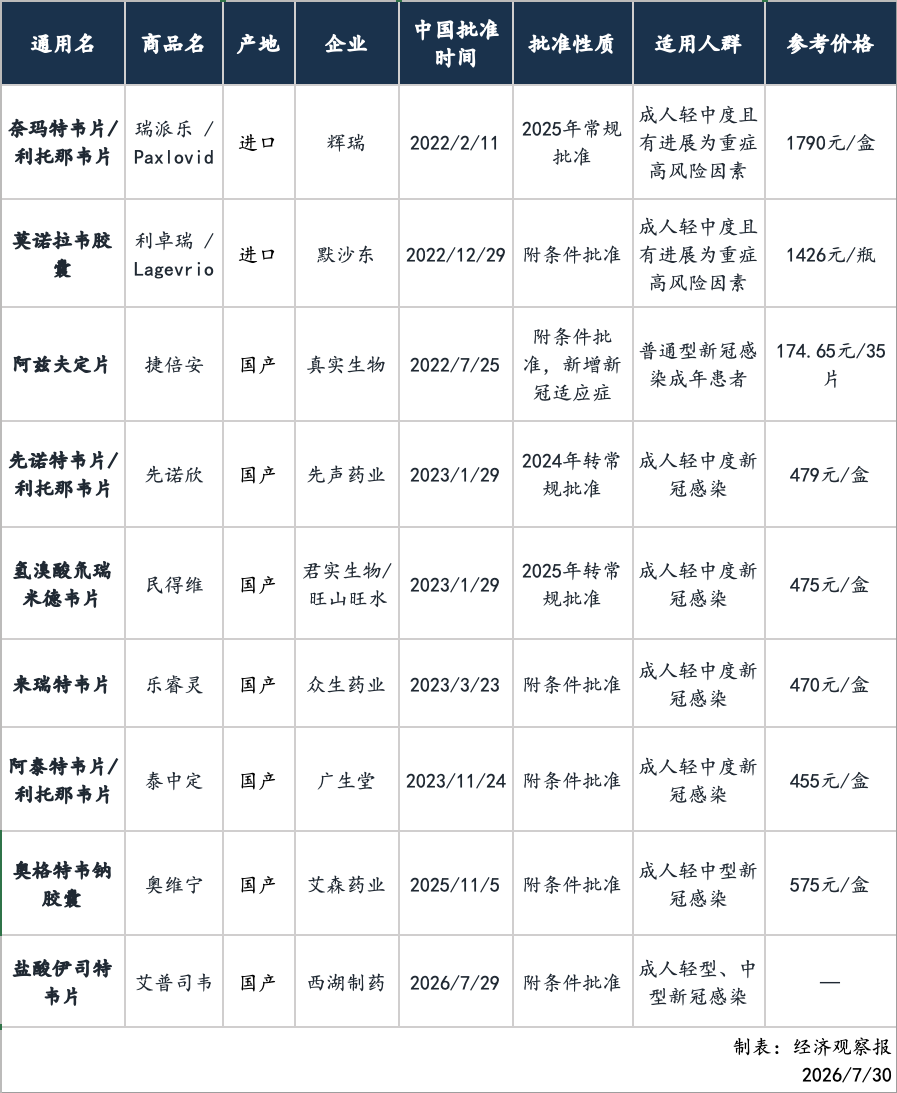
The first batch of COVID-19 new drugs in China has been conditionally approved for marketing from January to March 2023. On July 29, 2026, oseltamivir hydrochloride was conditionally approved, which is the sixth domestic COVID-19 new drug.
Conditional approval refers to the situation where a drug can be approved for market first with early evidence of efficacy, but the company must continue to supplement complete evidence after market launch. It is mainly applicable to clinically urgent drugs, public health emergencies, etc.
As of the time of writing, a total of three drugs in China have been converted from conditional marketing to routine approval, namely Pfizer's Namatevir/Letonavir tablets, Xiannuowei/Letonavir tablets from Xiansheng Pharmaceutical, and Junshi Bio's Deuterium Hydrobromide Remdesivir tablets.
Lu Hongzhou, president of Shenzhen Third People's Hospital, suggested: "Once there are symptoms, the first time to test, if positive, the first time to use antiviral drugs. Early antiviral treatment can effectively inhibit the virus, avoid aggravation of the disease, shorten the recovery time of symptoms, and prevent new crowns."
He pointed out that the experts agreed that high quality of evidence strongly recommended the elderly and patients with underlying diseases to use small molecule anti COVID-19 drugs at the early stage of infection, especially for cardiovascular disease, diabetes, cancer and elderly patients, and more recommended the use of drugs that do not interact.
"The infection of COVID-19 is much lighter than before, and most people will not get pneumonia." Li Dong once said that for young people and middle-aged people with normal immune function, most people can heal themselves in about a week, rest at home, and use antipyretic and analgesic, cough and expectorant or compound cold medicine according to the symptoms, which can generally alleviate the symptoms.
He introduced that antiviral drugs do not necessarily need to be taken. "If patients hope to recover a few days earlier and feel that the money is worth it, they can use the drugs.
(Yin Yue's pseudonym)


 Subscribe