2026-07-09 21:59


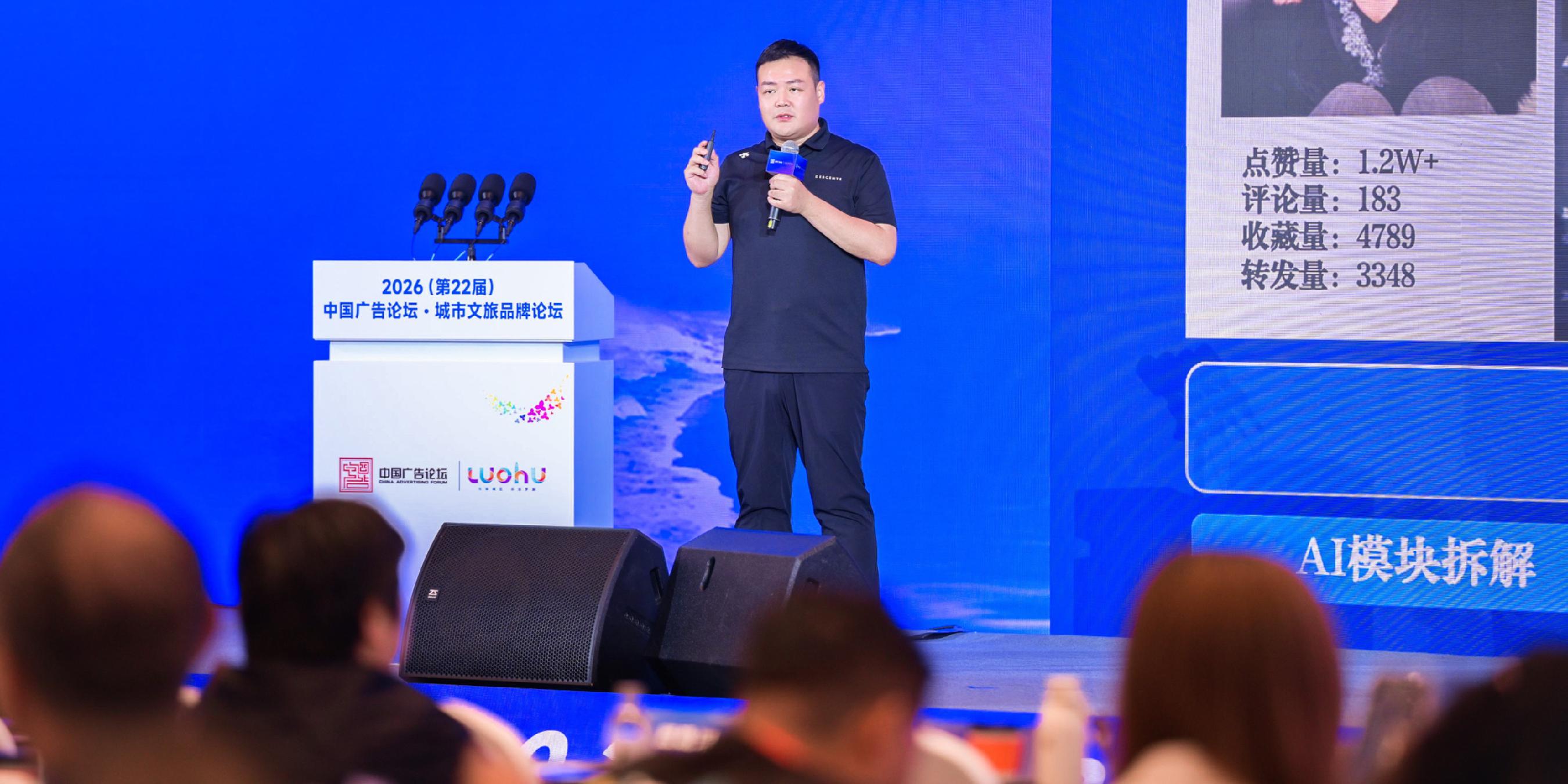
The 2026 (22nd) China Advertising Forum · Urban Cultural Tourism Brand Forum, hosted by the China Advertising Association, was successfully held on June 30th in Luohu District, Shenzhen. This forum focuses on the two main themes of brand building and digital economy development, bringing together government and enterprise representatives, authoritative media, industry scholars, brand owners, and advertising industry practitioners to conduct in-depth exchanges on core issues such as urban brand shaping, digital advertising innovation, and deep integration of culture and tourism. Together, we explore innovative paths for advertising to empower high-quality urban development under the AI wave, injecting new momentum into the transformation and upgrading of the advertising industry and the enhancement of urban brand value.
In the afternoon session of the forum, Liu Fangdong, CEO of Nuofang Yunchuang, delivered a keynote speech on "The Global Omni Marketing Revolution under the AI Wave". He pointed out that AI technology has covered the entire marketing chain, but the core problem faced by enterprises is how to effectively convert AI content at low cost and high efficiency. Based on this, he provided a systematic strategy for breaking down popular products and global distribution, which pointed out a practical and feasible direction for the AI marketing upgrade of cultural tourism and overseas enterprises.
Liu Fangdong first pointed out that AI has been fully integrated into the entire marketing chain, but the real pain point for enterprises is not whether they can use AI, but how to make AI content with the highest cost-effectiveness.
He mentioned that AI is currently very mature in content production - whether it is AIGC short dramas, film and television production, or short video generation, the technology is already in place. But he emphasized that the differentiation of AI marketing lies not in the production itself, but in how to make AI content more in line with platform algorithms and easier to obtain traffic. To this end, Nuofang Yunchuang took the lead in introducing an AI popular model analysis system. This system can target 23 global platforms and search for the top 100 popular short videos in a specific niche field in the target country and platform, feeding them to AI for explosive decomposition and extracting explosive factors from 16 dimensions. Liu Fangdong explained that whether a short video can become a popular product depends 80% on these popular factors. After the extraction is completed, the system will form an industry vertical model, and enterprises only need to import materials to mass produce content. With sufficient computing power, 10000 to 20000 short videos can be generated in a single day, and automatic desensitization, deduplication, and explosive factor optimization can be completed.
Focusing on content distribution and cost control, he proposed that the real challenge lies in how to achieve matrix operation at the lowest cost. Liu Fangdong explained in detail that Nuofang Yunchuang's approach does not rely on paid promotion, but rather uses an AI account cultivation system to manage bulk accounts on six major domestic platforms and 23 overseas platforms. The system can automate operations such as content publishing, group buying, or storefront mounting, achieving an integrated process from production to publishing. But he emphasized that in this process, companies must be wary of "AI redundancy" - the waste of tokens.He pointed out that currently over 45% of tokens are not used for productivity improvement, but are being consumed inefficiently. To this end, Nuofang Yunchuang adopts a combination solution of "RPA (Robotic Process Automation)+AI", which combines process automation with AI to save about 70% of token consumption and create maximum productivity value at minimal cost. On this basis, the system also supports cross language content creation in 174 languages and 24/7 live streaming of digital people, helping enterprises achieve full scene and uninterrupted AI marketing coverage.
Finally, Liu Fangdong shared the overseas marketing practices and business model innovations of Nuofang Yunchuang.
He mentioned that there is a huge content dividend in overseas markets. At present, Nuofang Yunchuang has self operated 1.1 million accounts from different social media platforms, distributed in more than 200 countries around the world, and plans to expand to 2 million within the year. These accounts are not for direct sale, but rather for creating personal accounts in segmented fields with the company. Taking a leading automotive brand as an example, Nuofang Yunchuang has maintained 100000 overseas automotive blogger accounts for it. From account provision, content production, private domain outreach to transaction attribution, all are the responsibility of Nuofang, and the enterprise only needs to provide product and supply chain support. Liu Fangdong clearly stated that Nuofang Yunchuang adopts the "incremental sharing" model - no service fee is charged in the early stage, and only after the product evaluation reaches 85 points or above and the cooperation is confirmed, will the actual incremental transaction be shared.
He also added that the system not only supports front-end transactions, but can also deposit customers in private domains - whether it is domestic WeChat or overseas Line, customer tagging follow-up can be achieved through automated RPA workflow without manual intervention. At present, Nuofang Yunchuang has helped a certain headphone brand achieve a sales scale of about 1.2 billion yuan.
Liu Fangdong concluded that the future of AI marketing lies not in how cool the technology itself is, but in whether it can help companies achieve real growth at the lowest cost and highest efficiency. Nuofang Yunchuang hopes to provide a feasible AI marketing transformation path for cultural tourism and overseas enterprises through a closed-loop model of "account+content+private domain+effect sharing".
The following is a conversation between Modern Advertising and Liu Fangdong, CEO of Nofang Cloud Creation:
Q: Do you think AI can become a breakthrough tool for Chinese companies to carry out overseas marketing? What specific aspects can provide assistance to overseas enterprises?
A: The answer is affirmative. Nowadays, the industry has achieved full implementation of AI, and the coverage rate of AI empowering the entire marketing and advertising communication chain can reach almost 100%. Our and many peer enterprises' practices have also confirmed that AI can greatly improve the overall operational efficiency of going global. Firstly, relying on AIGC to build an automated content factory and innovate the content production mode. In the past, producing 1000 short videos required a team of at least ten people to spend a whole day's manpower; Nowadays, the system will first capture the popular videos of the target track, disassemble and extract the core popular factors, and then hand them over to AI for learning and replicating to generate content. With the help of this mode, short videos can be produced with a guaranteed minimum playback volume of 5000, achieving a dual breakthrough in quality and efficiency compared to traditional content production modes.
Q: As a local enterprise rooted in Shenzhen, how do you view the unique value and empowerment brought by Shenzhen's industrial ecology to AI marketing innovation and brand going global?
A: Firstly, Shenzhen is a very inclusive and open city. Many Chinese overseas enterprises gather in Shenzhen, thanks to its policy advantages in reform and innovation. At the same time, Shenzhen has a very rich corporate ecosystem. Among the popular categories for going global, the 3C category has shown outstanding performance, giving birth to a number of leading companies such as Anke Innovation, DJI, Insta360, etc. The growth of these enterprises is rooted in the support of Shenzhen's huge overseas industry on the one hand, and on the other hand, it cannot be separated from a complete supporting service system, including logistics, financial flow, and information flow - these three types provide important support forces in assisting enterprises in the process of going global.


 WeChat registration or login