

Economic Observer Follow
2026-04-13 15:31



On June 1st, the Ministry of Public Security released the "New Rules for Determining Fatigue Driving of Motor Vehicle Drivers" (hereinafter referred to as the "New Rules"), which will soon be implemented. The new regulations stipulate that if a passenger motor vehicle driver accumulates more than 8 hours of driving time within 24 hours, it should be considered as fatigue driving. Passenger transport motor vehicle driver refers to a motor vehicle driver engaged in road passenger transport business activities. Ride hailing drivers, taxi drivers, etc. are all motor vehicle drivers engaged in road passenger transportation business activities.
In addition, the "New Regulations" also propose to determine the continuous driving time, parking rest time, and cumulative driving time of motor vehicle drivers by extracting driving record data from vehicle terminals or monitoring platforms, questioning or interrogating motor vehicle drivers, questioning witnesses, and retrieving video evidence checkpoint monitoring.
The new regulations further refine the criteria for determining fatigue driving. Previously, fatigue driving was mainly based on the relevant provisions of the Implementation Regulations of the Road Traffic Safety Law, which stipulated that driving a motor vehicle continuously for more than 4 hours without stopping for rest, or stopping for less than 20 minutes for rest.
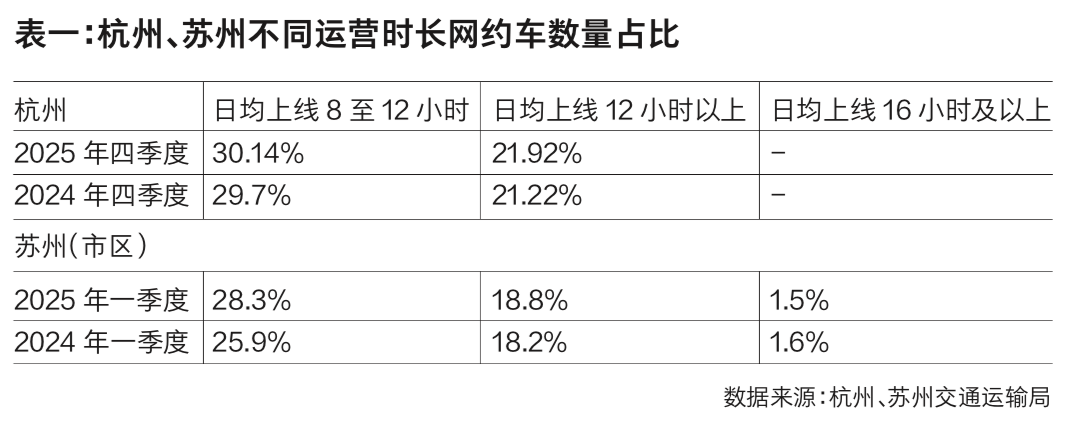
The actual working hours of current ride hailing drivers far exceed the requirements of the new regulations. In the first quarter of 2025, the proportion of ride hailing vehicles operating for more than 8 hours per day in Hangzhou and Suzhou (urban areas) was 52.72% and 47.1% respectively, with 1.5% of vehicles in Suzhou (urban areas) operating for more than 16 hours per day. (See Table 1)
The overtime work of ride hailing drivers has both active and passive factors. On the one hand, ride hailing drivers are a typical "more work, more pay" position, and a large number of drivers actively extend their working hours to increase their income; On the other hand, the unit price of ride hailing services in many cities continues to decline, forcing drivers to increase their working hours in order to maintain their original income levels.
The Economic Observer has compiled data on ride hailing services regularly released by the transportation departments of 10 cities (all of which have a GDP ranking among the top 20 in the country). Data shows that in the past three years, the unit price per kilometer or daily revenue of ride hailing services in most cities has been continuously declining.
For example, in the second half of 2025, the hourly wage of ride hailing drivers in Wuxi (urban area) will drop from the peak of over 33 yuan to 29.01 yuan. After deducting the platform's commission (taking Didi as an example, the average commission is 14%), the hourly wage of ride hailing drivers has approached the minimum hourly wage standard for part-time employment in Wuxi (25 yuan/hour).
Zhang Chenggang, Associate Professor of the School of Labor Economics at Capital University of Economics and Business and Director of the China New Employment Forms Research Center, stated that in recent years, the income "involution" of ride hailing drivers has become increasingly apparent, and many drivers can only maintain their income level by extending their working hours. After the implementation of the "8-hour work system", some drivers' income may experience a significant decline under the current hourly wage level, making it difficult for them to support their families.
The intensification of "internal competition" in ride hailing services
From 2015 to 2017, the ride hailing industry was in an explosive growth stage, and "earning over 10000 yuan per month" was one of the most well-known advertising slogans for ride hailing platforms to attract drivers into the industry. The regularly released data on ride hailing services in various regions also confirms that ride hailing drivers once had a period of "easy earning" time. But starting from the second half of 2024, such 'good days' will gradually fade away.
As shown in Figure 1, from the second half of 2023 to 2025, the average daily revenue of ride hailing services in Chongqing, Changzhou, and Wuxi (urban areas) will continue to decline, and all will reach a new low in average daily revenue in the fourth quarter of 2025. This daily revenue has not yet deducted platform commission, vehicle rental, and energy consumption costs.
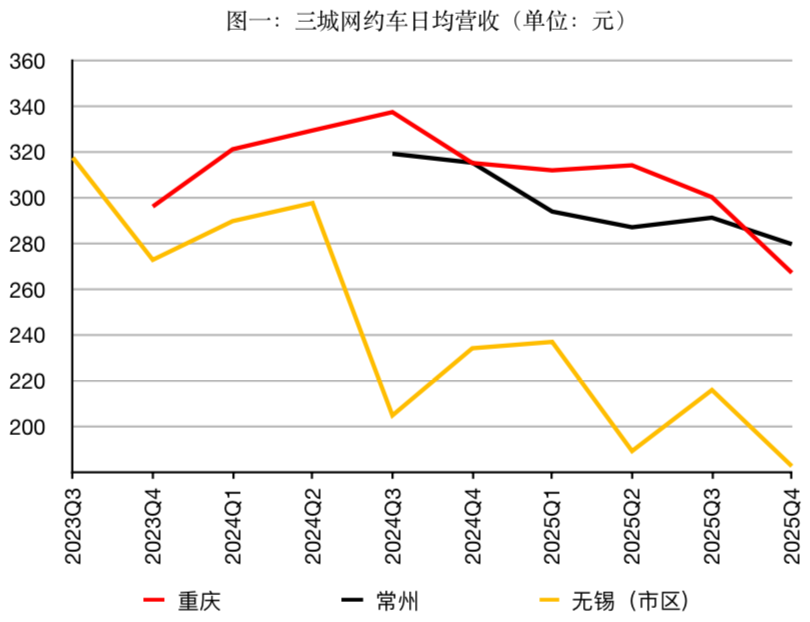
Taking Wuxi (urban area) as an example, the average daily revenue of ride hailing services in the fourth quarter of 2025 was 182.76 yuan, a decrease of 22% compared to the same period in 2024, far lower than the average salary of urban private sector employees in Wuxi in 2024 (81723 yuan/year, about 223.9 yuan/day). In the third quarter of 2023, the daily average revenue of ride hailing services in Wuxi (urban area) reached 317.34 yuan.
The limited or even declining daily revenue growth of ride hailing services is not due to drivers' lack of effort, but rather due to the continuous decline in the unit price per kilometer of ride hailing services. Therefore, all other conditions being equal, in order to maintain the income level of two years ago, drivers can only become more 'involuted'.
The characteristic of "involution" is particularly evident in Changzhou. From the third quarter of 2024 to the fourth quarter of 2025, the average daily revenue of ride hailing services in Changzhou gradually decreased from 319.03 yuan to 279.6 yuan, but the average daily passenger mileage continued to rise, increasing from 106.6 kilometers to 144 kilometers.
In January 2026, the Changzhou Transportation Bureau released a notice stating that in the fourth quarter of 2025, the number of local ride hailing drivers continued to increase, but the daily average revenue of bicycles decreased. Some drivers extend their working hours to maintain their income, but face the dilemma of 'more work, more pay'.
The online ride hailing operation data released by Shenzhen and Guangzhou also show that in 2025, local drivers will strive for higher income by significantly extending their operating mileage.
From 2022 to 2024, the average daily revenue of ride hailing services in Shenzhen with an average daily order volume of ? 10 orders is gradually declining, and has fallen to 438.2 yuan in the second half of 2024. But this trend will reverse in 2025: in the second half of 2025, the daily average revenue of Shenzhen ride hailing services (with an average daily order volume of ? 10) will directly rise to 548.9 yuan, a year-on-year increase of 25.3%, while the daily operating mileage will increase more significantly, with a year-on-year growth rate of 27.6%. (See Table 2)
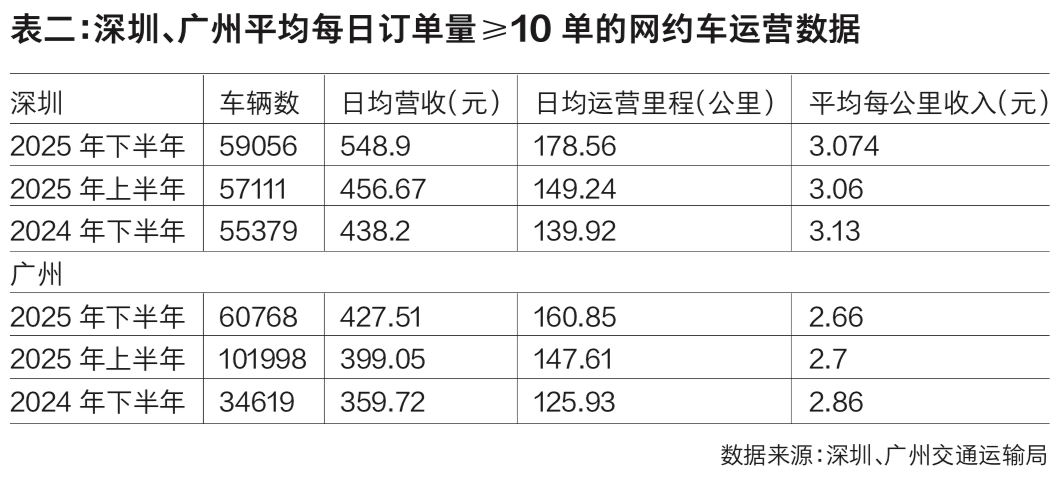
This means that although Shenzhen ride hailing drivers face a slight decline in their income per kilometer, they choose to increase their operating mileage in exchange for income growth.
The data for Guangzhou and Shenzhen are also similar, but what is more unique is that the income per kilometer of ride hailing drivers in Guangzhou has declined more significantly - the average income per kilometer in the second half of 2022 was 3.46 yuan, and by 2025 it has dropped to 2.66 yuan.
In addition, 'involution' is also reflected in the increase of driver operating hours. For example, in Suzhou (urban area), while the number of ride hailing services continues to grow, the proportion of vehicles operating for more than 8 hours per day has increased from 42.5% in the fourth quarter of 2023 to 47.2% in the first quarter of 2025.
According to data released by the Fuzhou Transportation Bureau, in the second and third quarters of 2025, local ride hailing drivers will work an average of 10-12 hours per day. In November 2023, it was mentioned that the average daily working hours of ride hailing drivers in Fuzhou were over 10 hours, with 4 days off per month.
Zhang Chenggang said, "In recent years, ride hailing drivers have faced the challenge of declining unit time income and can only maintain their income level by continuously extending their working hours. Our research shows that the majority of drivers spend around 10 hours online per day, and a very small number of drivers spend more than 15 hours online per day
The number of ride hailing drivers is still growing rapidly
Despite the intensification of the "internal competition" in the ride hailing industry, as an important channel for middle-aged employment, a large number of people continue to join.
In 2023, several first - and second tier cities began issuing warnings such as "saturation of ride hailing services". In 2024 and beyond, warnings of "saturation" have become normalized. When the Shenzhen Transportation Bureau released the operational data of the ride hailing market for the second half of 2025 and 2024, it even directly adjusted the warning from "approaching saturation" to "already saturated".
By 2026, such warnings will continue to occur frequently. In February 2026, the Suzhou Transportation Bureau released a report on the operation and risk warning of the ride hailing market, stating that based on the fourth quarter operation data, the size of the ride hailing market has stabilized. Practitioners who intend to engage in ride hailing services should make reasonable judgments about their income expectations and not easily believe false advertising that exaggerates their income, such as "easily earning over 10000 yuan per month".
Feng Shuaizhang, Dean of the Institute of Economics and Social Sciences at Jinan University, stated that the demand for ride hailing services in a city cannot grow indefinitely, therefore there is a peak in the market demand for related labor. From a market perspective, the order scale of major ride hailing platforms has reached a period of excessive growth and entered a mature development stage. Therefore, at the supply and demand level, the new demand for drivers on ride hailing platforms is actually relatively limited.
But the government's warning did not dampen people's enthusiasm for entering the industry.
According to the monitoring of the online ride hailing regulatory information exchange system, in January 2021, a total of 3.086 million driver's licenses for online ride hailing were issued across the country. By the end of October 2024, the number had increased to 7.483 million, with an average annual growth rate of over 900000. Since then, this data has not been released again.
From the 10 cities surveyed, Xi'an, Changzhou, Shenzhen, Guangzhou, and Wuxi have maintained a relatively high growth rate in the number of ride hailing drivers (i.e. the number of people who have obtained a ride hailing driver qualification certificate) in the past three years. Among them, the average annual growth rate of ride hailing drivers in Shenzhen and Guangzhou has remained above 40000, and in the past four years, the number of drivers in both cities has almost doubled.
In cities such as Hangzhou and Chongqing, although the number of people who have obtained local ride hailing driver qualification certificates or online appointment rental car transportation certificates has grown slowly, even entering a stagnant state, the daily active number of drivers taking orders in the local area has increased significantly.
For example, as of the fourth quarter of 2023, there were 116000 licensed ride hailing vehicles and 203000 licensed ride hailing drivers in Chongqing (central urban area). Two years later, the two figures were 118000 and 229000 respectively, with only a slight increase. But the daily number of vehicles receiving orders gradually increased from 43000 to 54000. At the same time, driver income has not rebounded, with the daily average revenue of local ride hailing drivers dropping from 337.2 yuan in the third quarter of 2024 to 267.1 yuan in the fourth quarter of 2025, a decrease of 20.8%.
Zhang Chenggang stated that in addition to issuing saturation warnings, some cities will also directly set industry access barriers to intervene in the number of ride hailing drivers, including stopping the issuance of vehicle transport certificates. This is equivalent to the government taking the initiative to "protect" drivers who have already entered the online ride hailing industry, while also depriving future generations of the "reemployment" option of online ride hailing drivers.
In response to the intensification of "internal competition" in the industry, but the number of ride hailing drivers is still growing rapidly, Zhang Chenggang said that the ride hailing industry is a huge and flexible employment reservoir. Due to its low entry and exit barriers, ride hailing services provide timely and decent employment opportunities for a large number of unemployed individuals. Against the backdrop of macroeconomic fluctuations, the role of the ride hailing industry as a "employment reservoir" is becoming increasingly prominent.
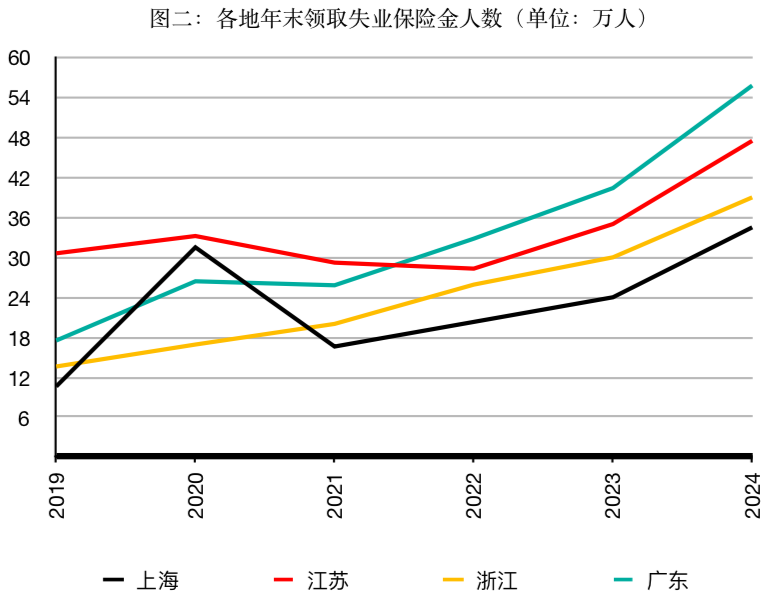
In recent years, the job market has faced certain pressures. The annual "China Statistical Yearbook" released by the National Bureau of Statistics shows that the number of people receiving unemployment insurance benefits in China has been continuously increasing from 2021 to 2024, with the most significant increase in 2024, rising from 3.521 million at the end of 2023 to 4.632 million at the end of 2024, an increase of 31.6%. Among them, the number of people receiving unemployment insurance benefits in Guangdong, Shanghai and other regions has increased significantly in 2024, with the total number exceeding that of 2020 (as shown in Figure 2)
Feng Shuaizhang stated that the ride hailing industry is like a mirror reflecting the job market. Although the scale of employment absorption in the industry is approaching its peak, the rapid growth of the number of ride hailing drivers reflects the multiple challenges facing the current job market. In this context, becoming the optimal choice for ride hailing drivers after comprehensive consideration.
How to balance the interests of multiple parties
When 'involution' becomes a major feature of the ride hailing industry, it remains to be seen what impact the upcoming 'New Regulations' on June 1st will have on ride hailing drivers.
Zhang Chenggang stated that after the implementation of the new regulations, the online time of ride hailing drivers shall not exceed 8 hours per day, and the actual passenger time shall be even less. Their daily revenue will inevitably face growth bottlenecks, and the profession of ride hailing drivers may become "uneconomical". In this context, the trend of sustained and rapid growth in the number of ride hailing drivers will soon reach a turning point.
Before the introduction of the "New Regulations", Didi had already stipulated in 2019 that drivers must take a 6-hour break after accumulating 10 hours of billing hours before they can go online again. Zhang Chenggang stated that in actual operation, a large number of ride hailing drivers choose to avoid platform rule restrictions by accepting orders through multiple platforms. The introduction of the "New Regulations" at the national level is conducive to safeguarding the physical and mental health of ride hailing drivers. However, it can be foreseen that even if this is a beneficial policy, if personal income cannot be guaranteed, there may still be a large number of drivers who adopt various methods to circumvent the rules and restrictions in practice
Feng Shuaizhang stated that at present, it is still necessary to observe whether the "New Regulations" are mandatory or reference regulations. If it is only a reference regulation, it is also necessary to observe whether the relevant departments will enforce it.
Regardless of whether the new regulations are enforced or not, the phenomenon of "online ride hailing drivers being forced to extend their working hours in exchange for stable income" will inevitably pose safety hazards to drivers and passengers. To solve this problem, on the one hand, it is necessary to restrain dangerous driving behaviors such as fatigue driving, and on the other hand, it is also necessary to explore the "breakthrough" of the ride hailing industry.
The 2026 Government Work Report proposes to promote the win-win development of platform enterprises, platform operators, and workers when deploying annual work tasks.
Is it feasible to increase the transportation unit price through administrative means? The taxi industry has previously adopted a similar approach.
Zhang Chenggang stated that this requires careful consideration. If the increase in transportation unit price leads to a decrease in the frequency of consumers taking taxis, it may actually result in a decrease in the total income of drivers.
Feng Shuaizhang stated that the decline in transportation unit prices is the result of full market competition, and government intervention in freight rates needs to be very cautious. However, in terms of rights protection and platform commission, the discourse power of ride hailing drivers is significantly weaker than that of platforms. Therefore, in the future, government departments can play a role in providing reasonable guidance and moderate intervention in the game between ride hailing drivers and platforms, promoting a more fair and reasonable distribution of income between both parties.
In Zhang Chenggang's view, increasing workers' income and strengthening the protection of workers' rights and interests are still fundamental solutions. Taking a break of at least 20 minutes after driving continuously for 4 hours is a basic requirement for safe driving for truck drivers in many countries, and drivers in these countries are more willing to actively comply. In addition to realizing its necessity, it is largely because their income level is sufficient to support them in complying with the rules

3M China President Ding Hongyu: 25 years on the same frequency as the times

AMD Senior Vice President and President of Greater China, Pan Xiaoming: Keenly Capturing the Pulse of China's Economic Development

Kong Na, Chairman and President of Angel Group: Supporting the Upgrading of the Real Economy to a Brand Economy


 WeChat registration or login


 Subscribe
