2026-11-26 16:58

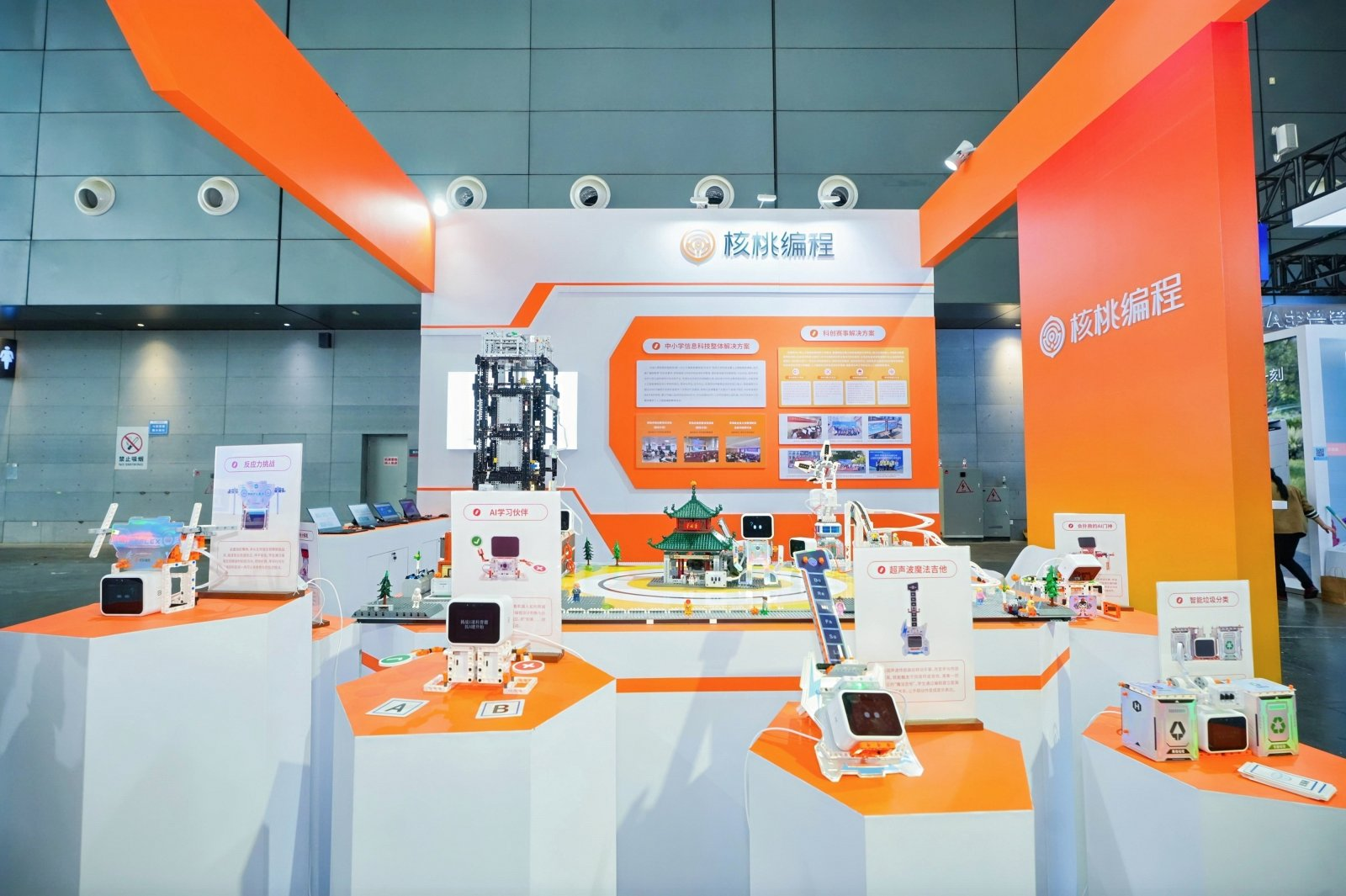
The vertical transportation tower, modern residential buildings, and replicated Love Evening Pavilion landscape pavilions, combined with AI welcome robots, form a complete set of interconnected smart city scenes. The student typed the last line of code on the terminal device, pressed the send button, and the instruction was immediately sent to the physical hardware, which quickly sensed and started the device. The abstract logic on the screen suddenly becomes a tangible work that can be seen and debugged, allowing students to fully experience the entire process from design, testing, error correction, to repeated iterations. This is a real-life demonstration of the new generation of AI programming hardware recently unveiled by Walnut Programming at the China Education Equipment Exhibition.
Behind the launch of this integrated software and hardware product is Walnut Programming's attempt to change the current situation where teenage programming has long been confined to screen code. In the past, many programming classes mostly focused on computers, with teachers verbally explaining the principles, and teenagers could only type lines of code on the keyboard and observe the program running in a virtual environment. Without the hands-on verification process, it is difficult for students to intuitively understand whether the code can solve real problems and how to solve them. Many programming courses are gradually separated from the exploration, trial and error, and hands-on creation advocated by science education.
Protecting the curiosity, imagination, and curiosity of young people, allowing them to experience the organic combination of learning, thinking, and doing through hands-on experience, is also a clear shift in the direction of science education in compulsory education. In July 2026, the General Office of the Ministry of Education issued the "Guidelines for the Leading Action of 'Learning by Doing' in Science Education at the Compulsory Education Stage" (hereinafter referred to as the "Leading Action"), proposing to strengthen scientific exploration and practice, comprehensively enhance students' scientific literacy, and serve the construction of a strong country in education, science and technology, and talent.
The education industry is looking for a suitable implementation path.
As early as its establishment in 2017, Walnut Programming began to explore this direction, gradually building a complete technology education service system covering thinking enlightenment, systematic learning, software and hardware practical operation, and scientific and technological innovation activities from traditional online programming courses. And this new plan also breaks away from the previous idea of simply adding experimental teaching aids, attempting to break down the barrier between code and the physical world, filling in the long-standing lack of hands-on activities in programming education, and guiding young people to establish scientific exploration habits through repeated debugging, failure, and modification.
The shift from code on the screen to tangible and modifiable physical creations also reflects the changes happening in youth technology education: with the continuous advancement of AI and robotics technology, technology education is no longer just focused on imparting knowledge, but is now centered around interests. Compared to mastering programming syntax, the ability to use technology to discover problems and solve them by hand is being placed in a more important position.
Science education 'learning by doing' - taking code out of the screen
Are teenagers interested in lines of dry code? Unless learning programming in an interactive and real-time feedback manner.
For a long time in the past, Walnut Programming has been thinking about this issue. At this year's China Education Equipment Exhibition held in Changsha, the "Future City" model built with local elements from Changsha is the concrete carrier of its new generation of AI programming hardware.
In the model, a vertical traffic tower, a four story modern residential building, a satellite shaped scientific observation station, and a replica of the Changsha landmark "Love Evening Pavilion" landscape pavilion are arranged in sequence; An AI welcome robot has been installed on one side of the urban ring road. The entire scene integrates home space, urban transportation, and scientific observation facilities, transforming abstract programming logic into visible linkage effects.
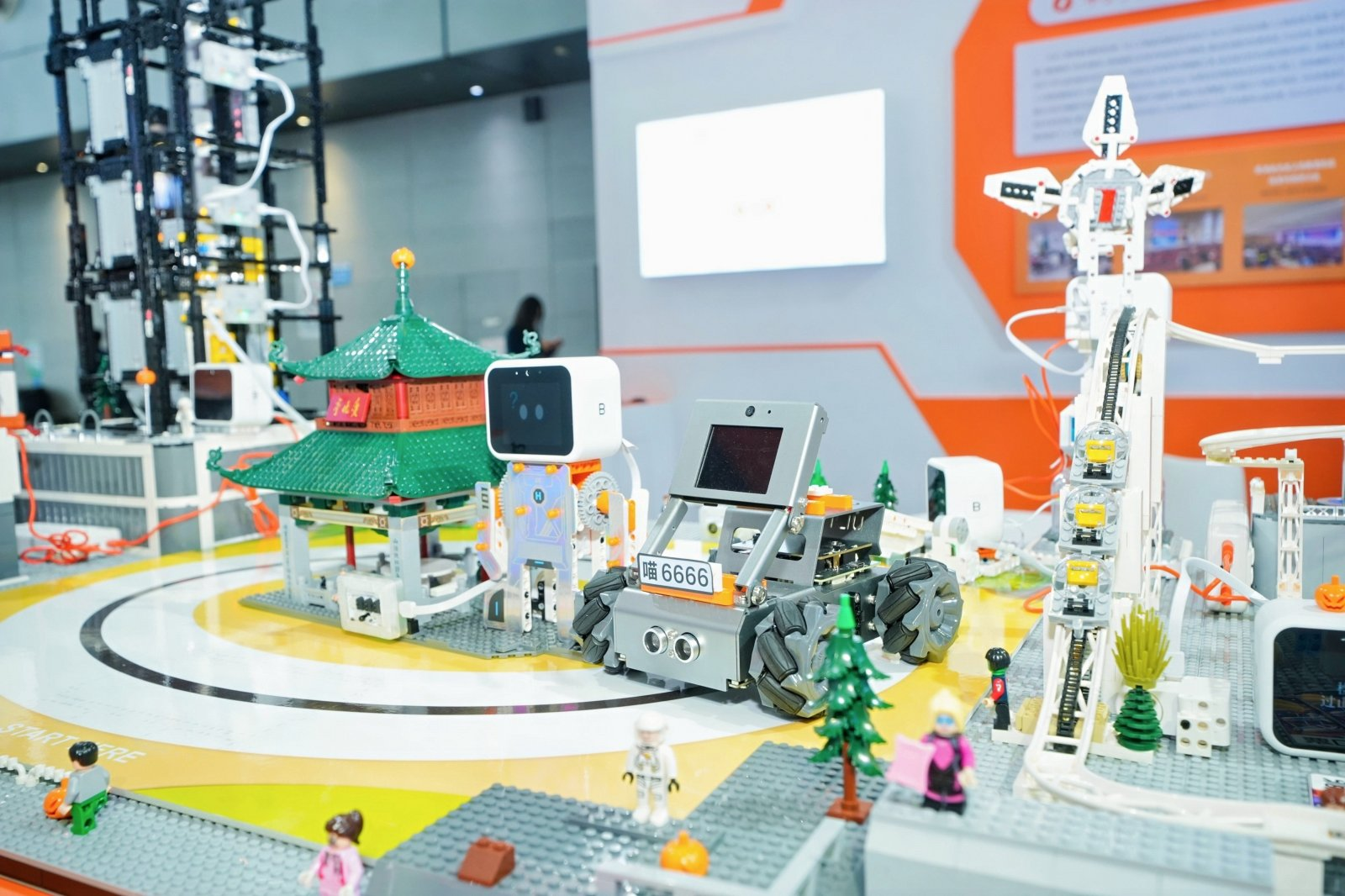
In this micro city, Walnut programming has pre-set corresponding interaction logic for each device. After the visitor selects the floor, the elevator car slowly rises and the indicator light lights up when it stops in place; The scientific research observation station extends outward with a satellite structure, integrating the imagery of space observations into urban scenes; Visitors will hand over paper tickets to the camera, and the main control board will automatically recognize the ticket information. The roller coaster will slowly start along the track; On the outer ring road, the inspection car travels along a fixed route and automatically stops when approaching the inspection station, waiting for the gate to open. The welcome robot can perceive approaching visitors and make interactive responses synchronously. The flowing light strip on the nearby Love Evening Pavilion landscape stage is also lit up step by step with voice explanation.
The core that supports the linkage of the entire scene is a unified main control board, which establishes a pathway between code, hardware works, and the real environment. The function of the main control board is to continuously collect external signals and provide feedback according to program instructions. The onboard camera gives it visual perception ability, which can recognize people, objects, colors, and locate target positions.
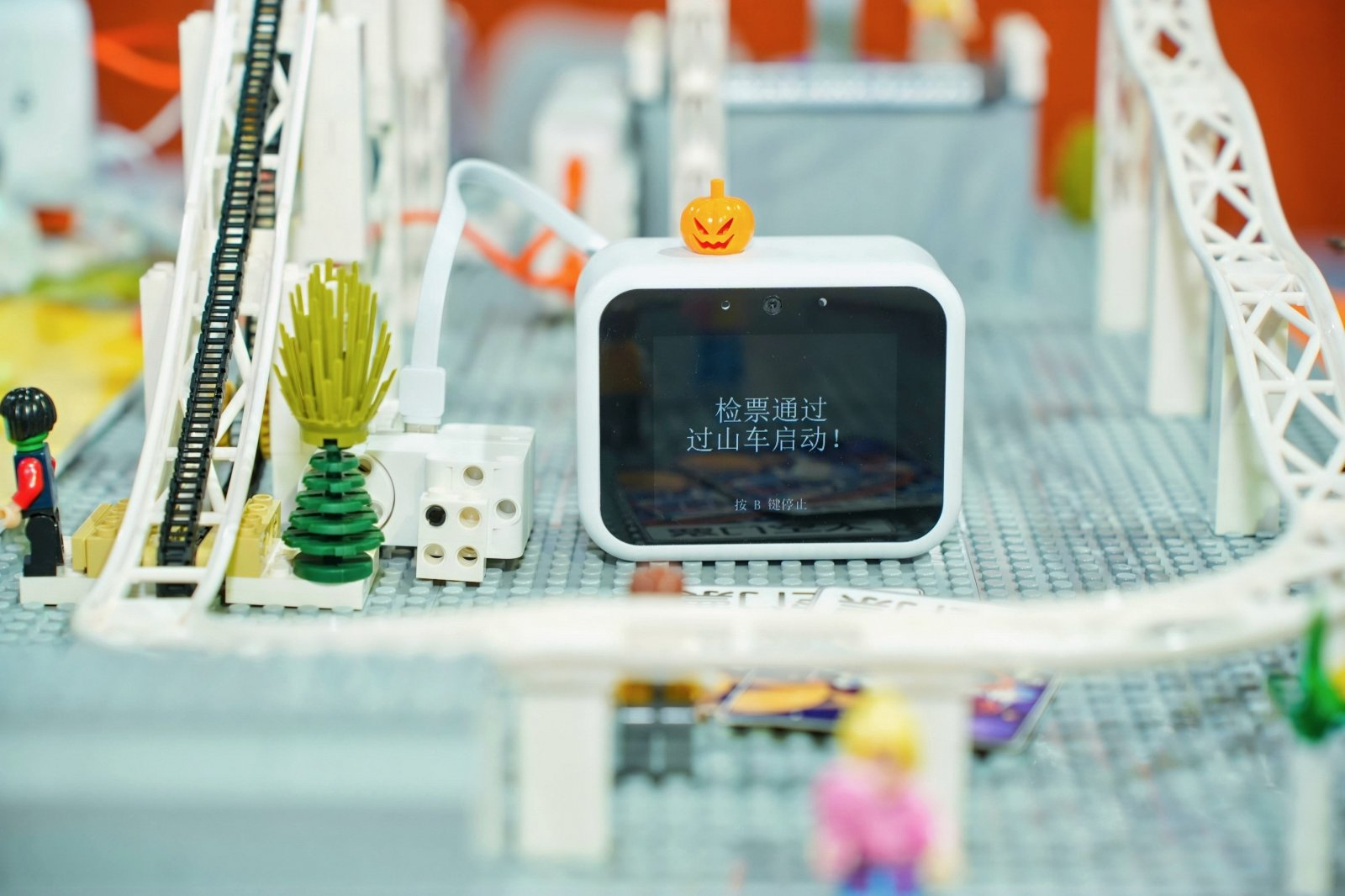
Compared to previous iterations of products, the new generation of AI programming hardware integrates sensing, interaction, and communication capabilities on a single main control board, no longer scattered across multiple independent components. Teenagers don't need to spend a lot of time selecting, wiring, and debugging basic peripherals, they just need to focus on project creativity and program design.
For example, in the color block sorting project, after teenagers complete the code writing, the main control board recognizes different colors and can drive the device to complete the classification.
Behind the lively linkage demonstration is the thinking of the hardware development team of Walnut Programming on the pain points of traditional programming learning. The threshold for programming languages mostly comes from abstract syntax, strict symbol specifications, and tedious keyboard typing. For teenagers, such content is like a heavenly book; Even for senior students, boring code can easily extinguish their newly ignited interest. The method proposed by Walnut Programming is to concretize abstract programming concepts in interactive experiences.
In the era of AI, coding itself has become easy, so many parents ask, what can be gained from learning programming? The answer is actually much more than just learning to write code. The core value of programming in the AI era lies in the cultivation of logical thinking and technological literacy.
Firstly, cultivate logical thinking. The essence of programming is to break down complex problems into executable instructions. The process of teenagers writing code is a systematic process of sorting out problems and finding solutions.
Secondly, exercise resilience. Programming errors are inevitable, and teenagers need to repeatedly debug, troubleshoot, and modify. In this process, they gradually learn to face problems and not give up easily.
Thirdly, stimulate creativity. Whether it's designing an automated greeting AI or building an entire micro city, teenagers can transform abstract code into tangible results. This kind of creator experience cannot be replaced by coding.
Walnut Programming hopes to use this AI programming hardware to connect screen code with the physical world, help young people establish scientific thinking, cultivate AI digital literacy, and gradually accumulate their long-term competitiveness. And behind this type of programming practice, it relies on the thinking system of informatics.
AI programming hardware: providing practical scenarios for technology education
After the large model can directly generate code, the original logic of technology learning for teenagers is loosening: since technical details can be generated with just one click using tools, allowing teenagers to repeatedly try and debug in virtual environments, where is its core value? Will learning related to informatics simplify the application of tool instructions?
In October 2025, the Ministry of Education and seven other departments issued the "Opinions on Strengthening Science and Technology Education in Primary and Secondary Schools", emphasizing the focus on science, technology, engineering, and mathematics, and stimulating scientific interest, learning scientific methods, and cultivating scientific spirit through hands-on practice. In July of this year, the "Navigation Action" further proposed that through the process of raising questions and hypotheses, designing plans, collecting and analyzing evidence, drawing conclusions and explanations, making improvements, exchanging and reflecting, preliminary scientific concepts can be formed, basic scientific methods can be mastered, and preliminary scientific thinking abilities can be developed.
The policy has redefined the focus of science courses. Rather than memorizing knowledge points and proficiently operating instructions, it is more important for teenagers to complete a complete chain around real problems, from proposing hypotheses, designing solutions, hands-on verification, to modifying and reflecting.
This framework also presents new questions for educational practices related to informatics - how to integrate this inquiry based learning method into the learning process.
The choice of Walnut Programming is to move towards creating hardware that inspires teenagers to practice hands-on. In the understanding of this team, AI can fill in various technical details, but it cannot replace teenagers in thinking about solutions to real-world problems. Walnut programming values whether teenagers can complete a complete chain: discovering problems, designing solutions, hands-on implementation, and iterative optimization.
Similarly, with the use of AI, some users will only receive generated results, while others can create works that are demonstrative, interpretable, and continuously modified. The difference in cultivating abilities lies in this aspect.
At present, the vast majority of related learning programs on the market are limited to virtual environments, and all feedback is pre-set by programs; There are also many science and technology innovation kits, which are essentially handmade, and systematic logical deduction is just an additional step.
The idea of Walnut Programming is to embed hardware interaction into the curriculum, allowing programs written by teenagers to step out of the screen, connect to the real world, and generate visible, interactive, and actionable feedback. This can enable teenagers to turn their ideas into works, and cultivate logical thinking and enhance scientific literacy in the project-based learning process of design, testing, and improvement.
The hardware teaching path of Walnut Programming has iterated multiple times, from the early launch of practical programming teaching products to the current launch of this integrated camera, Bluetooth, cloud and other capabilities control board.
In the past few months, 10 Walnut programming students have participated in the 2026 Huawei Connect Conference through selection stations. At the same time, the 2026 Alibaba Cloud Computing Conference was held in Hangzhou. Three Walnut programming students walked into the offline session of Alibaba Cloud AI Training Camp, built agents from scratch, and were awarded the title of "Alibaba Cloud AI Training Camp Agent Maker".
Let teenagers practice hands-on and solve problems in real scenarios. Walnut Programming has always tried to bridge the boundary between code and the real world, lowering the threshold for project-based learning in programming.

Overseas contract manufacturing is restricted, who will take on orders for domestically produced chips?

Financial institutions prepare for a 'good start', marketing workshops become popular

Automobiles hit 'patent wall' while going abroad: BYD accused of appearance infringement, Ti7 temporarily banned from sale in 27 EU countries