Economic Observer Follow
2026-10-10 14:41

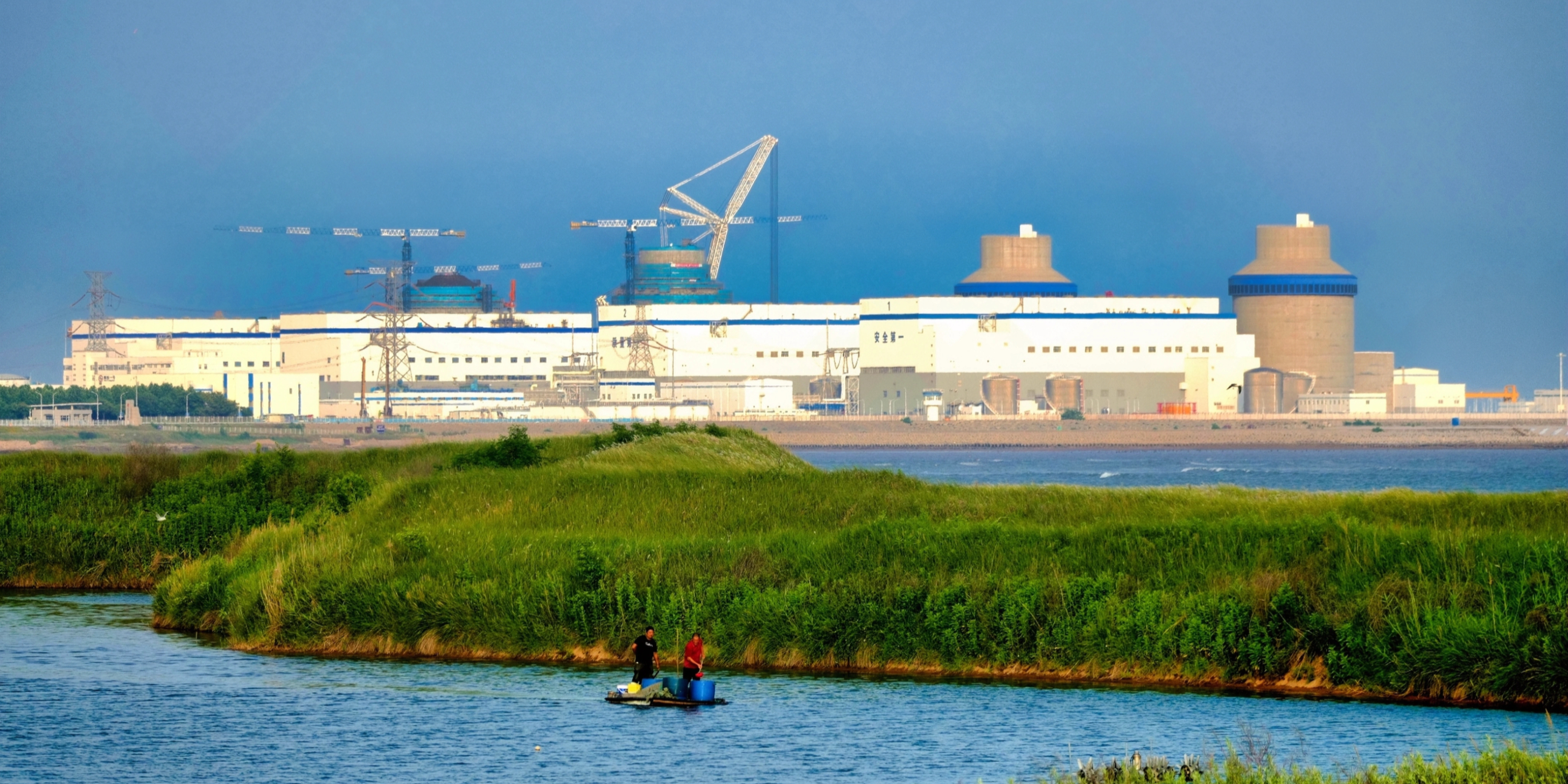
On August 13, 2026, the thermal performance test of Shandong Nuclear Power Haiyang Nuclear Power Unit 3 was declared successful. Hot test is a systematic "simulation test" before the formal loading of nuclear power units, which is a comprehensive inspection of the main equipment of the primary and secondary circuits.
More than a month later, the Economic Observer reporter followed the research team of China Life Asset Management Co., Ltd. (hereinafter referred to as "Guoshou Asset") to the construction site of Unit 3. The atmosphere of the successful hot test is still continuing, and various operations inside the nuclear island are progressing intensively, laying a solid foundation for the subsequent loading work of the unit.
The third and fourth units of the second phase project are expected to be completed and put into operation in 2027 and 2028, "said the staff of Haiyang Nuclear Power Plant. After all four units are put into operation, the annual power generation of Haiyang Nuclear Power Plant is expected to reach 40 billion kilowatt hours, which can meet the electricity needs of half of the residents in Shandong Province.
Since obtaining national approval in 2022, Units 3 and 4 have been under construction for over 4 years. Nuclear power investment has a long construction cycle and a large demand for funds, and insurance funds are the natural pursuers of such heavy asset projects. In 2018, Guoshou Asset was commissioned by China Life Insurance Company to invest 8 billion yuan in Guodian Nuclear Energy Co., Ltd. (formerly known as China Power Investment Nuclear Power Co., Ltd., hereinafter referred to as "Power Investment Nuclear Energy"). By 2025, these assets will be listed in the capital market through asset restructuring, with a market value of over 20 billion yuan calculated based on secondary market stock prices.
Wang Hou, from the Direct Investment Division of Guoshou Asset Management, is a direct participant in this investment project and has also conducted research at Haiyang Nuclear Power Plant multiple times.
So, how did insurance funds and nuclear power projects come together?
8 billion yuan bet on third-generation nuclear power
Haiyang Nuclear Power Plant is the first nuclear power plant in Shandong Province and also the world's first third-generation nuclear power plant.
After the Fukushima accident, the global demand for safety in nuclear power has reached an unprecedented level, and safety has become the core goal of nuclear power technology iteration. The technology used by Haiyang Nuclear Power adopts a passive safety system - it does not require external power or human operation, and can achieve automatic cooling of the reactor under extreme working conditions solely by gravity, natural circulation, and compressed gas; Equipped with a double-layer safety shell, the safety is greatly improved.
In 2007, the National Nuclear Power Technology Corporation signed an AP1000 third-generation nuclear island design and partial main equipment procurement contract, as well as a technology transfer contract with Westinghouse Electric Company in the United States, initiating the construction of the third-generation nuclear power self-reliance project. Haiyang Nuclear Power Plant was one of the implementers of the project.
In 2018, Haiyang Nuclear Power Unit 1 was officially put into commercial operation. At that time, the AP1000 technology was preliminarily validated from drawings to reality. It was around this point that investment opportunities came to the prince.
Nuclear power projects are high-quality investment targets, but when the opportunity arises, we initially don't know what to do, "the prince joked.
After conducting research, the investment team found that the road from drawings to implementation of AP1000 third-generation pressurized water reactor technology is not easy.
After extensive research and in-depth contact with multiple experts in the industry, the investment team decided to follow up on the project and ultimately facilitated the investment. At that time, there were three simple judgments: first, developing third-generation nuclear power technology was a national strategy; second, we had confidence in China's infrastructure capabilities; third, the core components of nuclear power construction had already been localized, and the overall project yield would definitely meet expectations
In December 2018, Guoshou Asset utilized funds entrusted by China Life Insurance Company to complete an investment of 8 billion yuan in Diantou Nuclear Energy, with a shareholding ratio of 26.76%.
In post investment management, we closely monitor the construction and operation of the nuclear power plant: whether the economic viability of the entire project meets expectations, whether there are any abnormal events during the operation of the nuclear power plant, and whether the working conditions of the relevant core components are stable, "said Wang Hou.
The problem he was worried about did not arise. After Unit 1 was put into commercial operation, Unit 2 was officially put into operation in January 2019. According to the person in charge of Shandong Nuclear Power, as of now, Units 1 and 2 of Haiyang Nuclear Power have maintained safe and stable operation since loading. They have completed five rounds of refueling major repairs and entered the sixth fuel cycle, fully verifying the safety, economy, and environmental friendliness of the technology. At present, the nuclear safety situation is stable, the performance of various system equipment is good, and all indicators meet the requirements of the design documents. From 2019 to 2025, the average utilization hours of the two units were 8077 hours per unit per year, which is higher than the national average of 7630 hours per unit per year.
A chance that arrived early
In October 2024, a major asset restructuring news brought a surprise to the prince. State Power Investment Corporation's listed company, Dianpingrong, announced that it plans to divest its main energy and financial businesses and acquire 100% equity in Diantou Nuclear Energy. After the restructuring is completed, the Electric Power Production and Financing will become a platform for the integration of national power investment and nuclear power operation assets.
This means that for Guoshou Asset, this 8 billion yuan equity investment will usher in new opportunities.
In December 2025, Electric Power Investment and Financing Co., Ltd. will exchange 100% equity of its capital holding with an equivalent amount of 100% equity of Electric Power Investment Nuclear Energy Co., Ltd. The difference will be purchased by the listed company through issuing shares to National Nuclear Power and China Life Insurance Co., Ltd. China Life Insurance has subscribed to approximately 4.412 billion shares of listed company stock with its 26.76% stake in Diantou Nuclear Energy. At the same time, the listed company issued shares to specific investors to raise nearly 5 billion yuan in matching funds - the investment direction of the funds is the currently under construction Units 3 and 4.
In the first half of 2026, Electric Power Production and Financing achieved a total operating revenue of 4.832 billion yuan, a net profit attributable to shareholders of the listed company of 1.763 billion yuan, and a basic earnings per share of 0.1002 yuan. At the same time, Electric Power Production and Financing has released a special dividend plan, which plans to distribute cash dividends of 0.70 yuan (including tax) for every 10 shares, totaling approximately 1.282 billion yuan (including tax) in cash dividends.
At present, China Life Insurance Company holds 24.09% of the equity in Dianchangrong, with a market value of 24.882 billion yuan calculated based on the closing price on September 24th.
Why Nuclear Power
In the eyes of the prince, there is a deep matching logic between insurance funds and nuclear power assets. As of the end of the second quarter of 2026, the balance of insurance fund utilization in China has exceeded 40 trillion yuan for the first time, and the management scale of Guoshou Assets is also nearly 9 trillion yuan. We need to find an industry that can support investments worth billions of yuan: assets should be heavy enough, the industry should be broad enough, and business expectations should be positive and stable enough. Energy assets have a long service life and stable cash flow, making them very suitable for insurance funds, "he said.
Beyond the energy industry, the investment team of Guoshou Asset Management is also continuously exploring new investment areas, and new quality productivity has always been an important investment direction anchored by Guoshou Asset Management.
Fan Yanming, member of the Party Committee and Vice President of Guoshou Asset Management, once interpreted the new quality productivity as follows: upgrading and upgrading traditional industries is the fundamental expression of new quality productivity in existing economic formats; Emerging pillar industries are the most direct growth mapping of new quality productivity; The future industry is the most forward-looking and flexible direction among them; Breaking through the bottleneck of core technology is a hard constraint for the formation of long-term competitiveness; The modern infrastructure system is the underlying support for achieving industrial diffusion. Among them, traditional industries have a solid foundation, large market size, and relatively strong performance certainty. In the process of transformation and upgrading, relying on technological transformation and model innovation, they are expected to form new profit growth points; The emerging pillar industries have relatively high technological maturity, rapid industrialization, and continuous release of market demand, which are the core growth assets for equity market allocation.
However, it should be noted that the "long-term" nature of insurance funds does not equate to the "patience" of investment. In the view of Zhao Jun, a member of the Party Committee and Vice President of Guoshou Asset Management, in order to truly leverage the advantages of long-term investment and value investment, and achieve the "capital asset" three capital cycle, insurance investment institutions need to take the initiative, practice hard, adapt to their own debt characteristics and risk return preferences, and explore and improve supporting systems such as investment research, risk control, assessment, and evaluation.


 Subscribe