Economic Observer Follow
2026-05-09 21:35



Economic Observer reporter Liu Xiaonuo
Chen has been off the ship for 39 days without any related symptoms, and his Hantavirus nucleic acid test results are all negative. After expert analysis, Chen has no risk of infection or community transmission. "This was announced by the Yibin Center for Disease Control and Prevention on the evening of May 9th.
On March 31st, this Chinese citizen was fortunate enough to leave the world-renowned Hongdius cruise ship in time. The next day, the first case of Hantavirus on board the Hongdius was reported. There is no temporal or spatial intersection between the two.
On May 8th, the World Health Organization (WHO) announced that there have been 8 reported cases of the Hantavirus outbreak on the HMS Hondius, and 3 deaths since April 11th - with a mortality rate of 38%.
This cruise ship, which is currently experiencing an outbreak, is sailing from the southern tip of South America to the west coast of Africa. The initial number of passengers and crew on board was 147, involving 23 countries.
Out of the existing 8 cases, 6 have been laboratory confirmed to be infected with the Andean virus. The Andean virus belongs to the Hantaviridae family and hosts rodents such as mice.
"Don't worry, it won't spread widely," said Lu Hongzhou, president of the Third People's Hospital of Shenzhen and director of the National Clinical Medical Research Center for Infectious and infectious diseases.
"Maybe it used to be in movies that people were locked up in the cruise ship to survive after the outbreak of the epidemic, and with the influence of COVID-19, people would panic. But as long as the mechanism is clear, there is no need to be afraid." Li Dongzeng, chief physician of the Department of Respiratory and Infectious Diseases of Beijing You'an Hospital affiliated to Capital Medical University, said, "The Andean virus is different from COVID-19 in nature, and COVID-19 was really a new virus at that time. There are still many research data about Andean virus."
Several interviewed doctors pointed out that the Andean virus is mainly prevalent in South America, with only limited human to human transmission, and currently has a relatively small impact on China. There have been sporadic cases of Hantavirus infection in China, but the pathogen is different from the Andean virus. The epidemic hemorrhagic fever caused by it is a Class B infectious disease in China, and hospitals have sufficient experience in diagnosis and treatment.
Previously, there were no cases of Andean virus infection in China. On May 6th, the Chinese Embassy in Cape Verde announced that there were no Chinese citizens on board the Hongdius cruise ship. On May 8th, the Chinese Center for Disease Control and Prevention stated that the Andean virus involved in this epidemic has no natural host distribution in China, and there have been no reports of human infections.
It's not a new virus
Lu Hongzhou introduced that the "Hantan virus" in Hantan virus was first isolated in 1978. As of 2018, the International Committee on Virology has identified 36 types of Hantavirus that can infect mammals. The Andean virus on cruise ships was discovered in the 1990s and mainly exists in South America.
The host of Hantavirus is mainly rodents, such as rodents.
There may be a large amount of viruses in the feces, urine, and saliva of rodents such as mice, and these excretions can form aerosols. In relatively enclosed spaces or close contact, people may inhale aerosols through the respiratory tract and become infected with viruses, "Li Dong once said.
According to Li Dong, it is also possible that rodents have eaten human food, leaving behind feces, urine, and saliva, which may cause infection in humans. Another common and now rare situation in rural areas is when a person is directly scratched or bitten by a mouse, or comes into contact with its excrement.
On May 7th, WHO Director General Tedros Adhanom Ghebreyesus announced at a press conference that the investigation into the cause of the current epidemic is still ongoing. The first two cases went on bird watching trips in Argentina, Chile, and Uruguay before boarding the ship, which included visiting locations of mouse species known to carry the Andean virus.
Li Dong once introduced that the incubation period of Hantavirus is generally 2-3 weeks, with the longest being 6-7 weeks. The official WHO statement this time is that the longest is 6 weeks. After being infected with the Andean virus, individuals may develop Hantavirus cardiorespiratory syndrome, with a mortality rate of approximately 30% to 50%.
Li Dong once said that the early symptoms of the Andean virus are not typical, and the main symptoms include fever, headache, muscle soreness, cough, nausea, vomiting, abdominal pain, diarrhea, etc., which are easily mistaken for ordinary respiratory or digestive tract infections. Just like the first death case on a cruise ship, when he passed away, people only knew that his symptoms were like a respiratory infection, but they didn't expect it to be an Andean virus infection. No virus testing was done, and now the cause of death can only be inferred afterwards
After the early stages, infected individuals will enter the cardiorespiratory phase, and their cardiorespiratory function will be affected, resulting in shortness of breath, wheezing, chest tightness, chest pain, as well as decreased blood pressure and cold limbs. Li Dong once introduced that it is generally believed that disease progression will be rapid after the cardiorespiratory phase, and cardiorespiratory failure may occur within 24-48 hours, which is life-threatening.
Li Dong once pointed out that there is currently no specific drug or vaccine for the Andean virus. According to clinical diagnosis and treatment guidelines, some broad-spectrum antiviral drugs may become clinical treatment options.
Far away from China
At present, the Hongdius has not officially docked, and there have been no confirmed cases in Asia. The Andean virus in South America is still relatively far away from China.
Li Dong once introduced that the Andean virus does not have a natural host in China. The host of the Andean virus in South America is the long tailed dwarf rice mouse, while the two prevalent Hantavirus hosts in China are mainly the black striped mouse and brown rat. Although they are both rodents, the virus is actually difficult to spread across species and species, and the possibility of spreading to areas outside of South America is also very low.
According to multiple interviewed experts, Hantavirus generally does not spread from person to person. However, currently the WHO and most mainstream views believe that the Andean virus is the only known human transmissible Hantavirus, but only "limited human transmission", which means that the virus has weak infectivity and requires close or relatively long periods of close contact to become infected.
In the Hongdius epidemic, the first two deaths were a Dutch couple aged 70 and 69, respectively.
It is currently uncertain whether this couple came into contact with mice together and were both infected by mice, or whether one person was infected first and then transmitted to another person, "Li Dong once said.
According to WHO assessment, the risk for passengers and crew on board is considered moderate, and the risk to the global population is low. WHO will continue to monitor the epidemiological situation and update the risk assessment. WHO recommends that no travel or trade restrictions be implemented based on current information.
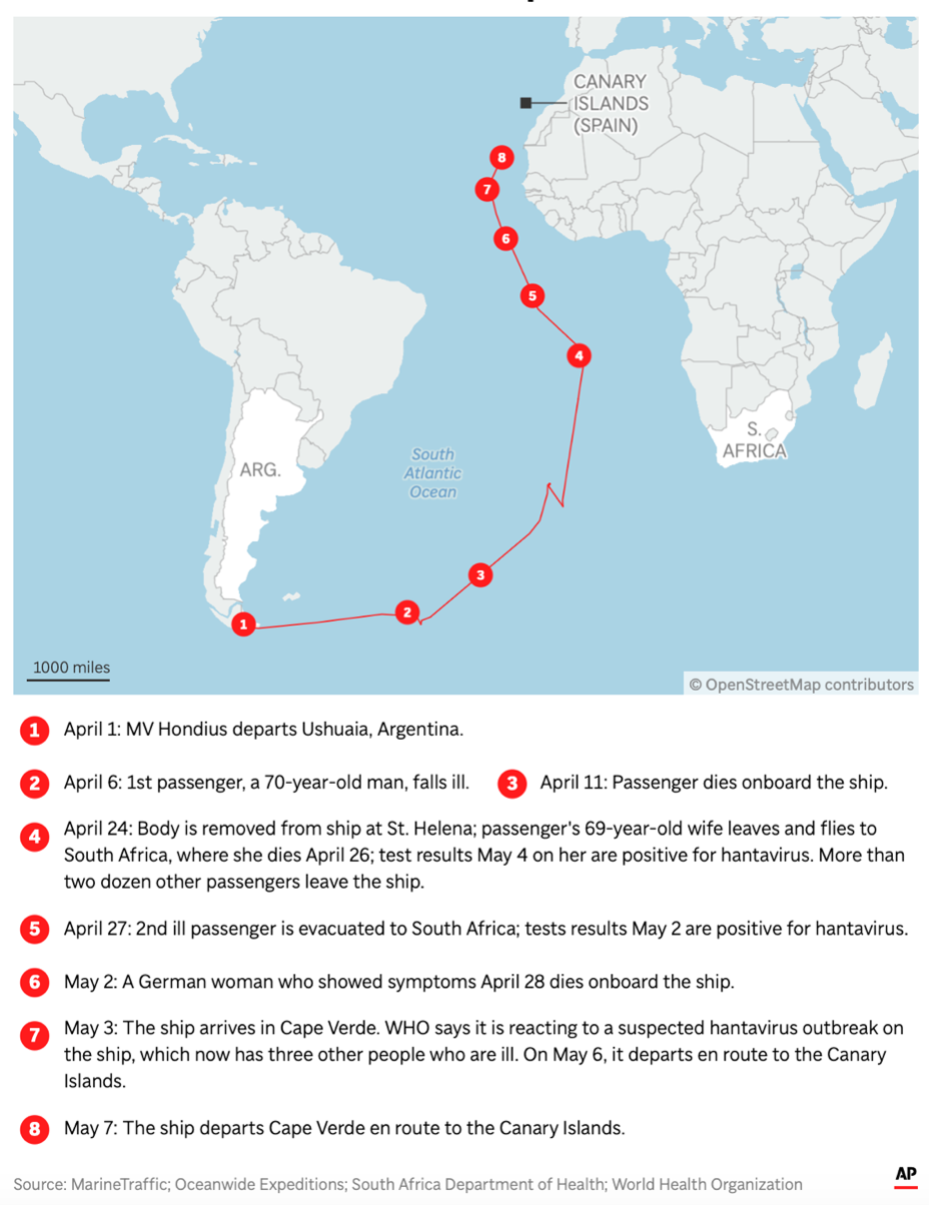
On April 1st, the Hondius departed. Initially carrying 88 passengers and 59 crew members, a total of 147 people from 23 countries. The original plan was to depart from the southern city of Ushuaia in Argentina, pass through the Antarctic and South Atlantic islands, and head to the island nation of Cape Verde off the west coast of Africa.
On April 23rd, the HMS Hondius arrived at the island of Saint Helena in West Africa. The body of the first case was taken off the ship, and the second case also got off the ship and took a plane to South Africa, where he passed away on the 26th. More than 20 people also disembarked on Saint Helena Island, who are citizens from 12 countries including the United Kingdom, the United States, Canada, Denmark, Germany, and the Netherlands. WHO has issued notifications to these countries and is working closely with multiple countries to control the impact of this epidemic through various means.
According to information released by Oceanwide on the evening of May 7th, the cruise ship is expected to arrive at the port of Granada in the early morning of May 10th. The port is part of Spanish territory and is located off the northwest coast of Africa.
Li Dong once suggested that whether traveling domestically or abroad, one should take the initiative to understand whether there are any special infectious diseases in the local area. When traveling, try to stay away from wild animals as much as possible, from large animals that can harm people to small ones such as mice, mosquitoes, and ticks. Regardless of whether they are alive or dead, try to avoid contact as much as possible, including when camping or picnicking outdoors. Within two months after returning from a trip, if symptoms appear, one should not take them lightly. It is important to seek medical attention proactively and inform the doctor of one's travel history.
At present, medical institutions such as You'an Hospital have opened travel clinics, which can provide travelers with consultation or examination services before and after travel.
Are Chinese vaccines effective
On May 8th, "Taiwan reported a fatal case of Hantavirus" ranked second on Weibo's hot search list.
The Economic Observer found that the fatal case occurred before the cruise ship epidemic. According to the information released by the Disease Control Agency of the Taiwan Ministry of Health and Welfare on May 3, there have been two cases of Hantavirus in Taiwan since 2026, which is the same as the number of cases in the same period of the past four years. The fatal cases occurred in January 2026; The second case of infection appeared in March and has been cured and discharged from the hospital.
Hantavirus usually has some sporadic cases, but the mortality rate is very low, "said He Yingli, the head of the Infection Department at the First Affiliated Hospital of Xi'an Jiaotong University.
Li Dong once introduced that China mainly has two types of Hantavirus, Hantan virus and Seoul virus, which are not transmitted from person to person. The former is prone to infection in the wild and has relatively severe symptoms; The latter is more common in urban residential areas, with relatively mild symptoms, and is more prevalent among catering practitioners. In addition, places such as attic, warehouse, or rooms that have been unoccupied for a long time have a high amount of excrement from mice, which can also make them susceptible to infection.
The diseases that these two Hantaviruses may cause are epidemic hemorrhagic fever (hemorrhagic fever with renal syndrome), which belongs to Class B infectious diseases in the Infectious Disease Prevention and Control Law of the People's Republic of China.
He Yingli said that Shaanxi, Northeast China, Shandong, Xinjiang and other places are the main epidemic areas of hemorrhagic fever. April to July and October to January of the following year are the peak seasons for hemorrhagic fever. Men have a higher incidence rate because they are more engaged in physical labor and outdoor activities. The population entering the epidemic area from other places is a high-risk group for hemorrhagic fever and is more susceptible to infection.
According to data from the National Bureau of Disease Control and Prevention of China, in March 2026, there were 183 cases of epidemic hemorrhagic fever and 0 deaths nationwide; According to the latest annual data, the number of cases of epidemic hemorrhagic fever in China in 2024 is about 4259, with 12 deaths.
Why is there such a huge difference in mortality rates among the same Hantavirus?
He Yingli believes that firstly, the lesions caused by the Andean virus may be relatively severe, as it can affect capillaries, especially the lungs, leading to respiratory distress or even respiratory failure; Secondly, hospitals in epidemic areas of hemorrhagic fever in China have rich experience in the diagnosis and treatment of hemorrhagic fever, and even grassroots hospitals can achieve early diagnosis and treatment; Thirdly, compared with the medical conditions in China, there are differences in the awareness, identification, diagnosis, treatment, and protection of this disease in specific places such as cruise ships.
He introduced that in early clinical diagnosis, hemorrhagic fever may present with acute fever accompanied by "three redness and three pain": headache, lower back pain, eye socket pain, facial redness, neck redness, and chest redness. In addition, there may be needle sized bleeding points on the scratched areas of the conjunctiva and skin. Some people may experience urinary bleeding, and women may experience increased menstrual flow or cerebral hemorrhage. In addition to clinical manifestations, laboratory diagnosis is also required.
He Yingli introduced that hemorrhagic fever has five stages: fever stage, shock stage, oliguria stage, polyuria stage, and recovery stage. Although there is no specific medicine for hemorrhagic fever, experienced infectious disease physicians can predict the development of the disease and use liquid therapy, supportive therapy, and symptomatic treatment to help patients smoothly pass the critical stage.
He Yingli suggests that if there are symptoms related to fever, one can promptly seek medical attention at a fever clinic. People in epidemic areas should try to receive sufficient treatment with the epidemic hemorrhagic fever vaccine, which has high safety and is the most effective way to prevent the disease.
In 2007-2008, the former Ministry of Health of China implemented an expanded immunization program, which included vaccines for epidemic hemorrhagic fever. This means that this vaccine can be administered for free in China.
However, the interviewed experts stated that there is currently no evidence to prove whether China's epidemic hemorrhagic fever vaccine is effective against the Andean virus. The epidemic hemorrhagic fever vaccine in China is a bivalent vaccine that is effective against Hantavirus types I and II, but its effectiveness against the Andean virus has not been studied or attempted yet, so theoretically it is unlikely to have a preventive effect. ?Li Dong once said.
He also suggested that if cleaning a room with mice, the first step is to open windows for ventilation to reduce the risk of inhaling aerosols for infection; Wear a mask and gloves when cleaning; It is best to perform wet cleaning, which means spraying water or disinfectant before cleaning to reduce the risk of dust inhalation.
The interviewed experts pointed out that regardless of the type of Hantavirus infection, early diagnosis and treatment should be sought in order to reduce the mortality rate.


Tech Show | The Science and Technology Expo has come to an end, with various districts in Beijing showcasing their 'black technologies'

Technology Show | Visiting the Beijing Science and Technology Expo, how can these technological exhibits rewrite the future?

What is more important than algorithms when AI competitions enter the 'deep water zone'?


 WeChat registration or login


 Subscribe