Economic Observer Follow
2026-04-23 20:03



Wang Jiang, Yang Yang/Wen
On April 10, 2026, the Supreme People's Court and the Supreme People's Procuratorate jointly issued the "Interpretation on Several Issues Concerning the Application of Law in Handling Criminal Cases of Corruption and Bribery (II)" (hereinafter referred to as the "New Anti Corruption Regulations"), which will officially come into effect on May 1 of the same year.
One stone stirred up a thousand waves, and after the new regulations were released, my team received intensive consultations from practitioners in various industries. Among them, there are voices expressing deep concerns about the prospects of business compliance, as well as panic speculations about whether the country will launch a "centralized liquidation" of specific industries. Various interpretations on the Internet are even more controversial, which further aggravates the confusion and anxiety of some private entrepreneurs.
This article aims to provide a systematic interpretation of the new anti-corruption regulations from the perspective of legal practice. We strive to clarify misunderstandings, analyze risks, and based on this, provide practical and feasible compliance paths for the sustainable development of private enterprises.
The improvement of the rule of law has never been to hinder development, but to delineate clearer paths and ensure a more fair competition. For private enterprises, a deep understanding and proactive adaptation to this new normal is not only necessary to avoid risks, but also the key to winning the future.
Core clause dispute: "Shared responsibility between officials and civilians" under equal protection and risk focus
The reason why the new anti-corruption regulations have attracted widespread attention is that they directly target the core areas of corruption within private enterprises and provide a clear response to the long-standing issue of legal application standards. To accurately grasp this, it is necessary to focus on the following three dimensions.
?1? Unified reference for conviction and sentencing standards: from "differential treatment" to "equal application"
The focus of controversy is highly concentrated on Article 8 of the new regulations. This provision stipulates that the conviction and sentencing standards for the crimes of bribery of non-state personnel, bribery of non-state personnel, embezzlement of official positions, and misappropriation of funds shall be implemented in accordance with the conviction and sentencing standards for the crimes of bribery, bribery (unit bribery), embezzlement, and misappropriation of public funds, respectively. At the same time, it is emphasized that when deciding whether to pursue criminal responsibility and sentencing, comprehensive consideration should be given to the nature, circumstances, and social harm of the crime, ensuring that the criminal responsibility and punishment are appropriate.
This provision has been interpreted as "joint responsibility between officials and civilians" and "collective inclusion of private enterprise owners", but its legal essence lies in the "reference application of conviction and sentencing standards". This means that when determining whether a private enterprise employee accepting bribes constitutes a "large amount" or a "huge amount", the amount standard for the crime of bribery of state employees will be used as a reference. This signifies that the law provides equal protection to the property rights and management order of both public and non-public ownership economies.
The new regulations, through reference and application, essentially unify the evaluation scale of "social harm" that infringes on the interests of different ownership subjects, and are a concrete deepening of the principle of legal equality in the field of anti-corruption. But it also leaves a "loophole", in the specific application process, judicial personnel should comprehensively consider the nature, circumstances, and social harm of the crime to decide whether to pursue criminal responsibility and sentencing.
?2? Significant upgrade in punishment for bribery by units: dual punishment system and improvement of punishment levels
The fourth article of the new regulations has refined the criteria for determining the "serious circumstances" and "particularly serious circumstances" of the crime of bribery by units, such as specifying the threshold for the amount of bribery, bribing multiple people, and bribing in key areas of people's livelihood. This should be understood in the context of the 12th Amendment to the Criminal Law of the People's Republic of China. The amendment increases the statutory maximum sentence for the crime of bribery by a unit from five years of imprisonment to ten years of imprisonment, and adds a penalty level of "imprisonment for more than three years but less than ten years". This revision directly addresses the pain point of "punishing individuals over units" in judicial practice.
In the past, due to the significantly lighter punishment for corporate bribery compared to individual bribery, some companies resorted to bribery through the form of "corporate will" to evade severe punishment. The combined effect of the new regulations and the amendment to the Criminal Law has significantly increased the illegal cost of bribery by units. In particular, Article 16 of the new regulations clearly states that if personal property is highly mixed with unit property and the improper benefits obtained through unit bribery actually belong to the individual, they should be punished for the crime of (individual) bribery.
This has sounded an unprecedented alarm for private enterprises, especially family owned enterprises with unclear governance structures and mixed public and private finances. The property confusion model of 'the company is my home', which may have been seen as a management flaw or civil dispute in the past, is now clearly exposed to criminal risks. Business owners must be acutely aware that the legal nature of treating a company as a personal 'money bag' and using it for improper benefit transfer has fundamentally changed.
?3? Criminalization of property mixing risks: Penetrating the corporate veil to hold individuals accountable
As mentioned above, the provision in Article 16 of the new regulations regarding the conviction of bribery in cases where "personal property and unit property are highly mixed" is a "Damocles sword" hanging over the actual controllers of private enterprises. This indicates that judicial practice has adopted a more stringent "penetrating" regulatory attitude towards the abuse of corporate independent personality and limited liability principles, and the use of enterprises as tools to commit illegal crimes.
This requires entrepreneurs to completely abandon the old concept that 'corporate property is personal property' and establish clear and compliant barriers in assets, finance, accounting, and other aspects. Otherwise, not only may they face prosecution for the crimes of embezzlement and misappropriation of funds, but in the issue of bribery, they will also directly penetrate the company's shell and pursue the personal criminal responsibility of the actual beneficiaries. Upgrading from civil liability risk to criminal liability risk is a threshold that must be crossed in the modernization of corporate governance.
Lowering the threshold for criminal conviction: the deterrent effect of a 'sword hanging high' is greater than that of a 'sword already unsheathed'
Faced with the adjustment of the standard amount of criminal charges, many entrepreneurs feel anxious. On the internet, interpretations such as "private enterprise bosses/pharmaceutical kickbacks/insurance rebates, 30000 yuan in prison" have made relevant private enterprise employees more anxious.
However, we need to clarify that by looking further ahead, we can see that this new regulation has mainly completed a "delayed connection" in terms of the threshold for criminal charges, and its changes are far from subversive.
As early as 2022, the "Provisions of the Supreme People's Procuratorate and the Ministry of Public Security on the Standards for Filing and Prosecuting Criminal Cases under the Jurisdiction of Public Security Organs (II)" had significantly lowered the filing amount standards for common crimes involving enterprises. For example, the starting point for the "large amount" of crimes such as bribery of non-state personnel and embezzlement of official positions has been reduced from 60000 yuan to 30000 yuan; The starting point for the crime of misappropriating funds for illegal activities has been reduced from 60000 yuan to 30000 yuan, and the starting point for profit-making activities or overdue payments has been reduced from 100000 yuan to 50000 yuan.
By comparison, it can be seen that the new anti-corruption regulations in 2026 maintain a high degree of consistency with the filing standards in 2022 in terms of the threshold for criminal offenses. The core purpose is precisely to solve the problem of inconsistency between the previous conviction and sentencing standards and the filing and prosecution standards, and to achieve a unified scale from filing to conviction and sentencing. Therefore, the so-called "sudden drop in threshold" is actually a reconfirmation of the standards that have changed in 2022 and an extension of judicial application. Over the past four years, there has been no significant increase in related cases.
It is worth noting that the second half of Article 8 of the new regulations explicitly requires that "the nature and circumstances of the crime should be comprehensively considered, the social harm should be accurately assessed, and the responsibility and punishment should be adapted". This reflects important judicial principles. The reduction of filing standards means that more illegal activities are included in the scope of criminal investigation, which enhances deterrence. But this does not mean 'arrest upon conviction' or 'sentencing upon conviction'. For cases that have just reached the amount standard, the circumstances are significantly minor, the social harm is not significant, and the enterprise has actively remedied the situation, the procuratorial organs may make a non prosecution decision in accordance with the law, and the judicial organs may also make a judgment of light crime or even exemption from punishment in accordance with the law. This is in line with the spirit of the "Opinions of the Supreme People's Court on Fully Utilizing the Role of Trial Functions and Effectively Strengthening the Judicial Protection of Property Rights", which states that "objectively view the non-standard problems of enterprise operation and declare innocent according to law for those with insufficient conviction basis". Therefore, entrepreneurs do not need to panic excessively about simple changes in the amount, but should pay more attention to the degree of illegality of the behavior itself and the attitude and measures of post correction.
More attention should be paid to the fact that in judicial practice, corruption cases within private enterprises are mainly handled by the economic investigation departments of public security organs, and "more cases and fewer people" is the norm. In practice, it is rare for public security organs to actively intervene in internal cases of private enterprises for investigation. Due to various reasons, it is difficult for public security organs to invest sufficient manpower and material resources to effectively crack down on corruption cases within private enterprises. In this regard, anti-corruption is vastly different from the anti-corruption efforts of the discipline inspection commission and supervisory commission against public power departments and state-owned enterprises. In the future, the anti-corruption efforts of private enterprises will still mainly rely on their autonomy and rely more on the effective operation of their own supervision system.
So, even if the new regulations lower the threshold for criminal charges, their substantive significance lies in the deterrent effect of the "sword hanging high", which will not lead to a surge in cases in the short term. Anti corruption within private enterprises remains a systematic governance project with a long way to go.
Equal sentencing for the same amount: Increasing the severity of punishment is beneficial for the maximum protection of the property rights and interests of private enterprises
The new anti-corruption regulations' equal sentencing for the same amount of crimes is the biggest 'trump card' for the equal protection of private enterprises in this new regulation. If the reduction of the threshold for criminal conviction is not clearly reflected in the amount - for example, the difference in the amount of embezzlement and bribery of non-state personnel from 60000 yuan to 30000 yuan, only 30000 yuan - but for the huge amount standard, from the old standard of 1 million yuan to 200000 yuan, the comparative effect is very obvious.
According to the old standards, state officials who embezzle or accept bribes of more than 200000 yuan are sentenced to more than 3 years in prison. However, internal personnel of private enterprises who embezzle their positions or engage in non-public bribery must reach more than 1 million yuan to be sentenced to more than 3 years in prison. This is an inequality in the punishment crackdown and has always been criticized by many private entrepreneurs. After all, in the same market economy environment, unequal punishment for property of the same value is equivalent to unequal protection. After aligning the standards, the deterrent effect of punishment will inevitably deter employees within private enterprises who want to seek benefits from the enterprise, thereby achieving substantial protection of the property rights and interests of private enterprises.
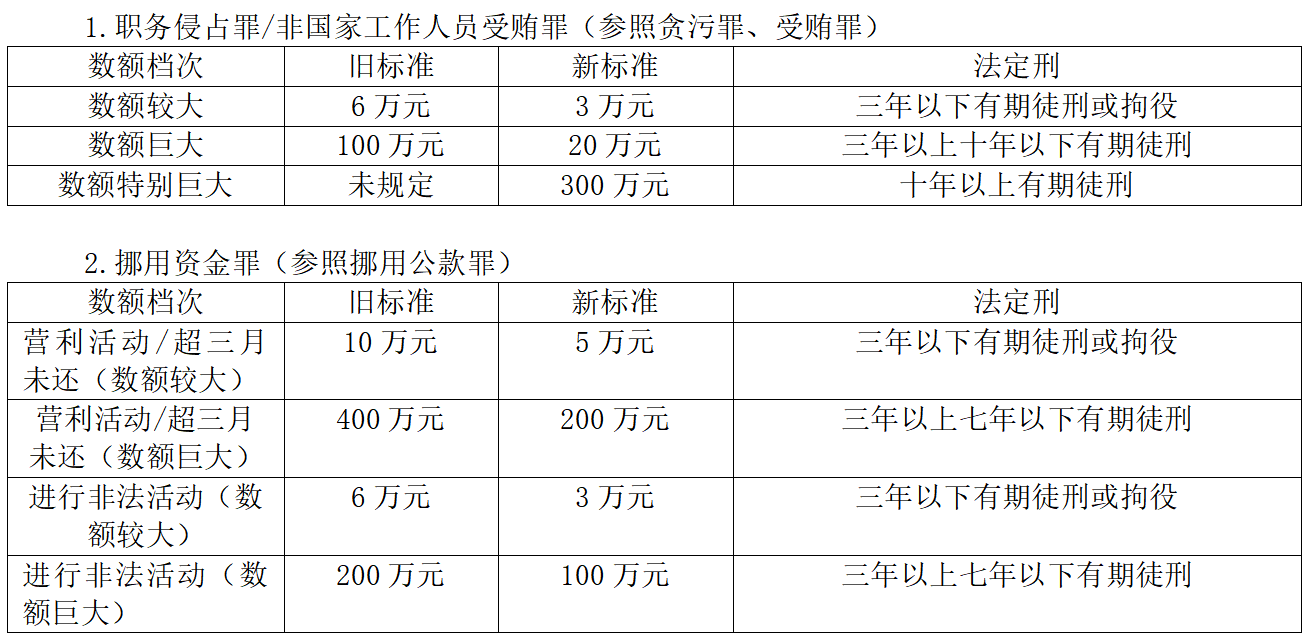
Classification and high-risk scenarios of criminal risks involving private enterprises
Against the backdrop of new anti-corruption regulations, criminal risks within private enterprises exhibit structured and job specific characteristics. According to the "Research Report on Corruption Crimes in Chinese Private Enterprises (2025)", personnel at different levels and positions have vastly different risk focuses.
For shareholders/actual controllers, the risks are concentrated in the crimes of embezzlement, misappropriation of funds, and bribery/corporate bribery. Especially in bribery related crimes, there is a clear "high-level" decision-making characteristic. In practice, the majority of bribery behaviors are decided or known by the responsible persons and actual controllers of enterprises. Under the new regulations, if personal property is mixed with company property and individuals profit from corporate bribery, it will directly trigger severe punishment for the crime of personal bribery.
For directors, supervisors, and senior management personnel, in addition to the risks mentioned above, crimes of breach of trust that harm the interests of the company have become a hanging sword. The 12th Amendment to the Criminal Law has expanded the crimes of illegally operating similar businesses, illegally profiting for relatives and friends, and engaging in favoritism and fraud by selling enterprise assets at low prices from the original charges only applicable to state-owned enterprises to private enterprises. This means that executives of private enterprises who harm the interests of the company for personal or family reasons will face criminal prosecution.
For key management positions such as procurement, sales, and finance managers, non-state personnel are at high risk of bribery and embezzlement. This type of crime is mostly concentrated in project contracting, material procurement, fund settlement and other links, and the power of positions is directly related to rent-seeking space. After the new regulations lowered the sentencing threshold, the criminal risks of "benefit fees" and "kickbacks" that were previously considered "small in amount" have sharply increased.
For ordinary employees (such as salespersons, warehouse managers, cashiers), the crimes of embezzlement and misappropriation of funds are the main risks, manifested as false reporting of expenses, withholding payments, repeatedly embezzling company property in small amounts, or short-term misappropriation of funds for personal use. Although the individual amount may not be large, according to the new regulations, if the cumulative amount reaches 30000 yuan (embezzlement) or 50000 yuan (misappropriation of funds for profit-making activities), it can be prosecuted.
Anti corruption work is moving towards socialization and popularization
Understanding the new anti-corruption regulations in 2026 should not be viewed as an isolated event, but rather as a macro narrative of the country's efforts to improve the legal protection of the private economy. This is a long-term strategic process that progresses layer by layer and deepens step by step.
In July 2023, the "Opinions of the Central Committee of the Communist Party of China and the State Council on Promoting the Development and Growth of the Private Economy" explicitly proposed for the first time at the central level the establishment of a system and mechanism for preventing and controlling corruption at the source of private enterprises, and required the issuance of corresponding judicial interpretations. In July of the same year, the Supreme People's Procuratorate immediately issued a special opinion focusing on punishing crimes committed by internal personnel of private enterprises.
The 12th Amendment to the Criminal Law, which will come into effect on March 1, 2024, expands the criminal subjects of breach of trust such as illegal operation of similar businesses and illegal profit-making for relatives and friends to private enterprise personnel, and increases the punishment for unit bribery.
The Law on the Promotion of Private Economy, which will come into effect on May 20, 2025, clearly states that "the state promotes the construction of institutional mechanisms for preventing and controlling corruption at the source of private economic organizations, supports and guides private economic organizations to establish and improve internal audit systems, and strengthens the prevention and control of integrity risks.
Until 2026, the two high schools will introduce new anti-corruption regulations, completing the final piece of the puzzle in the judicial application process. This clear timeline indicates that promoting anti-corruption within private enterprises from "soft constraints" to "hard rule of law" is an established and systematic policy direction of the country. Its purpose is not to suppress the private economy, but to lay a solid foundation for high-quality development of the private economy by eliminating internal pests, optimizing governance structure. The improvement of the national legal system provides strong external judicial support for enterprises to implement this legal obligation internally. Therefore, any fantasy that this wave will soon recede is unrealistic. Proactively embracing compliance and engaging in self revolution is the only right path for the survival and development of private enterprises.
The introduction of new anti-corruption regulations marks a new stage in China's anti-corruption struggle: from focusing on the "public power anti-corruption" of party and government organs and state-owned enterprises, to deepening the "socialized anti-corruption" that covers all social and economic organizations and touches the capillaries of market operation. This is not only an expansion of the field, but also an upgrade of the concept.
The overall anti-corruption awareness in society has significantly increased under the warning of various cases and the promotion of the rule of law. Employees, partners, and competitors of private enterprises may all be supervisors. More importantly, the anti-corruption control logic has deeply penetrated into the internal governance of private enterprises.
The state internalizes the external legal requirements of integrity, honesty, and compliance into internal governance standards that enterprises must establish through legislation and judiciary. Enterprises are no longer just objects of anti-corruption, but are also required to become the "main force" actively fulfilling their anti-corruption responsibilities.
Protecting whistleblowers and improving internal reporting mechanisms are the bridges that introduce social supervision into the internal workings of enterprises. The national law sets the bottom line and red line, and the internal system of enterprises builds a protective network. The two work together to weave a "heavenly web" that covers the whole society and all fields.
Solution: Build a compliance fortress that integrates "people, systems, and culture" into one
When the sword of anti-corruption extends from the realm of public power to within private enterprises, private entrepreneurs can take the opportunity to clear internal impurities and reform the governance system. But entrepreneurs must realize that if they do not set up a "iron cloth" of laws and governance for themselves, it is often the helmsmen and core layers of the enterprise who are ultimately counterattacked by the sharp sword.
Therefore, for entrepreneurs, the true safety margin comes from valuing change and responding to rising criminal risks with a compliant management system.
For middle-level managers and ordinary employees of enterprises, they need to see the trend of anti-corruption socialization, do their job well, restrain greed, and provide a "safety lock" for their personal career and life.
?1? Internal promotion: Implement precise drip irrigation training with hierarchical classification
Compliance training should not be a one size fits all approach, and precise penetration must be implemented based on job risks.
For actual controllers/major shareholders, the core of training lies in the "boundary between public and private property" and "decision-making compliance procedures". The focus covers corporate governance, related party transaction norms, external guarantees, legal red lines for fund lending, and personal ultimate responsibility for bribery decisions. Suggest conducting a one-on-one legal risk assessment.
Regarding directors, supervisors, and senior executives, we should focus on the "duty of loyalty and diligence" and "avoidance of conflicts of interest". The training should focus on the approval of related party transactions, major investment decisions, and the use of clean approval rights, and conduct in-depth thematic training at least once a year.
For key positions such as finance, procurement, and sales, it is necessary to focus on "job integrity" and "process compliance". Through scenario based case teaching, we will deeply analyze typical cases of commercial bribery, embezzlement, and misappropriation of funds, while strengthening the system for declaring conflicts of interest.
For ordinary employees, we should focus on "red line awareness" and "reporting channels". Through onboarding training and regular promotion, ensure that every employee is aware of the basic anti fraud policies, the company's "high-voltage lines," and secure and confidential internal reporting channels.
?2? System first: Building a rigid constraint compliance and anti fraud system
The system is the backbone of compliance and must be solid and rigorous.
One is to improve the reporting and investigation mechanism. Establish anonymous, diverse, and confidential internal reporting channels, and develop independent internal investigation procedures. Ensure clear rights and responsibilities in the process of accepting, initial verification, investigation, and disposal of clues, operate efficiently, and protect whistleblowers from retaliation.
The second is to improve the financial internal control system. Strictly adhere to the basic principles of separating approval and execution, and separating procurement and payment. Clarify the hierarchical authorization authority for fund payments, promote electronic approval and record keeping, and regularly verify bank accounts and transactions.
Thirdly, formulate special anti fraud policies. Explicitly prohibit and define commercial bribery, embezzlement, conflicts of interest, and other behaviors in the form of a Code of Conduct or Anti Fraud Regulations, publicize punishment measures, and make it an internally effective "legal code".
The fourth is to strengthen the function of audit supervision. Enhance the independence and authority of internal auditing, and conduct regular and irregular specialized audits on high-risk business areas such as procurement, sales, and project outsourcing; When necessary, introduce third-party compliance auditing and supervision to form effective checks and balances.
?3? Building a culture of integrity: cultivating a conscious and ecological mindset of 'not wanting to be corrupt'
Culture is the soul of compliance and the most enduring and fundamental defense line.
One is to set an example for leaders and promote from the top. The founder and core executives of a company must lead by example, steadfastly practicing the values of integrity and honesty in their words, actions, and business decisions. This is the "first button" of cultural construction.
Secondly, continuous promotion and integration into daily life. Utilize various platforms such as internal meetings, office platforms, and cultural events to continuously disseminate compliance concepts. By analyzing typical cases of internal investigation and punishment, warning education can be carried out to instill a sense of integrity in the mind and heart.
The third is incentive oriented, with clear rewards and punishments. Incorporate compliance performance into the performance evaluation and promotion system. Employees who actively refuse commercial bribery and report fraudulent behavior will be commended and rewarded, setting a positive example that benefits honest individuals and punishes fraudsters.
Conclusion
The implementation of the new anti-corruption regulations in 2026 is not only a severe challenge for Chinese private enterprises, but also a historic opportunity to improve quality and efficiency.
Private entrepreneurs should be aware that instead of missing opportunities in doubt and observation, it is better to actively transform external compliance pressures into internal governance upgrades.
Under the new anti-corruption regulations, the way out for private enterprises lies not in the uncertainty of "where to go", but in the firm determination to "follow the law". Only by respecting the law, rules, and improving governance can we overcome cycles and win the future.
(Wang Jiang, Executive Director of the Anti Fraud Investigation Center of the Law Firm, Yang Yang, Senior Partner of the Law Firm)


 WeChat registration or login


 Subscribe