


Economic Observer Follow
2026-01-10 18:57


Economic Observer reporter Zheng Chenye
On January 9th, CES 2026 (International Consumer Electronics Show), known as the "Tech Spring Festival Gala," closed in Las Vegas, USA.
On the eve of the launch, Huang Renxun, founder and CEO of Nvidia, made a judgment in his keynote speech: "The ChatGPT moment of Physical AI has arrived. ?He believes that machines have begun to possess the ability to understand the real world, reason, and take action.
In a speech during the exhibition, AMD Chairman Su Zifeng also mentioned a detail: Every time OpenAI co-founder Greg Brockman meets her, the topic is only one, which is "the need for more computing power".
As a chip manufacturer, Su Zifeng sees OpenAI's thirst for computing power chips. She predicts that the global computing power will need to increase by another 100 times in the next five years.
For Chen Jun, Executive Vice President and Chief Analyst of Qunzhi Consulting, what he sees is a change in the flow of computing power. Chen Jun told Economic Observer reporters that the biggest change at CES this year is "Physical AI" - AI technology is no longer limited to generating text or videos, but has begun to enter specific physical hardware.
When big models become machines, technical issues become cost issues, yield issues, and supply chain efficiency issues, which are precisely the problems that "Made in China" is best at solving.
In the CES exhibition hall, Huang Renxun's "Physical AI Moment" is supported by a large number of Chinese manufacturing companies - according to data from the China Council for the Promotion of International Trade, more than 200 Chinese companies participated in this year's CES.
From robot matrices, to display screens and smart glasses, to innovative hardware, Chinese manufacturers are racking their brains to showcase the specific form of AI entering the physical world.
A robot that blooms with a hundred flowers
At this year's CES, there is a noticeable change in the robotics industry: manufacturers are no longer fixated on showcasing simple physical abilities, but instead emphasize specific "job types" and operational scenarios.
In this field, Chinese companies have already occupied the ecological niche.
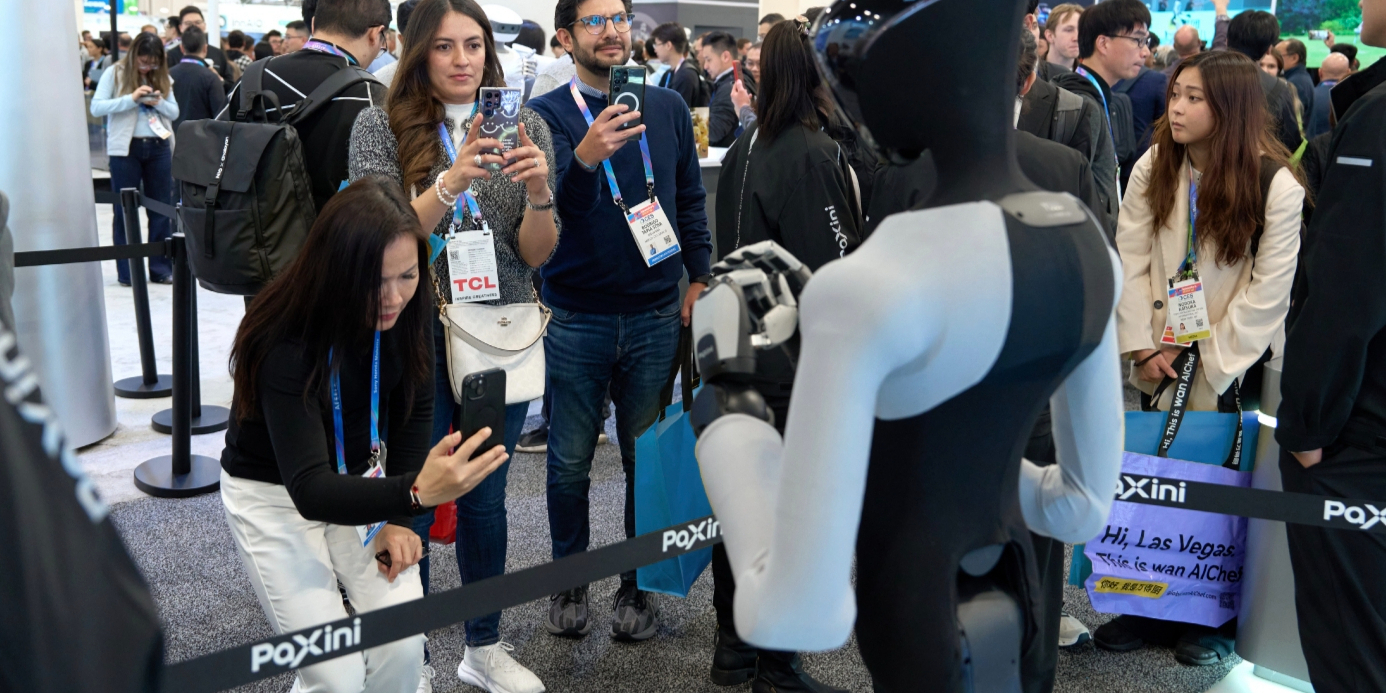
At the ENTERPRISE AI exhibition area at CES, a large number of visitors gathered in front of the booth of Pasini Perception Technology from Shenzhen. A humanoid robot named TORA-ONE is demonstrating the entire process of making ice cream. The robot pulls the lever, adjusts the force based on feedback, catches the ice cream and hands it to the audience.
Pasini Perception Technology showcased its self-developed multidimensional tactile dexterous hand DexH13 on site. This robotic arm is equipped with 1200 miniature tactile processing units, capable of sensing pressure changes of 0.01N. The person in charge of Pacini told reporters that with a sampling frequency of up to 1000Hz, the robot has the ability to perceive materials, pressure, and rebound.
In other words, Chinese robotics companies are solving the core problem of robot "feel" to enable them to perform fine operations.
Chinese companies are also competing with international giants such as Boston Dynamics at CES to explore the landing of industrial scenarios.
For example, the GR-3 humanoid robot released by Fu Liye Intelligent simulates the component sorting operation of an automobile assembly line on site. Fu Liye stated that this robot is equipped with 55 full body degrees of freedom, and its design intention covers industrial manufacturing and health care scenarios: in the industrial end, it attempts to solve non-standard motion problems in flexible manufacturing; In the health and wellness sector, it plans to go deep into rehabilitation institutions and nursing homes to provide auxiliary care services.
Zhongqing Robotics also showcased two products, T800 and PM01. Among them, T800 demonstrated on-site backflip, with its leg design imitating the contraction mechanism of human muscles, and the collaborative output can achieve a peak torque of 450N ? m. Zhongqing stated that its lightweight product PM01 has been implemented in the fields of public transportation and patrol inspection.
The exhibition booth of Yushu Technology has set up a closed boxing arena, where two G1 humanoid robots engage in combat on the arena. The robot calculates the center of gravity in real time based on the force situation and adjusts the balance quickly by taking small steps. This demonstration of impact resistance is aimed at complex industrial environment applications.
In addition to humanoid robots, there is also an increase in "special forces soldiers" dedicated to specific scenarios.
Ecovacs has released the pool cleaning robot Ultramarine. In the demonstration area, this robot dives underwater to clean the stains on the pool walls. Ecovacs claims that the product inherits its technological accumulation in perception and planning, attempting to extend intelligent cleaning from indoor floors to outdoor water bodies.
Aosha Intelligent showcased the VIATRIX extended range power exoskeleton, which, with the assistance of an electric motor, allows users to carry a weight of 50 kilograms while walking.
The head of Aosha Intelligence mentioned in a media interview that the efficiency of China's local supply chain is the foundation for its rapid product iteration. In terms of underlying motors, drivers, and sensors, the Chinese supply chain has the ability to reduce costs, driving its product iteration speed to reach six months to one year, while the iteration cycle of similar products in Europe is usually 2 to 3 years.
According to the prediction of Qunzhi Consulting, the global sales of complete robots will be about 45 billion US dollars in 2026, and it is expected to exceed 60 billion US dollars by 2030.
Chen Jun believes that the rise in labor costs is the core driving force behind its growth. In this process, Chinese manufacturing companies are accelerating the commercialization of robots through the efficiency advantage of their supply chain.
Seize the right to define the 'second screen'
If robots are the limbs of AI, then smart glasses are becoming the eyes of AI.
At this year's CES, Chinese companies' collective explosion in the AR/AI eyewear field demonstrated their ambition to seize the right to define the "second screen" beyond smartphones.
Thunderbird Innovation released the Thunderbird X3 Pro Project eSIM at the exhibition, which is the world's first binocular full-color AR glasses that support eSIM function.
This product is equipped with a communication module that supports independent phone calls and networking. This means that users can wear only glasses without carrying their phones in outdoor sports and other scenarios. The product is equipped with an equivalent 43 inch 3D space screen and Qualcomm Snapdragon AR 1 computing platform, supporting WeChat, Tiktok and other applications.
Thunderbird Innovation told reporters that the company has completed a new round of financing exceeding 1 billion yuan, with investors including funds under China Mobile and China Unicom. This is the first time that domestic operators have jointly invested in the smart glasses track.
Jimi Technology (688696. SH) has also released a new AI eyewear brand MemoMind, launching two series: MemoMind One and MemoMind Air. Among them, MemoMind One adopts a MicroLED+optical waveguide scheme, supporting real-time translation and word extraction functions, while MemoMind Air Display adopts a monocular display scheme, mainly providing navigation arrows, translated subtitles and other information prompts, attempting to significantly reduce the weight and power consumption of the glasses.
XGIMI Technology stated that the company is exploring AI glasses that completely abandon visual display modules and only retain audio interaction.
The innovative forms of these terminal products cannot be separated from the technical support of the upstream supply chain.
For example, GoerTek (002241. SH) released the reference design Rubis for AI+display smart glasses at the exhibition.
This solution has launched a three core heterogeneous platform consisting of MCU, ISP, and NPU, and uses lightweight materials such as magnesium aluminum alloy to control the overall weight of smart glasses at around 35 grams. In addition, GoerTek has also launched a full-color resin optical waveguide module F15Pi, which weighs as low as 4 grams.
For end brands, the reference designs provided by the supply chain often determine the lower weight limit and upper heat dissipation capacity of the product. GoerTek is defining the basic parameter standards for smart glasses through its integration capabilities in acoustics, optics, and microelectronics.
Guangfeng Technology (688007. SH) showcased its LCoS AR optical products, attempting to optimize its technical solutions to push the terminal price of consumer grade AR glasses down to within 1500 yuan.
The dragonfly G1 optical machine it released adopts a "single optical machine driven binocular display" scheme, with a single eye volume of only 0.35cc, reducing the cost of the core display unit by 50%.
According to IDC's forecast, the smart glasses market will reach a turning point in 2026, with global shipments expected to exceed 23.687 million units. Qunzhi Consulting predicts that the global sales of AI glasses will be approximately $10.7 billion by 2026, a year-on-year increase of over 80%.
Chen Jun told Economic Observer reporters that lightweighting, improved end-to-end AI computing power, and application scenarios are the core driving forces behind the growth of AI glasses. The layout of Chinese enterprises in this field is not only assembly manufacturing, but also deep into the underlying of optical modules, display chips, and interaction design.
Screen form and computing power base
At CES 2026, upstream supply chain companies also demonstrated the ability of technology to delineate hardware boundaries.
Tianma Microelectronics has released a new generation of intelligent cockpit solutions. In the exhibition car, a 1.25-meter-long screen occupies the entire center console. This 49.6-inch irregular screen integrates instrument panel, center console, passenger seat, and rearview mirror displays.
Tianma has achieved over 210000 independent dimming units on this screen using ACRUS pixel level dimming technology, with a contrast ratio of 100000:1. This is mainly to solve the problem of reflection on the car screen under strong light, as well as the interference of screen reflection on the driver during night driving. In addition, Tianma also showcased its collaboration with Corning on cold bending cover glass technology, allowing the screen to seamlessly fit the windshield.
TCL Huaxing showcased the world's first printed OLED car screen.
Unlike traditional vapor deposition processes, printing OLED technology produces screens like printing newspapers, with a material utilization rate of over 90%. The screen covers the passenger's field of view and can adapt to complex curved surfaces inside the car. TCL told reporters that the world's first high-end printed OLED production line, TCL Huaxing T8 project, officially started construction in October last year, which will accelerate the mass production of printed OLED products.
The screen determines the appearance of the product, and the chip determines the intelligence of the product. In the "last mile" of computing power landing, the binding between Chinese hardware manufacturers and international chip giants is becoming increasingly close.
Lenovo Group Chairman and CEO Yang Yuanqing had a conversation with NVIDIA founder and CEO Huang Renxun during the exhibition and announced the launch of the "Lenovo Artificial Intelligence Cloud Super Factory".
Yang Yuanqing stated that Lenovo's business cooperation with Nvidia will achieve a fourfold increase in scale within the next 3 to 4 years. Huang Renxun stated that for enterprises to implement AI, they need to combine advanced models with their own data to build exclusive intelligent agent systems. This needs to be deployed on enterprise level infrastructure and extended to the edge.
To some extent, this is the survival wisdom of Chinese manufacturing enterprises in the AI era. On the one hand, by collaborating with computing giants such as NVIDIA, we ensure access to the most advanced infrastructure; On the other hand, utilizing its own engineering capabilities and manufacturing scale, it encapsulates these computing powers into servers, PCs, and edge devices, and pushes them to the market.
Chen Jun analyzed to reporters that high computing power, low power consumption, and integration are the technological development trends in the field of AI chips. He also told reporters that with the innovation of upstream supply chains in the domestic technology field, more domestic enterprises hope to showcase their products and strength in the global market, win respect and development.
According to data from Qunzhi Consulting, the global sales scale of end-to-end AI terminals is expected to be around 340 million units by 2025, and is expected to double to over 650 million units by 2028. Among them, the sales volume of AI PCs in 2025 is about 23 million units, and it is expected that the shipment scale will exceed 100 million units by 2028.
From the lightweight design of smart glasses, to the joint module of robots, and to the innovative form of car screens, the role of Chinese supply chain enterprises at CES is changing - becoming participants in technical standards and definers of product forms in the AI era.
Subsidy policy shifts, car market sales decline for three consecutive months

HSBC reports that gold prices may hit the $5000 mark in the first half of the year, with market expectations that silver prices will continue to rise

How can Herm ? s in the mobile phone case industry make young people rush to buy it?


 WeChat registration or login

 Subscribe
