


2026-01-08 15:31



If you are in a large-scale intelligent computing park that plans to accommodate hundreds of thousands of acceleration cards, people will have a new understanding of the term 'cloud computing power'.
In this computing power cluster consisting of tens of thousands of stacked cabinets, the physical interconnection between devices can span several kilometers.
This large-scale computing power cluster not only consumes electricity equivalent to a medium-sized city, but also faces a more specific and challenging engineering problem of how to fit a massive number of connecting cables into a limited physical space and ensure microsecond level synchronization of data during such long-distance transmission.
In traditional perception, data centers are containers of computing power, but in such large-scale clusters, the "connectivity" of the physical layer may be becoming the ceiling that restricts efficiency.
When the number of acceleration cards increases from 1000 to 100000 or even hundreds of thousands, the complexity of wiring does not increase linearly, but rather exponentially. At the same time, facing the continuous increase in power consumption of single cabinets in AI intelligent computing centers, high-density cabling solutions will play a positive role in Scale out and Scale up.
In addition, when a large model needs to call thousands of acceleration cards for training, the computational efficiency is not only determined by the performance of a single acceleration card, but also by whether these acceleration cards can maintain high bandwidth, low latency, and non blocking data exchange after stacking.
In this sense, fiber optic networks are no longer simply connecting accessories, but rather the key constraint that determines whether a computing power cluster can operate at full performance.
This means that if the contradiction between connection density, connection efficiency, and space occupation in large-scale intelligent computing centers is not resolved, it will be difficult for stacked computing chips to operate effectively.
The customer's needs are constantly upgrading, and the solutions we provide must also keep up with the times and be able to respond at the fastest speed possible, "said Chen Ziyan, Director of Corning Optical Communication Data Center Business in China. Based on the aforementioned industry pain points, Corning's optical communication factory located in Jiading, Shanghai will undergo a new round of expansion.

The core of this expansion is to introduce high-density optical connectivity technology for AI intelligent computing centers into domestic production in China. By significantly reducing the physical volume of optical fibers and connectors, Corning attempts to "free up" valuable physical space for crowded computing clusters, thereby improving the overall efficiency of data transmission.
This layout carries Corning's judgment on the foundation of China's digital economy. In the current era where computing power has become the core productivity, the efficiency of physical connectivity will directly determine the utilization rate of computing power.
Corning is committed to providing efficient and reliable infrastructure support for Chinese customers in this fiercely competitive market through localized advanced manufacturing capabilities.
The 'required option' beyond computing power
In the past two years, the parameter scale of large models has grown exponentially, leading to a qualitative change in the connectivity requirements within data centers.
Chen Ziyan pointed out that the evolution of data centers is undergoing a shift in focus from scale out to scale up.
Under the Scale out architecture, there are mature solutions for connecting cabinets to each other; However, under the Scale up architecture, in order to achieve high-speed interconnection between GPUs within a single cabinet, the physical space limitations are approaching their limits.
Another technology trend that has been repeatedly discussed in the industry is the "light in, copper out" trend.
In traditional server cabinets, copper cables are widely used due to their low cost. However, with the iteration of GPU computing power and the increasing demand for data transmission speed, the physical characteristics of copper cables determine that their effective transmission distance is shortening.
When the GPU chip process reaches two nanometers and the new generation rack becomes wider and larger to accommodate more computing power, copper cables at distances of more than 3 meters often cannot meet the bandwidth requirements for high-speed transmission, which is a performance boundary determined by the physical level.
More severe challenges come from energy consumption and space. The power of server cabinets in traditional data centers is usually less than 20 kilowatts, while the power of the new generation AI cabinets has skyrocketed to 130 kilowatts or even higher. This means that data centers must reserve more space for liquid cooled equipment or air-cooled channels, further compressing the physical space left for wiring.
If traditional diameter optical cables are continued to be used in such high-power, high-density cabinets, the result will not only be cable trays overflowing, but dense cables will also block airflow circulation, leading to equipment overheating and downtime.
This is an unacceptable risk hidden danger for a large Internet factory that frequently invests billions to build an intelligent computing center.
Corning's core product SMF-28? Contour fiber can reduce the outer diameter from the traditional 250 microns to 190 microns, thus solving this engineering problem.
The reduction of 60 microns at the micro level, when projected onto the construction of macro data centers, means a huge release of space.
When these finer fibers are bundled into optical cables, their cross-sectional area is reduced by 40%, which means that within the same cable tray space, operators can deploy nearly twice the number of connections, or leave 40% more space while maintaining the same number of connections.
In addition to thinning the fiber optic cables, Corning also attempted to make the connectors smaller. The MMC connectors produced by the Jiading factory have a density 36 times that of traditional LC connectors.
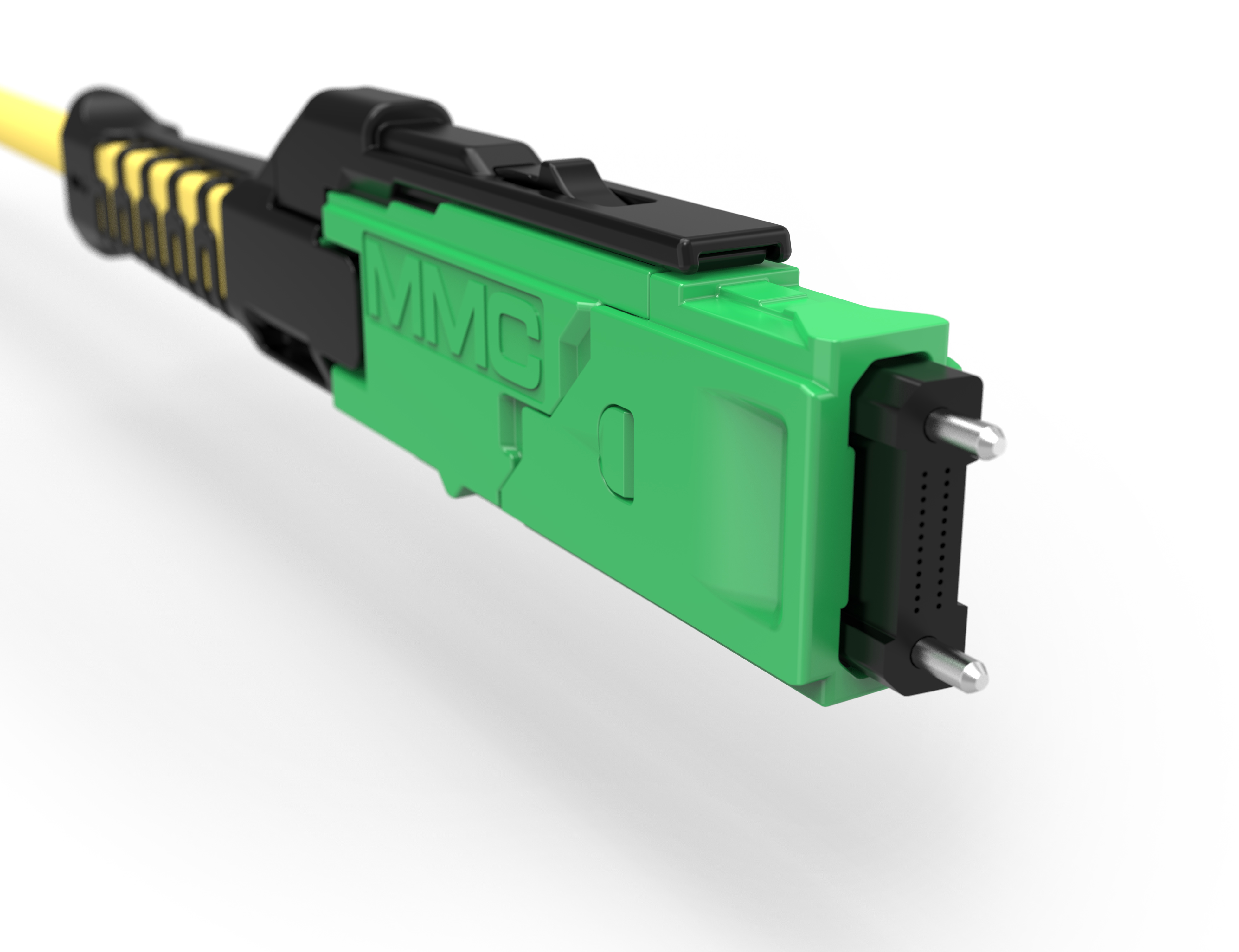
This pursuit of "interconnectivity density" constitutes the current business logic core of Corning Optical Communications.
In the context of increasingly expensive and tight supply of computing chips, optimizing physical connections to improve data throughput efficiency is a cost-effective means of optimizing computing power.
For cloud vendors who are building large-scale intelligent computing centers, this is no longer an "optional" option, but a "mandatory" one.
Localization of high-end manufacturing
The expansion of Shanghai Jiading factory marks Corning's deep integration of high-end manufacturing of optical communication into China, and Jiading factory has the complete capability from core materials to final product delivery. Entering the workshop of the Jiading factory, it is difficult to see a fully automated assembly line filled with robotic arms, replaced by a more refined "human-machine collaboration" mode.
This is due to the special production attributes of optical connector products - non-standard, customized, multi variety, and small batch.
At the threading station, a large number of well-trained frontline technicians are using microscopes to thread glass optical fibers with a diameter of 125 microns into extremely small core holes.
This process is referred to as "needle and thread work" by internal technicians. Due to the highly customized construction plan of AI data centers and the rapid iteration period, the product specifications are often extremely complex.
Yesterday, the customer required an 8-core connection system, but today it may have changed to a 16 core connection system or other requirements. There are also dozens to hundreds of cores to choose from for optical cables. This non-standard demand makes it difficult for rigid automated production lines to adapt and requires skilled technical workers with rich experience and strong hand eye coordination skills.
On this production line, every subtle action is related to the final transmission performance.
Workers need to first peel off the optical fiber to expose a 125 micron bare fiber, and then thread it into the core.
Subsequently, the product will be placed in an oven to heat and solidify the adhesive used to bond the optical fiber and the plug. The next cutting step is particularly crucial. In order to remove excess optical fibers that have passed through the plug, workers use not ordinary cutting tools, but a highly rigid cutting knife. With just a gentle push, the protruding optical fibers are neatly cut.
But this is only a macro level 'flattening'.
From a microscopic perspective, the cut surface remains rough. In order to eliminate the back loss of optical signals during transmission, it is necessary to polish and grind the end face at the nanometer level.
In the testing process, the relevant equipment will automatically determine whether the geometric dimensions of the end face meet the standard.
The screen will display the fiber optic end face magnified 400 times, and any small scratches, dents, or dust can cause the entire cable to be judged as unqualified.
If the cable still fails the test after cleaning, it must be reworked, or even the connector must be cut off and redone.
This almost stringent quality control explains why even in today's highly automated world, the manufacturing of high-performance fiber optic connectors still relies on highly skilled industrial workers.
Fiber optic is often seen as a basic consumable with a low threshold, but it is these microscopic processes that are difficult to detect with the naked eye that constitute the real technological barriers and explain why Corning's products have always been widely recognized in the high-end market.
Corning's decision to place such high-precision manufacturing processes in China also has clear considerations for localizing its supply chain layout.
China has one of the most active data center markets in the world, and is also the region with the fastest response speed in the optical module and optical communication industry chain.
For China's Internet giants and operators in fierce competition, the physical distance of the supply chain often determines the speed of business launch.
Chen Ziyan revealed that the current construction of AI data centers requires "fast delivery". When a client's intelligent computing center project is launched, it is often required to complete the project landing in a very short period of time.
If relying on overseas imports, the long logistics cycle and customs clearance process will become an unbearable time cost.
More importantly, "Co design" involves Corning's local technical team directly intervening in the customer's preliminary planning in the face of highly complex engineering requirements in the construction of AI intelligent computing centers. Based on specific data center structures and heat dissipation schemes, the team precisely customizes the length, sheath materials, and connection methods of optical cables.
This kind of responsiveness of "raising demands in the morning, proposing solutions in the afternoon, and delivering products next week" can only be achieved through in-depth localization layout. Through the customized pre termination scheme, Corning can help customers improve the on-site deployment speed by 70%, which means huge commercial value for Internet manufacturers who rush to meet the construction period.
This model of "local research and development, local production, and local delivery" constitutes the moat for Corning Optical Communications' business in China.
Importantly, this enables Corning to capture the technological trends in the Chinese market in a timely manner.
From 'Manufacturing' to 'Intelligent Manufacturing'
The steady growth of optical communication business validates Corning's forward-looking judgment in the field of digital infrastructure.
In addition to the incremental benefits brought by AI, Corning Optical Communications' foundation in the Chinese market remains solid. In the broader construction of digital infrastructure, Corning's products are being tested in diverse scenarios.
2025 marks Corning's 45th year in the Chinese market.
Since the establishment of its first office in 1980, Corning's development in China has not only been a business story of foreign-funded enterprises seizing opportunities in China, but also a microcosm of its deep participation in the construction of China's modern industrial system.
Taking the Shanghai Jiading factory as an example, it is not only a key node in Corning's global supply chain, but also an important base for cultivating senior technical workers and engineers.
In the face of the industrial opportunities brought by the development of artificial intelligence, the factory's data center interconnection project has attracted a large number of local high skilled talents, and the number of employees has increased from a few hundred in the initial stage to a thousand, with plans to increase by another 50% by 2026.
This continuous investment not only brings advanced optical communication manufacturing technology to China, but also injects vitality into regional economic development. Corning is fulfilling its firm commitment to long-term investment in China with practical actions.
In the future, with the advancement of national projects such as "East Data West Computing", long-distance connectivity (DCI) between data centers is becoming a new growth point.
When computing power resources are dispatched from the eastern hub to the western node, the fiber optic transmission network spanning thousands of kilometers needs to carry unprecedented data traffic.
Corning is currently developing multi-core fiber technology, which aims to build multiple transmission channels within a single fiber to exponentially increase transmission capacity. This is seen as a key technology for solving future long-distance massive data transmission.
At the same time, Corning has also launched a layout for the possible future CPO (co encapsulated optics) technology route, which directly encapsulates the optical engine next to the switching chip to further reduce power consumption and latency.
This prediction and investment in the technology cycle ensures that Corning will always be present no matter how the technology roadmap evolves.
The development process of Corning Optical Communications in China is a process from "introducing products" to "cultivating ecology".
Through deep cooperation with local optical module manufacturers and system integrators, Corning not only exports products, but also participates in the development of high-density connectivity standards that are suitable for the Chinese market.
After all, in the era of computing power competition, the high-end supply chain that is closest to customers, has the fastest response speed, and the most abundant technological reserves is truly irreplaceable.
Subsidy policy shifts, car market sales decline for three consecutive months

HSBC reports that gold prices may hit the $5000 mark in the first half of the year, with market expectations that silver prices will continue to rise

How can Herm ? s in the mobile phone case industry make young people rush to buy it?


 WeChat registration or login


