2026-11-11 19:14

In 1961, the first industrial robot Unimate was put into use at General Motors' New Jersey factory, picking up high-temperature parts from die-casting machines according to pre stored instructions in magnetic drums. Afterwards, the vision system allows the robot to recognize the position and posture of the parts and begin to undertake more processes.
More than 60 years have passed, and "black light factories" that do not require manual supervision have emerged, but there are still many operations that robots cannot replace, and the assembly of automotive wiring harnesses is one of them.
According to Audi's announcement in January 2026, the automation rate of wire harness production and assembly in the entire automotive industry is less than 10%. The shape of flexible cables is constantly changing, and whether each connector is properly connected must be repeatedly judged and confirmed during contact.
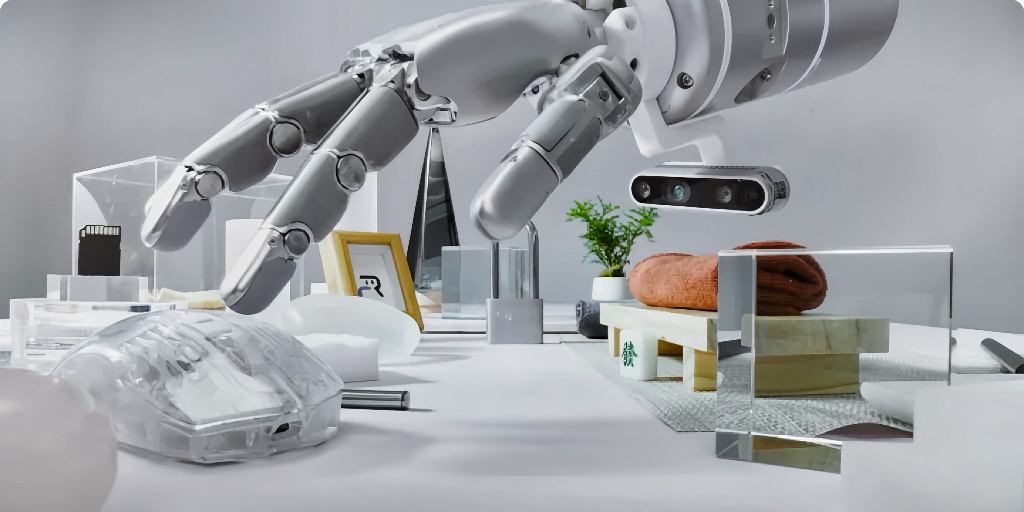
Robots have made significant progress from recognizing objects to reaching out to grab them, but how to control the force, respond to sliding, and confirm the completion of the operation when the hand touches the object remains a challenge. The dexterous hand that undertakes this step is often referred to as the "last centimeter" of the robot.
These tasks that need to be completed through contact are the areas that physical AI is trying to take over, and they are also the most difficult bone to crack.
Recently, Ant Lingbo Technology (hereinafter referred to as "Ant Lingbo"), a subsidiary of Ant Group, has open-source the tactile basic model LingBot Touch, which converts signals from different tactile sensors into unified contact information for use by different dexterous hands and motion models. Previously, Ant Lingbo's robot universal brain had covered spatial perception, environmental interaction, and agile operation, and this time added tactile ability.
After Touching
In the 1980s, robotics scholars such as Hans Moravec proposed that effortless perception and action for humans are precisely the most difficult abilities for machines to master, which later became known as the Moravec paradox.
For machines, the state after contact often cannot be seen visually.
Taking the task of twisting bottle caps as an example, vision can help fingers align with the bottle cap. After starting to rotate, the bottle cap may have loosened, or it may just be sliding along the cap wall with the fingertips. The two situations are similar in the image, and the required motion adjustments are not the same.
The contact state of fingertips is often obstructed by fingers and objects, and it is also the basis for adjusting actions in the action model. It is not only related to whether the task can be completed, but also to whether the object is damaged.
Measuring this information requires tactile sensors at the fingertips, which provide finer contact positions, force distributions, and sliding states compared to force sensors already used in robotic arm wrists, and have more complex signals.
But installing tactile sensors does not mean that robots can use touch effectively.
In the real machine test of Ant Lingbo, the action model π 0.5 controlled the dexterous hand to complete the task of pulling and closing the zipper. The success rate was 39% without using touch, but decreased to 15% after directly inputting the original sensor signal, and increased to 59% after inputting tactile information processed by LingBot Touch.
The contact signal needs to be converted into information that can be utilized by the action model, and LingBot Touch is located between the sensor and the action model, undertaking this step. Ant Lingbo mentioned in its technical report that the average positioning error of LingBot Touch in determining the contact center of fingertips on the Sharpa Wave dexterous hand is 0.12 millimeters.
The same control was conducted on 26 real machine tasks, covering operations such as flipping book pages, twisting bottle caps, and moving deformable cups, using two dexterous hands, Sharpa Wave and Star Era XHand1. After integrating LingBot VLA and three external action models, namely π 0.5, Diffusion Policy, and T-Rex, developed by Ant Lingbo, into LingBot Touch, the average success rate increased by about 14 to 26 percentage points compared to not using touch.
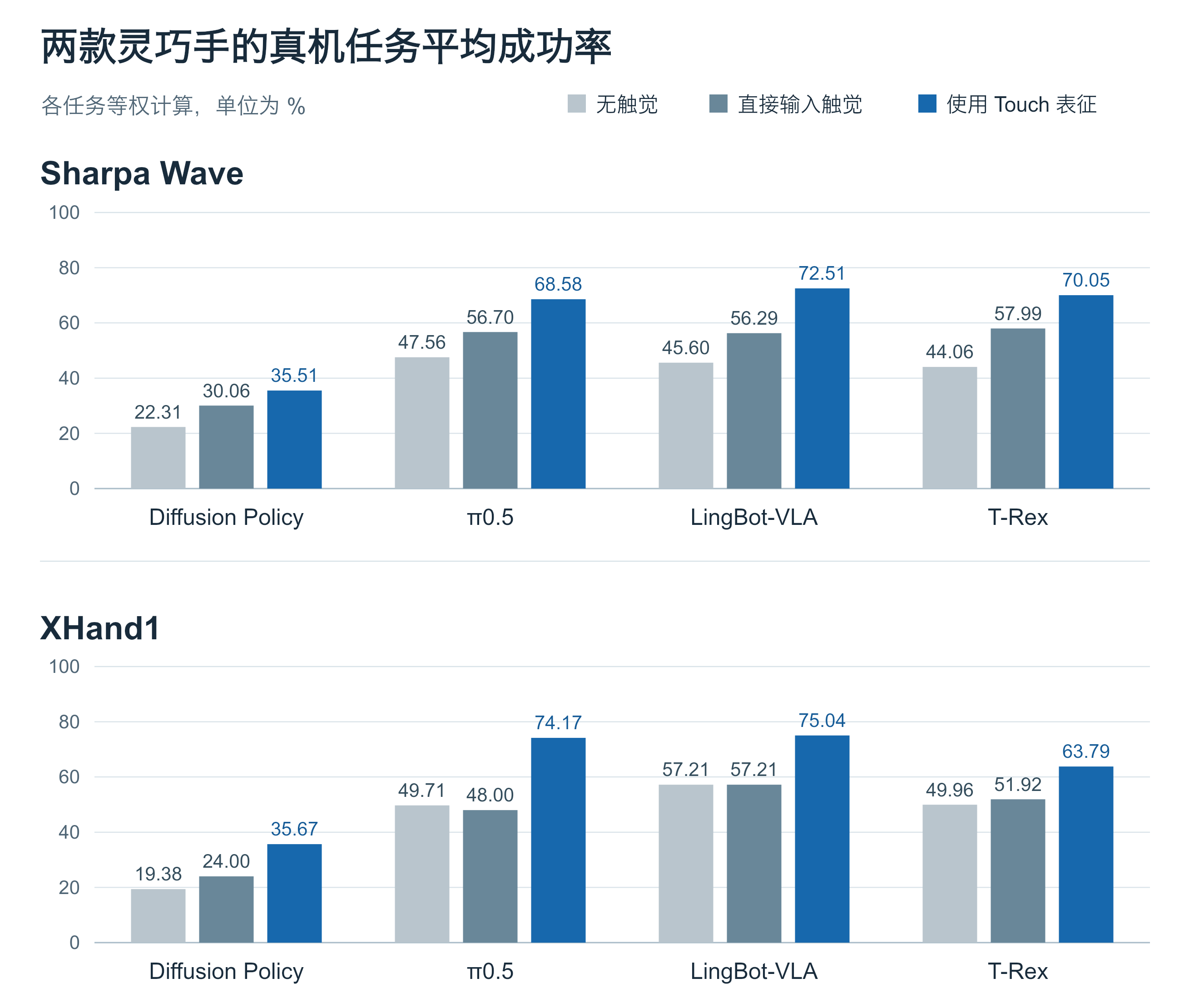
Among them, the success rate of T-Rex in the bottle cap twisting task was 56.25% when not using touch, 62.5% when directly inputting the original signal, and increased to 90% after connecting LingBot Touch. In addition to real machine testing, LingBot Touch has also been validated in 12 simulated reinforcement learning tasks.
The quality of modal input largely determines the quality of action output, in other words, there is no good output without good input, "said Zhu Xing, CEO of Ant Lingbo. High quality tactile input comes from specialized models, and model training cannot be separated from data.
Change to the other hand
The training data for tactile models can only come from hardware, and data collection, model training, and adaptation often need to be carried out from scratch for each new dexterous hand of the robot.
This is related to the current status of hardware. The dexterous hand is currently in a stage where multiple technological solutions coexist. According to a report released by International Data Corporation (IDC) on November 9, 2026, the mainstream driving solutions have not yet formed a unified technological direction.
Tactile sensors are similar, with mainstream solutions including visual tactile, magnetic tactile, and piezoresistive sensors, which respectively record surface deformation, magnetic field changes, and resistance changes of soft rubber.
The diversity of hardware solutions leaves room for innovation for enterprises, but also leads to data segmentation.
The same contact can generate different raw signals under different sensing principles and contact arrangements. For a model trained on a sensor, it is often difficult to use it after replacing the sensor or dexterous hand.
In response to this issue, LingBot Touch's approach is to first unify the signal layer, encode it separately according to the sensing principle, and then output a unified tactile token through a shared model.
The data collected by different hardware can be used together for training, with pre training data of nearly 5000 hours and approximately 1.33 billion frames, from real operations of human wearing tactile gloves and teleoperated dexterous hands, covering actions such as grasping, rotating, sliding, assembling, and hand coordination.
The effectiveness of this approach was tested during hardware replacement. The magnetic tactile sensor model installed on XHand1 was not included in the pre training data. The team kept the parameters of LingBit Touch unchanged and only used XHand1's operation demonstration to train the action model.
In the six tasks, after replacing tactile input with tactile tokens instead of raw signals, the average success rate of π 0.5 increased from 48% to 74.17%, and LingBot VLA increased from 57.21% to 75.04%. The success rate of LingBot VLA in handling easily deformed cups has increased from 58% to 90%.
After replacing the dexterous hand, the ability to extract contact information can be retained, and what needs to be learned again is the control of this hand by the action model. The magnetic tactile data in pre training is all collected by humans wearing gloves, and the contact experience accumulated by human hands can also help robots understand tactile signals on their hands. Glove collection does not rely on the robot itself and provides a path for expanding the scale of tactile data.
This first affects dexterous hand manufacturers, and competition among manufacturers is no longer limited to hardware parameters. IDC mentioned in the aforementioned report that tactile perception and operational control are also core competitive dimensions.
IDC China Research Manager Li Junlan recently pointed out that the differences between manufacturers in the future will also be reflected in whether they can effectively combine hardware, models, data, and skills.
For these manufacturers, sensor calibration, noise reduction, and reading correction still need to be completed by themselves, and universal tactile models do not require training from scratch. Research and development resources can be directed more towards sensing accuracy and durability. The action modeling team still needs to train specific tasks, but can start from existing tactile abilities.
From the perspective of the entire industry, the diversity of hardware originally made it difficult to share data, but under a unified model, it has the opportunity to become a source of data. According to IDC's forecast, the global shipment of dexterous hands is expected to be around 25000 units by 2026, with Chinese manufacturers accounting for over 85%. The diverse range of dexterous hands and sensors provides favorable conditions for China to develop universal tactile models.
The real world will not pause
Almost simultaneously with the open source of LingBot Touch, American artificial intelligence company Anthropic released the Claude Fable 5.2, a universal large model, demonstrating its ability to control robots to twist bottle caps, restore Rubik's cubes, and more. The internal test results released by Anthropic show that the average success rate of the RoboDojo model in robot simulation operation evaluation is 64.9%, higher than the previous generation model's 27.6%.
Prior to this, another general-purpose large model GPT-6 Astra, without specialized training in robotics, had already surpassed all 40 publicly available action models on the list in 42 tasks on RoboDojo.
However, the test results also showed that GPT-6 Astra performs poorly in tasks that require high-precision control, dynamic control, and two handed collaboration, with most of the challenges occurring after hand contact with objects. The real world does not pause, and when an object begins to slide in the hand, the robot needs to adjust its grip immediately. The model that processes tactile signals must be lightweight enough.
Zhu Xing stated that the universal large models represented by Claude Fable 5.2 and GPT-6 Astra have indeed enhanced the complex task reasoning and physical operation capabilities of robots, and Ant Lingbo is actively absorbing them.
To truly run the closed-loop operation, the hard bone of physical operation generalization cannot be bypassed, and to a large extent, it still depends on the breakthrough of the embodied basic model itself, "he said.
In Zhu Xing's view, the two types of models are closer to a collaborative relationship. General large models enhance robots' understanding and reasoning of tasks and environments, while embodied basic models specifically trained for robots improve physical perception and closed-loop operation capabilities. The two mutually promote each other and jointly accelerate the maturity of embodied intelligence industry.
Based on this judgment, Ant Lingbo summarizes its technological direction as "embodied native", designing and training models around the needs of robots to perceive the environment, predict changes, and perform tasks in the physical world.
Along this direction, Ant Lingbo's action model LingBot VLA 2.0 has previously been adapted to 20 robot configurations from 17 brands. LingBot Touch has been integrated with LingBot VLA, and its reusable range extends from the robot body to dexterous hands and sensors.
According to Zhu Xing, ant wave will also promote more modes such as vision, depth, touch and even temperature to be aligned in the unified model.
These capabilities are not only for use by Ant Lingbo itself. LingBot Touch is not bound to Ant Lingbo's self-developed action model. The technical report, model, and code are all open source and can be accessed and used by hardware manufacturers, whole machine enterprises, and teams with existing action models.
Ant Lingbo also conducts commercial testing in retail sorting, logistics sorting, and industrial scenarios with manufacturers such as Tongle Ju and Titanium Tiger, as well as scene partners such as National University Pharmacy and Longsheng.
From the perspective of industrial division of labor, the ability of touch, which is needed by all parties, is more suitable for basic model enterprises that can access multiple hardware and action models. Hardware manufacturers focus on ontology and sensors, while application teams focus on tasks and scenarios, reducing the investment from scratch and enabling more practical applications to be implemented.
From following preset program actions, to utilizing visual positioning, to planning tasks with large models and relying on tactile perception for contact, in the more than 60 years of "machine replacing human", every step forward is based on the maturity of new abilities.
As touch becomes a shared ability among different hardware, the progress of the "last centimeter" of dexterous hands is expected to accelerate, and the value of basic model enterprises will gradually emerge in this process.