Economic Observer Follow
2026-09-22 19:07

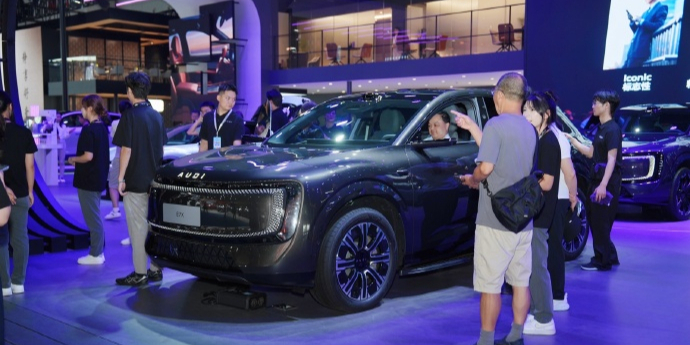
The news of Audi headquarters suing parallel import car manufacturers for bringing 'AUDI' electric vehicles into Germany has recently caused a huge response in China. AUDI is a new energy brand launched by Audi for the Chinese market, developed and produced by SAIC Audi, positioned as intelligent and youthful. After the public opinion escalated this matter into "Audi boycotts the entry of AUDI brand electric vehicles into Germany", the relevant person in charge of Audi China told the Economic Observer that Audi China will intervene in this matter.
On the afternoon of September 21st, Audi China issued a clarification statement, stating that the legal action taken by Audi headquarters is aimed at importers who sell AUDI models without official authorization, and is not a rejection of the AUDI brand. The reason for suing the imported car dealer is that Audi dealers in Germany currently do not have the ability to provide after-sales service guarantees for these imported car models.
At present, the parallel import car manufacturer Auto China has deleted the relevant information of two AUDI models on its official platform. But this incident has once again highlighted the high sensitivity of joint venture electric vehicle exports.
AUDI exports to Germany triggers trademark infringement
Audi China stated in a statement that "in order to effectively safeguard the legitimate rights and interests of overseas consumers, Audi headquarters has taken relevant legal actions against importers who sell AUDI models overseas without official authorization. The statement from Audi headquarters is a reminder to address the current unauthorized sales behavior of overseas importers and to effectively protect the relevant rights and interests of overseas consumers. ”
The sued Auto China is a German imported car dealer headquartered in Munich, established in 2022, mainly engaged in importing small quantities of Chinese new energy vehicles into Europe through parallel imports. In 2025, Auto China took the lead in producing a single bike T Ü V (an independent third-party testing group authorized by the German government) for the Xiaomi SU7 and registered it on the road in Germany.
Auto China currently sells Chinese new energy vehicle brands including Xiaomi SU7, Jike, Jetour, and Zunjie. In mid to late August this year, its official website officially launched sales pages for two models, AUDI E5 Sportback and AUDI E7X. On September 18th, German media revealed that Audi headquarters had initiated legal proceedings and subsequently removed two models from the Auto China official website.
As a parallel car importer, Auto China obtains vehicle sources in China through self purchasing from dealers, rather than authorized sales by car companies, and is responsible for the customs declaration, clearance, and German T Ü V technical certification of vehicles. The certification process for imported vehicles in Germany is very complicated, and the parallel import vehicle platform's packaging agency has opened up a convenient channel for German users to purchase Chinese cars.
However, as they are not officially exported in large quantities by car companies, the responsible parties for these imported car models to Germany are the import traders, not the vehicle manufacturers; And the certification obtained is the T Ü V certification for individual vehicles, not the EU WVTA (Whole Vehicle Type Approval).
The boundary of T Ü V certification for bicycles is very clear: it only tests the hardware safety and road compliance of the vehicle itself, and only represents that the vehicle meets the hardware conditions for registration and on road use; We do not confirm or endorse any intellectual property rights such as trademarks, software copyrights, etc., nor do we automatically attach original factory warranty, official OTA push, or vehicle recall responsibility.
Audi's lawsuit is based on the EU Trademark Regulation. This legislation, based on the principle of "exhaustion of territories", stipulates that only when the trademark owner or a third party with their consent first places goods bearing the trademark on the European Economic Area (EEA) market, the trademark rights of the goods will be declared exhausted within the EEA region, and the trademark owner will have no right to prevent further circulation of these goods within the EEA. The German Trademark Law also follows this principle.
The parallel imported cars exported to Germany obviously do not meet the above two conditions. These vehicles are not officially authorized for export by car companies and have already completed their first sales in China. Therefore, parallel imported cars cannot trigger the "exhaustion of trademark rights principle", and the trademark claims of the models sold are still in the hands of the car companies.
This means that even for genuine AUDI cars, as long as the vehicle is not sold in the European Economic Area for the first time and is imported in bulk to Germany for sale without Audi's permission, even if the vehicle can be used on the road as a single T Ü V, Audi can still apply for an injunction to stop the sale of these parallel imported cars on the grounds of trademark infringement.
The Hamburg District Court in Germany once applied the principle of exhaustion of European trademarks to Volkswagen IDThe parallel import case will be judged. At present, other Chinese car brands have not announced any formal legal claims against Auto China to the public. Xiaomi has previously stated that it reserves the right to take legal action against another German parallel import car manufacturer.
In contrast, the legal risks of parallel imported cars in China are smaller. China's Trademark Law does not make clear provisions for parallel imports, but judicial practice has formed a clear tendency towards the principle of "international exhaustion". As long as the product is a genuine product legally placed in the foreign market, the trademark owner has no right to prevent the product from being imported into China for sale. In addition, with the support of national policies, there are no trademark infringement disputes related to parallel imported cars in China.
Why knowingly violate?
Since there are clear legal risks, why do German parallel import car dealers still knowingly violate them?
At the end of 2022, Brudni Auto, a trading company based in Berlin, Germany, purchased 22 IDs produced by SAIC Volkswagen6 CROZZ electric vehicles, transported to Hamburg, ready for public sale in Germany after completing bicycle certification. Volkswagen Group immediately filed a lawsuit in the Hamburg court, claiming trademark infringement and design infringement. At the beginning of 2023, the court issued a temporary injunction prohibiting sales; In March 2026, the Hamburg court made a substantive judgment, determining that the parallel import constituted trademark infringement and ruling that the vehicle in question could be destroyed. This is the most cited case of reverse parallel import of Chinese made joint venture electric vehicles, and the AUDI parallel import case will largely follow this legal logic directly.
Promote the import of ID for Brudni AutoThe core driving force of CROZZ is IDThe huge price difference between China and Germany for the series of electric vehicles. The parallel importer once proposed in a media interview that after deducting transportation, tariffs, and T Ü V certification costs for individual vehicles, the Chinese version of ID6 still has a significant price advantage in Germany. German local Volkswagen authorized dealers also privately complained about IDThe series is priced too high in Germany. Because of this, German distributors are very wary of the cross-border parallel import model.
Unlike the Chinese version of German brands, the new energy vehicle models of Chinese domestic brands not only have price advantages, but also have more attractive technological content. Taking Auto China as an example, the Xiaomi SU7 MAX sold by it starts at 479200 yuan (excluding value-added tax), and the official guide price for this car in China is 303900 yuan. Although the German price is lower than the "export doubles" price that Chinese people remember, it is an attractive choice for parallel import car dealers that can attract German users and earn high profits.
In recent years, with the continuous expansion of China's intelligent electric vehicle technology influence and the expansion of new energy vehicle exports, coupled with the high-profile display of Chinese brands at the Munich Auto Show, the number of European users who hope to experience China's high-tech electric vehicles continues to increase. This business opportunity was captured by parallel import car dealers.
Auto China is not the only German dealer engaged in the business of new energy vehicles in China. In June of this year, another larger German automotive parts platform, Autohelden, also announced the large-scale import of Xiaomi SU7, Jike, Avita, and Jetour, and promised to provide a three-year or 120000 kilometer warranty for Xiaomi SU7. Autohelden plans to achieve a sales volume of 50000 vehicles in Europe for the first full year, with one-third completed in Germany.
The multi-layered policy barriers set by the EU against official exports of electric vehicles from China have left narrow commercial space for parallel importers in Germany. But the risk of intellectual property litigation is always present. It is reported that due to Xiaomi's official plan to enter the European market in 2027, Xiaomi has publicly hinted at the possibility of taking legal action against Autohelden for taking the lead.
In addition, after-sales service issues will be long-term pain points, including limited software system functionality, inability to adapt technology and hardware to the entire scene, and lack of quality assurance and maintenance systems.
For this consideration, Audi emphasizes that AUDI brand models have not been supplied to any countries outside of China through Audi's official distribution channels. In markets outside of Germany and China, Audi and authorized dealers are unable to provide technical support and after-sales service for these models. In short, the behavior of parallel importers will harm AUDI's user rights and brand reputation.
The highly sensitive state of joint venture electric vehicle exports
Compared with domestic domestic brands such as Xiaomi, Jike, and Jetour, AUDI, as a joint venture brand, has a higher sensitivity to parallel export models.
Audi China's statement reflects this. The statement emphasizes that the relevant reports (from foreign media) are intended to express that the Audi dealer network in Europe is unable to provide after-sales service guarantees for non officially supported parallel imported AUDI vehicles, rather than a lack of recognition of the brand. And solemnly declare: 'AUDI brand is a new electric brand established by Audi in China, and an important pillar of Audi's dual brand strategy.'. ”
The lack of recognition of the AUDI brand is a misinterpretation of this incident. Another perspective is that Audi in Germany is wary of electric vehicle products from China. From these two perspectives, parallel export cars have become a "mirror", reflecting the internal and external pressures faced by joint venture car companies in launching new electric vehicle brands in China.
The AUDI brand was born in 2024 and is a new energy brand specially created for China by Audi and SAIC. It is also Audi's attempt to reverse the passive situation of new energy transformation in China in a unique way.
The two AUDI models introduced by Auto China to Germany are the pure electric E5 Sportback and E7X, which were launched in September last year and May this year respectively. These two cars were jointly designed by Audi and SAIC, and are equipped with cutting-edge intelligent driving and intelligent cockpit technology in China. At present, the two cars have established preliminary competitiveness in their respective segmented markets, with sales far exceeding the pure electric models of Audi's four ring brand.
Since the birth of the AUDI brand, there has been a saying that "letter brands are not as authentic as four ring brands". Although at Audi headquarters, AUDI letter Audi and four ring Audi are two parallel brands.
Objectively speaking, as a new brand and category of vehicles, the hasty landing of Chinese made AUDI electric vehicles in Germany will inevitably have an impact on the stability of the entire Audi brand in the German market. In addition, at the product level, the uncertainty impact of AUDI intelligent electric vehicles on user perception is also a concern for the Audi Group.
In fact, the entire Volkswagen Group is facing the same challenges. There are unconfirmed reports that in June and July of this year, Volkswagen headquarters explored a possibility of introducing lower cost and more advanced technology Chinese market exclusive electric vehicles developed by Chinese joint ventures to fill the gap in the European domestic pure electric vehicle market. This idea has sparked fierce internal opposition, believing that the competitiveness of Chinese new cars will directly impact the stability of Volkswagen's entire domestic system.
For this consideration, ID. produced by Volkswagen AnhuiThere is currently no consensus on whether the series of electric vehicles will be exported. Yuzhong Electric Vehicle is a smart electric vehicle category specifically designed for the Chinese market, jointly developed by Volkswagen and local Chinese joint venture partners. Compared with German domestic products, it also has generational advantages.
Although in the past two years, IDThe "sister model" of UNYX and Zhong06 (Volkswagen Anhui's first domestic model) continues to be exported to the European Union through Volkswagen Anhui, but the identity of the car is CUPRA Tavascan. CUPRA is a high-performance sub brand under SEAT, and Volkswagen Anhui's factory is the only global production base for Tavascan models. The export of CUPRA Tavascan to Europe brings pure increment and there is no risk of "disrupting the market".
Volkswagen Anhui CEO Liu Zhanshu recently stated in an interview that further planning and exploration are needed to determine whether more products will be exported in the future, and a very clear answer cannot be given at this time. Compared to Volkswagen Anhui, Audi's answer is clearer. When asked two weeks ago if AUDI would export, Audi China President Luo Yinghan clearly replied, "It's not currently in our plans.
It is reported that the parallel import of AUDI models to Germany has not yet had a substantial impact, and the only order data publicly cited by the media is: within 72 hours of its launch on the Auto China official website, 127 pre orders were received. There is no authoritative publicly available actual delivery quantity. After Audi headquarters initiated legal proceedings, two cars have been taken down from the Auto China official website, and subsequent orders are frozen, with a high probability that delivery will not continue.


 Subscribe