Economic Observer Follow
2026-07-16 19:00


The construction of a rights protection system for 200 million flexible employees has been included in the policy agenda for the next five years.
On July 9, the Ministry of Human Resources and Social Security (hereinafter referred to as the "Ministry of Human Resources and Social Security") released the "Fifteenth Five Year Plan" for the Development of Human Resources and Social Security, which clearly proposed "to promote and improve the policies for protecting the rights and interests of workers in flexible employment and new forms of employment", and proposed "to encourage and support flexible employment personnel, migrant workers, and people in new forms of employment to participate in employee pension insurance, fully cancel the restrictions on registered residence registration of flexible employment personnel to participate in employee pension insurance in the place of employment, and continue to expand the coverage of employee pension insurance".
Flexible employment has become an important component of China's workforce. According to data from the National Bureau of Statistics, by 2025, the total number of employed people in China will be approximately 725 million. According to the Ministry of Human Resources and Social Security, the scale of flexible employment in China will exceed 200 million by 2025. Based on this calculation, the proportion of flexible employment population to the total employed population is close to 30%.
In recent years, from the Ministry of Human Resources and Social Security to local governments, the importance of protecting the rights and interests of flexible employment groups has been increasing. Some platform companies have also introduced innovative measures to work together with the government to promote the protection of the rights and interests of flexible employment groups.
But this is destined to be a systematic project.
The Labor Law of the People's Republic of China (hereinafter referred to as the "Labor Law") and several rules and regulations constitute a complete protection system that is suitable for the protection of the rights and interests of traditional workers. However, this system cannot effectively cover and adapt to flexible employment groups.
Dong Baohua, vice-chairman of the Chinese Society of Social Law Research and who has participated in the argumentation and drafting of the labor law, said that hundreds of millions of formally employed workers have been protected by the labor law over the past three decades. But as workers, just because the relationship between flexible employees and platforms is not recognized as a labor relationship, 200 million flexible employees cannot enjoy the protection of labor laws, resulting in multiple labor rights being in a state of "naked running".
What are the difficulties in labor security for flexible employment groups, what are the links that need to be sorted out, and what are the dilemmas they face?
The Economic Observer interviewed several scholars who have conducted long-term research and frontline investigations in this field, attempting to clarify the different perspectives between academia and practice. The interview found that the industry has not yet formed a unified opinion on the application of labor rights and interests such as the control of excessive working hours for flexible employment groups, the payment of employee pension insurance, and paid annual leave. This also reflects the complexity of the construction of a system to protect the rights and interests of flexible employment groups.
However, consensus has been reached among all parties in the debate: safeguarding the legitimate labor rights and interests of flexible employment personnel is not only related to the overall situation of high-quality and full employment, but also to social harmony and stability, as well as the well-being of individuals and families.
Zhang Dandan, an economics professor at the National Development Research Institute of Peking University, said that no country has such a large flexible employment population as China. In order to improve the labor rights and interests of flexible employment personnel, government departments have been continuously introducing targeted adjustment policies. However, in reality, a series of problems still exist, such as weak subjective willingness of workers to participate in insurance. It can be said that there is currently no standard answer in the government, enterprise, and academic circles on how to improve the protection system for the rights and interests of flexible employment groups.
Difficult to solve the problem of working hours
Among the various rights and interests stipulated in labor laws, working hour management has been one of the most concerned issues in recent years. According to labor laws, workers are required to work no more than 8 hours per day and an average of 44 hours per week.
In 2025, the average weekly working hours (referred to as "average weekly working hours") of employed personnel in enterprises across the country will end the previous 9-year growth trend and show a slight decline. In the first six months of 2026, the average weekly working hours will further decline.
However, multiple research reports and official data show that the problem of a large number of flexible workers working excessively long hours remains prominent. For example, data released by the Fuzhou Transportation Bureau shows that in the second and third quarters of 2025, local ride hailing drivers will work an average of 10-12 hours per day; In the fourth quarter of 2025, the proportion of online ride hailing services operating for more than 12 hours per day in Hangzhou reached 21.92%.
Dong Baohua analyzed that one of the reasons for the long working hours of a large number of flexible workers is the lack of institutional constraints. There have been calls from various sectors of society to apply labor laws and regulations on working hours to flexible employment industries such as express delivery, food delivery, and ride hailing. However, this demand has yet to be implemented, and overtime in related industries remains very serious, even increasing. In addition, flexible workers have a much stronger willingness to work overtime in order to increase their income than regular workers, which makes it difficult for regulatory enforcement to intervene and take action.
The viewpoint opposing the application of labor laws' working hours provisions to flexible employment groups believes that flexible workers often work overtime voluntarily and voluntarily, and forcibly limiting working hours may actually harm their income and interests, and the benefits outweigh the losses.
Feng Shuaizhang, Dean of the Institute of Economics and Social Sciences at Jinan University, said that the work freedom of flexible employment personnel is similar to that of individual businesses, and there is currently no limit on the working hours of individual businesses.
He believes that under normal circumstances, workers would strike the optimal balance between income growth and rest rights.
In the past few years of research, Zhang Dandan found that the demands of food delivery riders are focused on two aspects: income security and work-related injury insurance. She stated that new policies targeting flexible workers need to consider their impact on personal income. For example, if the daily average working hours of food delivery riders are forcibly reduced from 12 hours to 8 hours, it is necessary to consider how to make up for the loss of one-third of income. If the income of the rider cannot cover the cost of family living, the resulting livelihood and employment issues may outweigh the long working hours themselves.
Previously, the work hour management system for ride hailing drivers had sparked significant controversy. In February 2026, the Ministry of Public Security issued the "Rules for Determining Fatigue Driving of Motor Vehicle Drivers" (hereinafter referred to as the "new regulations"), which stipulate that if a passenger motor vehicle driver accumulates more than 8 hours of driving time within 24 hours, it should be recognized as fatigue driving. At first, the market believed that ride hailing drivers would also be included in the new regulations, ushering in a "mandatory 8-hour workday". But at the end of May, the person in charge of drafting the new regulations made it clear that the new regulations do not involve business activities such as renting cars (including ride hailing services).
The side that supports the application of labor laws or strengthened supervision of working hours believes that flexible workers' overtime work is not entirely voluntary. The platform algorithm will constantly motivate long-term workers, and the overtime work of a considerable number of flexible employees is a kind of helplessness trapped in the algorithm. At the legal level, mandatory protection should be provided to avoid greater risks caused by issues such as fatigue driving.
Associate Professor Qiao Qingmei from the School of Labor and Human Resources at Renmin University of China said that the problem of long working hours for food delivery riders and ride hailing drivers is essentially a typical phenomenon of "whipping fast cows". Flexible workers can increase their income by extending their working hours, but they cannot be encouraged without restrictions to exchange their health for higher income. Working under fatigue conditions greatly increases the likelihood of work-related accidents for workers. Improving the income level of this group should rely on improving the income distribution system, rather than harming the health of workers.
Xue Huiyuan, Deputy Director of the Social Security Research Center at Wuhan University, stated that the excessively long working hours of ride hailing drivers, food delivery riders, and others are essentially an economic incentive structure issue. Under the current platform payment model, workers' income is strongly tied to their online hours and completed orders. Under the incentive of "running more, earning more", workers are induced by algorithms to voluntarily work overtime. If the right to rest for ride hailing drivers and food delivery riders can be implemented, the most direct effect would be to reduce the traffic safety risks and occupational health hazards caused by overwork.
In Feng Shuaizhang's view, although the working hour management regulations of labor laws may not be fully applicable, the government can impose certain working hour restrictions based on bottom line requirements such as worker health protection and public interest protection to constrain all workers.
For example, if a certain type of occupation works for more than a certain amount of time per week or day, which seriously damages physical health and causes public risks such as fatigue driving, it should be included in the scope of duration control. The relevant rules apply to all workers and are not specifically targeted at flexible employment groups.
Previously, some platform companies have implemented measures to control working hours. For example, Didi implemented the rule of mandatory 20 minute rest after driving for 4 hours or more in 2017; In November 2024, Meituan will pilot a system in the East China region where customers will receive reminders if they run orders for more than 8 hours in a single day, and will be forced to take offline if they run orders for more than 12 hours.
Overall, the prerequisite for implementing working hour control is to ensure that the average income of flexible employees does not significantly decline as much as possible. Xue Huiyuan stated that if only the working hours are restricted without adjusting the pricing mechanism, the actual income of flexible employment groups will decrease, which will trigger resistance from practitioners and even lead to "underground order taking" behavior. Therefore, the regulation of working hours is not an isolated policy, it must be promoted synchronously with supporting systems such as minimum hourly wage guarantee, order unit price negotiation, and worker income compensation, otherwise the effect may backfire.
Dong Baohua said that from the current macroeconomic development trend, it may not be possible to enforce the working hour management for flexible employees in the short term. However, in the medium to long term, a standardized hourly management system similar to the "8-hour work system for ride hailing drivers" is an inevitable trend in the development of the industry. Given that flexible employment covers a wide range of industries, industry associations or relevant departments should take the lead in developing differentiated time management standards for different industries in the future.
Should employee pension insurance be mandatory to pay
In the past few years, in order to encourage flexible employment groups to actively pay for the basic pension insurance for urban enterprise employees (hereinafter referred to as "employee pension insurance"), the policy level has continuously lowered the threshold for participation. At present, except for some megacities, flexible employees can basically participate in employee pension insurance directly in the place of employment, without being restricted by the registered residence system.
After the implementation of the new social security regulations in September last year, the mandatory payment of social security in the traditional employment market has been further strengthened, but flexible employees can still choose whether to pay employee pension insurance independently. For flexible employees who actively participate in social insurance, platforms such as Meituan and JD.com have proposed providing certain social insurance payment subsidies.
During the research, Qiao Qingmei found that due to the complete autonomy of insurance and payment decisions, many food delivery riders have a lower willingness to pay for employee pension insurance and are more inclined to turn this money into cash flow received in the current month.
Taking Beijing as an example, flexible employees who voluntarily participate in employee pension insurance as individuals will have a minimum monthly pension insurance payment burden of 1432.4 yuan by 2025.
In November 2024, the Law Enforcement Inspection Group of the Standing Committee of the National People's Congress released a report on inspecting the implementation of the Social Insurance Law of the People's Republic of China, which mentioned that the participation rate of small and micro enterprises, flexible employment personnel, and new forms of employment workers is relatively low. According to a survey by the Chinese Society for Social Security, the compliance rate of China's employee pension insurance (the proportion of contributors to insured persons) has decreased from 85.2% in 2011 to 80.8% in 2022.
Feng Shuaizhang said that employee pension insurance is essentially a mandatory savings system promoted at the national level, aimed at enabling every worker to achieve a sense of security in old age and naturally possessing mandatory attributes. The size of the flexible employment group is already large and is still growing. If such a large number of workers can independently decide whether to pay for employee pension insurance, there will be hidden concerns about the continued operation of the employee pension insurance system.
To promote the participation of flexible employment personnel in employee pension insurance, Feng Shuaizhang believes that the active roles of platform enterprises, individuals, and the government should be fully utilized, rather than relying solely on individual contributions. If platform enterprises do not pay social security for flexible employees, it will result in unfair competition between different enterprises. At the same time, the government may consider providing a certain proportion of social security payment subsidies to flexible employment groups to alleviate the social security burden on individuals and platform enterprises.
Previously, some regions have explored social security payment subsidies. For example, starting from 2025, Beijing will provide social security subsidies to eligible flexible employees; On May 20th of this year, Sichuan proposed that platform enterprises that meet the corresponding conditions will receive social insurance subsidies from government departments at a rate of 10% of the platform enterprise's unit payment amount by 2026.
The flexible use of industrial forms is complex and diverse, and mandatory insurance will encounter many situations that need to be identified. For example, for flexible employment groups with only a small number of orders and limited monthly income, should they pay social security?
Feng Shuaizhang believes that in response to this situation, there is no need to set a lower limit for the contribution base of employee pension insurance. Instead, platform enterprises can allocate a certain proportion of funds for employee pension insurance contributions based on the actual number of orders and business volume received by practitioners. The more orders there are, the more employee pension insurance premiums individuals pay, and the higher the pension they will receive when they retire in the future. This payment model does not require significant adjustments to the existing social security system
Dong Baohua said that in order to improve the enthusiasm of flexible employment for social security payment, we can also consider liberalizing the registered residence registration restrictions of urban and rural residents' pension insurance (commonly known as the "farmers' pension system"). At present, individuals can only pay farmers' pensions in the place where their registered residence is located rather than the place where they work. In practice, even if individuals contribute the same amount of pension to farmers, the pension for farmers in economically developed areas, especially Beijing and Shanghai, will be significantly higher than that in central and western regions; Secondly, individuals can also alleviate short-term payment pressure by choosing a lower contribution base to participate in the farmers' pension.
Promote consensus on unemployment insurance reform
In recent years, in the face of macroeconomic fluctuations, unemployment insurance has played an increasingly important role in expanding coverage, improving efficiency, and ensuring people's livelihoods.
According to data from the Ministry of Human Resources and Social Security, from 2013 to 2025, the expenditure of the national unemployment insurance fund gradually increased from 54.13 billion yuan to 216.53 billion yuan. In the first five months of 2026, the unemployment insurance fund expenditure was 88.08 billion yuan, a year-on-year increase of 13.1%. In addition, by 2024, the per capita level of unemployment insurance benefits has risen to 1898 yuan/month.
From the perspective of institutional design, currently unemployment insurance only covers the formal employment population who have established labor relations, and the payment is jointly borne by the employer (payment ratio of 0.7%) and the employee (payment ratio of 0.3%). Due to its low payment cost and wide coverage, unemployment insurance is regarded as a "shock absorber" for economic operation, which can to some extent alleviate the risk of income interruption and ensure basic living for individuals after losing their jobs.
Based on the characteristics of unemployment insurance, the consensus formed by the interviewed experts is that the system design should be adjusted as soon as possible to include flexible employees in the unemployment insurance system. According to data from the Ministry of Human Resources and Social Security, by 2025, a total of 249 million people in China will have participated in unemployment insurance, which is much lower than the number of employed people in the country (about 750 million).
Qiao Qingmei stated that according to national statistical data, the pension insurance and medical insurance for flexible employment groups have achieved varying degrees of coverage, but there are obvious shortcomings in unemployment insurance and work-related injury insurance. Most flexible workers are often the economic backbone of a family, and once they are unable to continue working due to accidents, the importance of work injury insurance and unemployment insurance will be particularly highlighted.
Nationwide, only Guangdong is currently attempting to break through the restrictions of the unemployment insurance system and include flexible employment groups. In 2021, Guangdong issued a document proposing to pilot the participation of flexible employment personnel in unemployment insurance in 9 cities in the Greater Bay Area, including Guangzhou and Shenzhen. Guangdong proposed in the interpretation of pilot policies that the pilot has filled the gap in the unemployment insurance system for flexible employment personnel in Guangdong Province, and guaranteed the unemployment insurance rights and interests of flexible employment personnel. Among them, flexible employment personnel bear the full payment, and the payment base is the average income of flexible employment for twelve months before personal insurance.
The definition of unemployment follows strict international standards, and having no income in the short term may not necessarily be considered unemployment. Therefore, consistent with the "threshold" for applying for unemployment insurance through formal employment, flexible employment personnel participating in the pilot program in Guangdong also need to meet a series of conditions when receiving unemployment insurance benefits.
Specifically, for regular employees to apply for unemployment insurance benefits, they need to meet the conditions of "interruption of employment not due to their own wishes, having completed unemployment registration, and having job search requirements". In the pilot process, Guangdong has also put forward the same requirements for flexible employment, and clarified that "non voluntary interruption of flexible employment" includes the following situations: the flexible employment platform unit it relies on has its license revoked, ordered to close, revoked or dissolved in advance, bankrupt or suspended completely; The flexible employment platform units that rely on no longer provide flexible employment positions; The insured person is unable to engage in flexible employment due to illness or injury.
Simply put, in addition to the cause of injury, regular employees who are laid off by companies can be considered to have interrupted their employment without their own intention, and the application threshold is relatively low; Flexible employment, on the other hand, requires platform companies such as Meituan and Ele.me to cease operations or no longer hire flexible workers in order to meet the standards. In reality, triggering the conditions is extremely difficult. Therefore, even if flexible employment personnel are included in the unemployment insurance system, there is still significant uncertainty in their willingness to pay premiums and actual benefit rates.
Dong Baohua said that under the current rules, only the passive unemployed can receive unemployment insurance benefits, and individuals who leave their jobs voluntarily cannot apply for them. The standard for unemployment insurance benefits is generally determined at 70% of the local minimum wage standard. The overall level of benefits is low and the procedures are cumbersome, which has led to some passive unemployed people choosing to give up receiving them. This has prevented unemployment insurance from playing its due role in responding to macroeconomic fluctuations.
The "Statistical Bulletin on the Development of Human Resources and Social Security in 2024" released by the Ministry of Human Resources and Social Security shows that as of the end of 2024, the number of people participating in unemployment insurance was 245.89 million, and 4.63 million people (1.88%) received unemployment insurance benefits. A total of 9.05 million unemployed people (3.68%) received unemployment insurance benefits of different periods throughout the year.
Previously, an expert who has participated in the reform of the social security system multiple times told reporters that due to the strict rules set for the distribution of benefits in the "Unemployment Insurance Regulations", unemployed people rarely receive unemployment insurance benefits. In the long run, the "Regulations on Unemployment Insurance" should be revised to make this system no longer a weak point and truly play a role in providing relief to the unemployed.
Positive changes in maternity allowance and work-related injury insurance
Since 2026, the maternity insurance and "work-related injury insurance" for flexible employment personnel, which have lower personal contributions and higher levels of protection, have ushered in a new round of expansion and upgrading.
Traditionally, work-related injury insurance has only covered the formal employment population, while common commercial accident insurance has shortcomings such as limited compensation and narrow coverage, making it difficult to cover the rehabilitation and long-term living costs caused by serious injuries or disabilities of the parties involved.
In the research, Xue Huiyuan found that among various types of social security, occupational injury protection is the most concerned type of protection for flexible employment personnel, followed by medical insurance and pension insurance. Especially for older workers, they have shown obvious anxiety.
In 2022, the Ministry of Human Resources and Social Security launched the "New Occupational Injury" program, which addresses the pain point of flexible employment lacking work-related injury insurance. The "new job injury" does not require flexible employment personnel to have a labor relationship with the platform, and the overall approach is to participate in insurance on a daily basis, pay according to orders, make monthly payments, and participate in general insurance. All insurance costs are borne by the platform.
According to data from the Ministry of Human Resources and Social Security, the pilot program for "new occupational injuries" will begin in 17 provinces in 2022. As of July 1, 2026, the cumulative coverage of "new occupational injuries" has reached nearly 30 million people, effectively playing a protective role in occupational injuries, especially major injury accidents.
On the other hand, in December 2025, the National Medical Security Work Conference proposed that by 2026, the medical insurance department will promote the inclusion of flexible employment personnel, migrant workers, and new forms of employment in the coverage of maternity insurance. Previously, exploration has been carried out in Jiangxi, Zhejiang, Tianjin, Guizhou, Shanghai and other places.
Since 2026, Ningxia, Jiangsu, Fujian, Hainan and other places have chosen to follow suit. This means that more and more flexible employees in various regions can also enjoy relevant benefits after participating in maternity insurance, including medical expenses and maternity allowances.
The difference is that for formal employment, the maternity allowance in most regions of the country is equal to the average monthly salary of the employer's employees in the previous year divided by 30 times the prescribed number of vacation days. Due to the fact that flexible employment personnel do not have an employer at the labor relationship level, there are significant differences in the calculation methods used to calculate the maternity allowance for flexible employment personnel in different regions (as shown in the figure below), and the final maternity allowance that individuals can receive will also vary significantly.
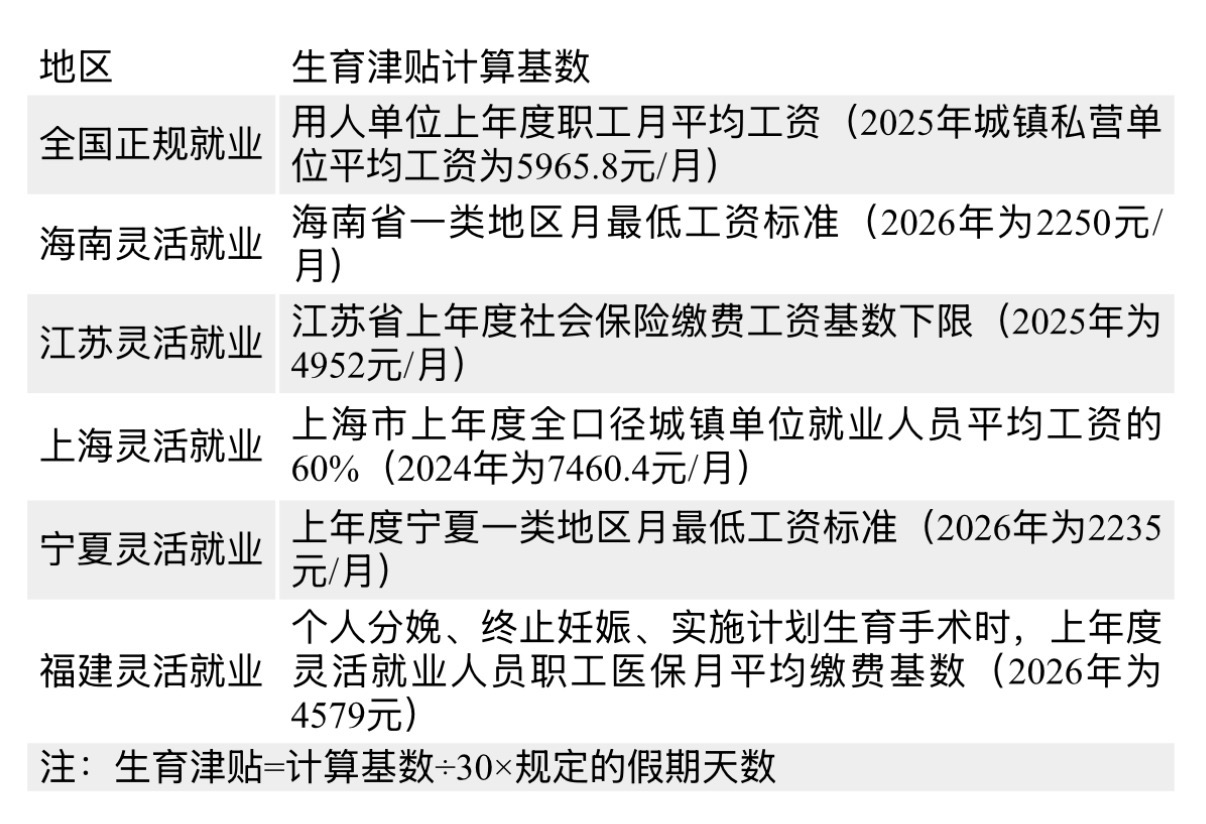
Overall, in provinces (regions) such as Hainan and Ningxia, even if individuals pay maternity insurance based on the same contribution base, the maternity allowance that flexible employees can receive is likely to be significantly lower than that of the regular employment population.
Feng Shuaizhang stated that including flexible employment personnel in the maternity insurance system when calculating maternity allowances will bring about many institutional adjustments, but these are only technical issues. In the long run, regardless of macroeconomic fluctuations, with the further development of the platform economy, the scale of flexible employment personnel will remain at a relatively high level. Therefore, addressing the issue of protecting the rights and interests of flexible workers is an unavoidable issue of the times.
We need a new labor law
At present, the most comprehensive regulation for workers is the Labor Law, which has been implemented for over 30 years. In addition to the basic guarantee of "five insurances and one fund", the Labor Law also stipulates that enterprises must ensure that employees have at least one day off per week, statutory holidays, paid annual leave and other statutory rights.
But an important prerequisite for the effective implementation of labor laws is the existence of a standard labor relationship between workers and employers. For a long time, the cooperative relationship between flexible workers and platforms has been mostly defined as civil cooperation or "incomplete labor relations", so over 200 million flexible workers cannot be subject to labor laws.
Xue Huiyuan stated that the current legal framework adopts the "binary division of labor relations", which only distinguishes between standard labor relations and civil relations, making flexible employment fall into a gray area of supervision. When the labor supervision department carries out a series of supervision based on the current labor law, there is a lack of clear legal means, making it difficult to implement supervision. This is also the reason why the academic community has been calling for the introduction of the "labor triad" - to create an intermediate category between traditional employees and independent workers, and to build a legal connection channel for the basic labor rights protection of flexible employment groups.
In this context, whether the protection of labor law's rights and interests can be directly applied to flexible employment groups has become a controversial topic in academia and industry.
The viewpoint supporting adaptation holds that all workers should equally enjoy basic labor rights. Xue Huiyuan stated that from the legal perspective of fair labor rights, all workers should equally enjoy the rights of vacation, holiday pay, maternity protection, etc. In the long run, flexible employment groups should be gradually included in the same protection system.
Qiao Qingmei said that countries such as Italy, the United Kingdom, and the United States have included platform employees in the formal labor employment security system. Flexible and regular employees are both laborers, and differential treatment of holiday pay and holiday benefits cannot be solely based on differences in labor nature. This is not the value orientation that the social security system should have
The viewpoint opposing direct application holds that if labor laws are forcibly applied to flexible employment groups, it will directly undermine the advantages of flexible employment.
Zhang Dandan stated that flexible employment and formal employment enjoy different labor rights. Flexible employees can independently arrange their working hours, and this "comfort level" itself is a welfare; The welfare of formal employment is regulated by the social security system, but there is a lack of flexibility in work arrangements, so it is necessary to provide employees with sufficient rest time through labor laws. With the development of technological iteration and task-based employment models, flexible employment, as a labor relationship model, is more in line with the development needs of modern productivity. In the short term, if the rights and interests of labor law are forcibly applied to flexible employees, flexible employment will lose its efficient and flexible characteristics
Xue Huiyuan stated that flexible employment has no fixed employer, and is characterized by large income fluctuations and loose employment relationships. It is difficult to divide responsibilities and share costs, and directly copying the traditional employee welfare system lacks practicality. In the short term, it is impossible to achieve complete equality of rights and interests between flexible employment and formal employment groups.
This also means that the protection of the rights and interests of flexible employment groups faces two path choices: either revise the current labor law to include flexible employment formats in the scope of application; Either a new law can be specifically introduced to build a targeted system for protecting the rights and interests of flexible employment groups.
Dong Baohua said that the Ministry of Human Resources and Social Security, the All China Federation of Trade Unions and other departments had intended to promote the revision of the Labor Law, but the revision of the law had a ripple effect and ultimately could not be implemented. The current dual structure of the labor market has already taken shape, and we should actively seek opportunities to amend the Labor Law and the Labor Contract Law of the People's Republic of China.
Feng Shuaizhang stated that it is not appropriate to apply a series of regulations of the labor law to the flexible employment group one by one. But the rights and interests of flexible workers need to be incorporated into the corresponding legal framework to achieve legal protection. Therefore, we can refer to traditional labor relations and discuss which regulations are more applicable to flexible employment groups.
Xue Huiyuan also stated that it is far from enough to "make up for changes" within the old legal framework. The new form of employment has systematic differences from the traditional employment model of the industrial era in terms of working hours calculation, salary structure, management methods, risk sharing, etc. Therefore, at least one administrative regulation level new employment form worker rights protection method is needed to achieve systematic and standardized management of the rights protection of flexible employment groups.

Want to buy a smart car with a budget of over 100000 yuan? Cannot bypass the Aion N60

Why can the repeatedly banned borderline marketing always get out of the circle smoothly?

The APEC Digital Week city promotion video is officially launched, and Chengdu, the city of innovation and creation, will keep running with the world!


 WeChat registration or login


 Subscribe