Economic Observer Follow
2026-03-26 16:57



Liu Jun | Wen
1? The leader of Silicon Valley who opposes Silicon Valley
The Science and Technology Republic: Hard Power, Soft Beliefs, and the Future of the West "is a" hybrid "work that combines corporate biographies, philosophical critiques, and social declarations. It fiercely criticizes Silicon Valley's" culture of complacency "and calls for the reshaping of the" Science and Technology Republic "- a governance model that tightly integrates Silicon Valley elites with the state to address the AI arms race and geopolitical threats. The book has radical arguments and far-reaching impact, and is regarded as a representative work of right-wing technology thinking in Silicon Valley.
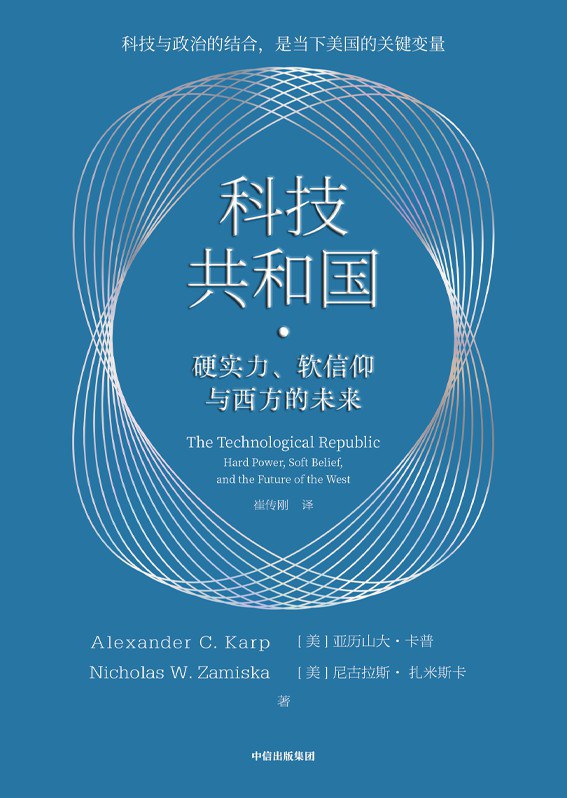
Tech Republic: Hard Power, Soft Faith, and the Future of the West
Written by Alexander Kapu Nicolas Zamiska
Cui Chuangang | Translation
Ark Studio | CITIC Publishing Group
December 2025
From the perspective of structure and content, "The Republic of Science and Technology" can be summarized as three intertwined main lines: first, a historical review of the US national engineer industrial system during the Cold War; Secondly, a systematic critique of Silicon Valley's consumer orientation and platform capitalism model; Thirdly, the normative proposition of "national mission return" in the era of contemporary artificial intelligence and data technology.
Kapu and Zamiska's emphasis on the national mission of technology is not a simple policy shift, but a reactivation of the liberal science technology political tradition advocated by Vannevar Bush in "Science: The Endless Frontier" during the late World War II and strengthened during the Cold War. During the late stages of World War II and the Cold War, the United States closely linked technological progress with its mission of civilization around the narrative of "free world" and "national security", giving engineering and scientific research not only economic significance, but also clear political and ideological meanings. Tech Republic attempts to bring this long marginalized tradition of "Silicon Valley platform capitalism" back to the ideological core of American tech elites. Kapu emphasized that technology is no longer an "endless frontier", but a "deadly defense line". This shift from "linear spillover of basic research" to "reverse drive of geopolitics" marks a shift in the Western scientific system from "curiosity driven" to "fear driven".
Kapu's identity has a certain uniqueness. He is not the traditional engineer type entrepreneur in Silicon Valley, nor is he a typical venture capitalist type technology elite. Kapu's final degree was a doctoral degree in social theory from a German university, with academic training focused on the intellectual traditions and social theory of the European continent, rather than computer science or engineering. This academic background makes Karp stand out among Silicon Valley executives. Mainstream media in Europe and America describe Karp as a "Silicon Valley anti Silicon Valley leader".
In 2003, Karp and his classmate, Peter Thiel, a representative figure of the Silicon Valley technology right, co founded Palantir Corporation. The company is known for providing data analysis and intelligence software to the US Department of Defense, intelligence agencies, and allied forces such as Ukraine. Its early funding sources included venture capital firms under the Central Intelligence Agency. By 2025, the company's market value will exceed 400 billion US dollars, making it one of the most expensive companies in the world. This background of "intelligence security" has deeply bound Palantir to the US national security system since its inception, and has also shaped Karp's long-term structural understanding of the relationship between "technology state war capability", forming an important empirical basis for the repeatedly emphasized argument in "Tech Republic" that "national mission takes precedence over consumer innovation".
Of course, Kapu's "anti Silicon Valley" stance does not mean a denial of technological capital itself, but rather a repositioning of how technological capital should be embedded in the country's political structure. Kapu's relevant discourse does not deny the importance of capital and the private sector, but attempts to reconstruct the normative role of technology enterprises in the national power structure by emphasizing the national mission, so that technology capital is no longer just a market entity, but a part of the national capacity system.
The author's review of the technological system during the Cold War is not a nostalgic historical narrative, but rather a comparison of systems with clear political intentions. By repeatedly emphasizing the Manhattan Project, DARPA (Defense Advanced Research Projects Agency), and Apollo program, Kapp and Zamiska attempt to demonstrate that the technological leadership in American history did not come from spontaneous competition among dispersed market entities, but from the centralized allocation and strategic mobilization of engineering resources by state power. This narrative logic is actually a fundamental challenge to the neoliberal technological governance model. The reinterpretation of this historical experience in this book implies the normative position of technological republicanism: technological capabilities should be understood as part of the state's public power, rather than purely private capital assets. Of course, they are not advocating for the state's comprehensive control over technology enterprises, but rather advocating for institutional design to enable engineering and technology elites to re assume public responsibilities related to the fate of the "republic".
Overall, this book takes readers directly into the core debate within the American tech elite about the fate of technology, nation, and civilization. Kapu and Zamiska, with their unique dual identities as founders of technology companies and serious political readers, face a key question: as digital technology increasingly becomes the core infrastructure for national capacity, warfare, and social governance, do Western countries still have the political will and institutional capacity to shape the direction of technology?
2? From a 'scientific republic' to a 'technological republic': reconstruction of national capacity?
From a broader perspective, 'The Republic of Science and Technology' has a clear direction towards geopolitical reality and great power competition strategy, demonstrating an evolutionary chain of ideas for the reconstruction of 'national capacity': from the institutionalized 'scientific republic' advocated by Vannevar Bush in 'Science: Endless Frontiers', to the functional' entrepreneurial nation 'revealed in Mariana Mazzucato's' Entrepreneurial Nation', and finally to the civilizational strategic 'technological republic' in Kapu's' The Republic of Science and Technology '. This is a process of reshaping national capabilities from "scientific system construction" to "innovation function expansion" and then to "strategic civilization integration". This evolution is not simply a theoretical inheritance, but a redefinition of national capacity that occurs with changes in the international order structure.
In 1945, Bush established a blueprint for the institutional relationship between technology and the state for post-war America in "Science: Endless Frontiers".
The core judgment of the Bush report is that basic research is the source of technological progress; The state must provide sustained and stable public financial support; The scientific community should maintain autonomy; Innovation follows a linear model of "basic research applied research industrial diffusion". This institutional arrangement gave birth to the post-war scientific research system in the United States and laid the organizational foundation for the country's technological advantages in the future.
In the framework of the Bush report, the source of national capacity is not administrative orders, but institutionalized scientific research supply. The state indirectly gains strategic advantages by supporting science rather than directly intervening in the market. The reason why this model is established has its historical premise: the United States has overwhelming advantages in industry and finance; In the early stages of the Cold War, technological competition was characterized by a high degree of national mobilization; There is a high degree of consistency between the research community and national goals. It can be said that the Bush report envisioned a "scientific republic" - a national capacity structure centered on a scientific research system, laying a solid foundation for the United States' national capabilities.
Entering the 21st century, the neoliberal political and economic structure dominated by globalization and financial capital has gradually weakened the country's sense of sovereignty in technological innovation and the technology industry. However, in her critically acclaimed work "The Entrepreneurial State," Italian American scholar Mazukato proposed the famous reverse proposition: the state is not a repairer of market failures, but a creator of innovation.
Mazukato emphasized that the country undertook the earliest and highest risk investment through the analysis of DARPA, the Internet, pharmaceutical research and development and other cases; Private capital enters after risk reduction; The innovation chain itself is the result of the shaping of national systems. She further expanded the connotation of national capacity in theory: the role of the state shifted from "funder" to "direction setter"; The structure of technological innovation has shifted from a "linear model" to an "interactive network"; National capacity is no longer just about providing scientific research resources, but actively shaping technological paths and industrial structures. The theoretical narrative proposed by Mazukato takes place against the backdrop of deepening globalization, outward migration of manufacturing industries, and weakened national capabilities, and is a theoretical counterattack against the "de nationalization narrative". But in Mazukato's view, national capacity is still mainly aimed at economic growth and industrial policies, and its problem awareness still belongs to the political and economic category.
In "The Republic of Science and Technology," Karp and Zamiska proposed a new shift in national capacity building. In their view, today's national capacity is no longer just a tool for economic growth, but a core resource related to national competition and the survival of civilization. The national capabilities presented in "The Republic of Science and Technology" exhibit three new features: technological capabilities are directly embedded in the national security framework; Innovation goals are linked to geopolitical competition; National mission and social beliefs are regarded as prerequisites for technological advantages. National capacity has risen from the level of "system economy" to the level of "strategy civilization": the Bush Report emphasizes that countries acquire capacity through scientific systems, Mazukato emphasizes that countries shape capacity through innovative investment, and Kapu and Zamiska directly call for countries to maintain the ability of civilization to survive through technological sovereignty.
From a 'scientific republic' to an 'entrepreneurial nation' and then to a 'technological republic', it can be seen as an iterative transformation of the 'theoretical narrative' of national capabilities. This transformation is not purely a theoretical deduction, but rather a reflection of the deep structural changes in international politics and economy.
When the global supply chain is highly integrated, advantages can be supported solely by institutional advantages and innovative frontiers; However, when global supply chains become fragmented and technological competition becomes politicized, national capabilities must be re strategized. And the deeper changes behind this actually lie in the increasing politicization of the "state science relationship" - including domestic and international politicization: in the Bush era, science had a high degree of autonomy; In Mazukato, the state has always been constructing and shaping the structure of technological innovation; At Kapu and Zamiska, national capability directly becomes the core of national strategic sovereignty and the survival of civilization.
Kapu's pursuit of a 'technological republic' is essentially an attempt to establish a digital 'political decision-making power' through algorithms. The deeper significance of military intelligence security composite companies such as Palantir lies not in data processing, but in the decisive ability they give sovereigns to "identify friend or foe" in the fog. The 'Republic of Science and Technology' is no longer the efficiency driven 'entrepreneurial nation' depicted by Mazukato, but a 'decisive entity' pursuing 'algorithmic sovereignty'. The combination of technology and sovereignty is dissolving the bureaucratic system of traditional countries and forming a new "Silicon Valley style sovereign decision-making theory".
Of course, 'The Republic of Science and Technology' is not a strictly academic work, and the language of Karp and Zamiska is more like an urgent political manifesto than a rigorous theoretical construction or practical policy initiative. The purpose of this work is to loudly remind Western society that technological advantage is not a byproduct of the spontaneous order of the market, but the result of the joint construction of institutions, investments, and cultural beliefs. At this point, it provides a new perspective for contemporary discussions on national capacity, as well as new inspirations for us to understand the complex relationship between technology, industry, and the state.
3? The Rise of Silicon Valley's Technology Right Wing and the Tearing of the Left, Center, and Right in the United States
After the publication of "The Republic of Science and Technology" in 2025, it sparked highly polarized reactions in the left, center, and right intellectual circles of Europe and America. On the one hand, this book is considered a rare systematic self-criticism from within Silicon Valley; On the other hand, it has been strongly questioned and criticized by liberals, advocates of technological ethics, and civil liberties due to its public defense of national security oriented technological development.
The divergent evaluation of this work by the left, center, and right in Europe and America once again reflects a key rupture in the contemporary political and economic structure of the United States and even Europe: one end is the institutional inertia of liberal technological culture and platform capitalism, and the other end is the structural push of national security and geopolitical pressure on the re politicization of the technological system; The tearing conflicts between the left, center, and right within the United States and even Europe are becoming increasingly irreconcilable: the left is struggling, the right is pressing closer, and the once powerful centrists are in a dilemma and helpless.
Some researchers in Europe and America regard Palantir as the core representative of the "tech right" in Silicon Valley: Thiel is a supporter of Trump, promoting "effective accelerationism" and the integration of defense technology, emphasizing the use of technology to maintain US hegemony and confront China. Left wing media such as Jacobin magazine criticized Palantir for leading Silicon Valley's transition from "consumer technology" to "deadly military technology", and its CEO Capp publicly criticized Silicon Valley's "awakening virus" and promoted deep integration with the Pentagon.
The criticism in 'Jacobin' did not 'wrongly accuse' Karp and Zamiska. The two of them reinforced this stance in "Tech Republic": fiercely criticizing Silicon Valley elites for "leaving the country" and focusing on "trivial consumer goods" (such as social apps) rather than national security. They called for the "New Manhattan Project" - Silicon Valley collaborating with the government to develop military AI, ensuring US technological hegemony, and preventing international "unethical" competition. In the book, the two emphasize the integration of "hard power" (military AI) and "soft faith" (Western values), viewing Silicon Valley as the engine of a "tech republic", shouting "revive patriotism", maintaining the absolute deterrent advantage of the US technology industry, promoting the "spiritual justice" of Western values, and maintaining Western civilization in visible turmoil.
In recent years, Silicon Valley has shifted from "hyper liberalism and left leaning" to the right, which is a microcosm of the polarization of American politics and economy, as well as the tearing of consensus between the left, center, and right. A research report from think tanks such as Pew Research Center points out that political polarization in the United States has intensified since 2008, and the tech industry in Silicon Valley has amplified this trend: right-wing elites in Silicon Valley are dissatisfied with the anti-monopoly, encryption regulation, and AI regulation of the Biden era, and have turned to Trump's policies of deregulation and tax cuts. This shift is the rise of 'technological authoritarianism': tech oligarchs (such as Musk and Thiel) are pushing for 'accumulated regime change', pursuing data extraction rights, and weakening democratic regulation.
Some elites in Silicon Valley are gradually turning to the right, not simply due to party preferences, but rather a transition from "platform capitalism" to a "military intelligence complex" form. The extreme right-wing in Silicon Valley exhibits obvious characteristics of "technological Bonapartism": contempt for mediocre parliamentary democracy and a desire to solve the lag of civilization through technological authoritarianism. This is not only a rift within the United States, but also a profound self doubt within Western liberalism about whether democracy can still harness technology.
Left wing researchers strongly criticize Silicon Valley's right-wing "anti awakenism" - opposing diversity, fairness, and inclusivity (DEI) and supporting Trump's anti immigration and deregulation agenda, leading to internal divisions - with Silicon Valley's leadership leaning to the right (40% supporting Trump), but the majority of employees leaning to the left (60%), resulting in protests and resignations.Centrists warn that technology industries such as AI may exacerbate economic differentiation: Silicon Valley tech giants profit, while ordinary people worry about job losses and rising energy costs; The right-wing in Silicon Valley is pushing for a "chip war" and AI diplomacy, ignoring the needs of developing countries, which will exacerbate global political and economic divisions, polarization, and fragmentation. The right-wing supports Kapp's viewpoint that Silicon Valley has lost its patriotism and needs to integrate with the defense industry and national strategy.
In summary, the political polarization of the left, center, and right in Silicon Valley is likely to solidify over the long term; The current situation of left, center, and right polarization and division in the United States will not only affect the country, but also reshape the global technological competition and geopolitical ecology.
4? The Mirror of Others: The Logic and Structure of Technological Competition and National Capacity Restructuring
For Chinese readers, the value of 'The Republic of Science and Technology' lies in serving as a 'mirror of others', helping us understand the institutional logic of contemporary technological competition and the deep structure of national capacity reconstruction. It is worth reading critically and engaging in serious dialogue.
The ideological shift reflected in this work indicates that some political and technological elites in the United States are attempting to rebuild legitimacy for a more national strategic oriented technological governance model from an ideological and institutional perspective. In the future, the technology competition between China and the United States may shift from pure industry and market competition to institutional model competition regarding the relationship between technology and the state. As the United States increasingly links artificial intelligence, semiconductors, data infrastructure, and national security, China's international technological environment will become more politicized, secure, and institutionalized.
In addition, the book explicitly elevates technological competition to the level of civilization choice, which means that the competition for technological routes is endowed with institutional and value attributes. This ideological shift serves as a warning that the future technological competition between China and the United States will increasingly be embedded in narratives about the superiority of institutions and civilizations. On the road to building national capacity, how can we achieve technological breakthroughs while avoiding falling into the trap of technological authoritarianism and civilizational opposition? This is the enlightening light reflected by the "mirror of the other" in "The Republic of Science and Technology".
Overall, in the era of deep integration and complex entanglement between artificial intelligence, data platforms, and national security, "The Republic of Science and Technology" provides a highly realistic and controversial text for understanding the contemporary competition in science and technology among major powers and the reconstruction of national capabilities. The book clearly reveals the underlying ideological logic of the "American Republic of Science and Technology," revealing the current situation and background of the wider political and economic changes in the United States, where the left, center, and right are torn apart. At the same time, it also raises a more fundamental and ultimate question: when science and technology are completely "securitized" and "faith-based," will science still have its public nature? Kapu's "Republic of Technology" promotes Western self-help, but does it also foreshadow the ultimate funeral of the ideal of "science without borders" since the Enlightenment?
(The author is a socio-cultural scholar)


ST Qingyue fined 172 million yuan for suspected fraudulent issuance and illegal letter disclosure

Focusing on "Artificial Intelligence Empowering New Industrialization", the 2026 Artificial Intelligence Industry Conference opens in Jinan

Can Traveler 7 take care of both commuting on weekdays and mountain trips on weekends? This time, the all-new Jetour Traveler 7 will focus on its "Keyo" # Smart Beauty Travel Champion Box # Kecheng Keyo Keyo Travel # 7 Series Square Box New Benchmark # New Traveler 7 Renewal Surprise Price Starting from 125900 yuan


 Subscribe