Economic Observer Follow
2026-11-10 16:57

On November 9th, data released by the National Bureau of Statistics showed that the year-on-year growth rate of the Producer Price Index (PPI) in October reached 5.7%, continuing the upward trend since the beginning of this year and reaching the highest level since June 2022. Meanwhile, the national Consumer Price Index (CPI) rose by 0.7% year-on-year in October.
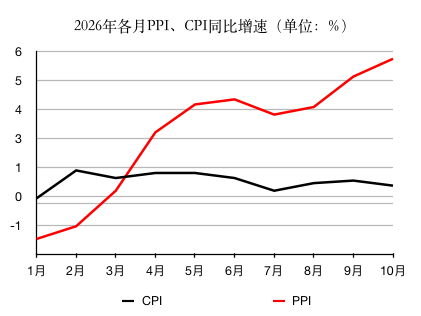
After several consecutive months of negative year-on-year growth in PPI, the year-on-year growth rate of PPI turned from negative to positive in March 2026, and the overall increase continued to rise thereafter.
Regarding the reason for the expansion of PPI growth in October, Dong Lijuan, Chief Statistician of the Urban Department of the National Bureau of Statistics, explained in an article that input and seasonal factors affect the price increase of major energy related industries. Affected by factors such as the transmission of upstream basic energy prices and the release of demand for electricity, coal, and gas during the critical preparation period for the peak winter season, the prices of downstream refined petroleum product manufacturing, organic chemical raw material manufacturing, coal processing, gas production, and supply industries increased by 6.8%, 6.8%, 3.2%, and 1.5% month on month, respectively. The total impact of the six industries on PPI increased by about 0.61 percentage points month on month, exceeding 80% of the total increase. Secondly, the orderly promotion of capacity management and the rapid development of artificial intelligence have driven up prices in some raw material and equipment manufacturing industries. The production capacity of some industries has been adjusted in an orderly manner, and the supply-demand relationship has improved.
Regarding this, Zhang Lin, Executive Vice President of Far East Credit Research Institute, believes that the rise in oil prices has obvious geopolitical disturbance characteristics. After the easing of the situation in the Middle East in November, oil prices have fallen, and with the increase of the base, the upward support will be weakened. October is likely to be the high point of the year-on-year increase in PPI this round, and it will enter a downward channel from November. However, coal prices are still supported in the short term due to winter demand and supply constraints, and are expected to weaken next spring. In addition, the prosperity of the artificial intelligence and storage industries will continue until at least the first half of next year, but with the release of new production capacity, the growth rate will narrow and there is a possibility of cyclical decline.
However, the year-on-year growth rate of CPI in the first 10 months of this year has remained around 1%. From February to June 2026, the scissors gap between PPI and CPI growth rates widened, and the year-on-year growth rate difference between the two increased from negative 2.2 percentage points in February to 3.1 percentage points in June; The growth rate scissors gap between July and August remained at 3 percentage points, expanded to 4.1 percentage points in September, and reached 5 percentage points in October.
Zhang Lin believes that the differentiation of PPI and CPI growth rates is worth paying attention to, but it should not be simply interpreted as the emergence of inflation on the production side. Essentially, this is a combination pattern of "upstream cost shocks and weak downstream demand".On the one hand, the rise in PPI is highly concentrated in the energy chain and the artificial intelligence related industry chain: the former is driven by international oil prices and coal supply disruptions, while the latter is driven by global computing power investment and storage price increases, both of which belong to cost driven increases; On the other hand, the downstream consumer goods market is highly competitive and demand is not growing synchronously. It takes time and process for enterprises to transmit costs downwards, so the CPI increase is not significant. Therefore, the profitability of upstream industries is improving, but some companies in the middle and downstream industries may have to bear certain cost pressures.
Zhang Lin said that these industries may fall into the following categories: first, high energy consuming industries such as building materials, downstream chemical industries, and papermaking, which are affected by rising energy costs and constrained by weak demand for real estate and infrastructure; The second is the fully competitive consumer goods manufacturing industry, such as home appliances, textiles and clothing, and food processing, where the industry itself has limited room for price increases; The third is public utilities, including the electricity, heat, and gas industries. As upstream coal and gas prices rise, terminal prices must remain stable.
But Zhang Lin also judged that this pattern of differentiation does not have sustainability. After October, international oil prices have fallen slightly, and coupled with the gradual increase in the same period last year, the year-on-year increase in PPI is likely to be close to the high point of this round. Next year, it may show a trend of "high-level decline and central downward shift"; The CPI is relatively weak due to the drag of food, and is expected to moderately rebound in the future with the recovery of service consumption and changes in the base. At the policy level, in the face of this differentiation, the focus is on expanding domestic demand, smoothing the price transmission mechanism, and helping middle and downstream enterprises reduce costs
Zhang Liqun, a researcher at the Macro Economic Research Department of the Development Research Center of the State Council, stated that the scissors gap between PPI and CPI has widened, and special attention should be paid to the short-term operating pressure of enterprises, especially small and medium-sized manufacturing enterprises. Next, the macro environment for the development of small and medium-sized enterprises should be improved as soon as possible, and efforts should be made to continuously increase efficiency in expanding domestic demand.


 Subscribe