2026-08-17 09:58


On the scorching day of Yisi, Mr. Liu Yu from the China Ancient Books Protection Association called me and told me that there is an ancient stele in Yuyao, Zhejiang Province. It was written by Li Guang, the Minister of Personnel of the Southern Song Dynasty, a political counselor, and a Grand Secretary of the Zizheng Hall. The content involves Master Huangbo Xiyun and the Tang Dynasty Prime Minister Pei Xiu.
The monument is located in Jiangshan Village
Just after the beginning of autumn, we embarked on a journey to visit the monument in Yuyao. Director Yang of the Culture, Sports and Tourism Bureau of Fuqing City contacted Mr. Zhang from the local cultural relics department as a guide and arrived at Jiangshan Natural Village in Hushan Village, Moushan Town, Yuyao City, where this ancient monument is preserved.
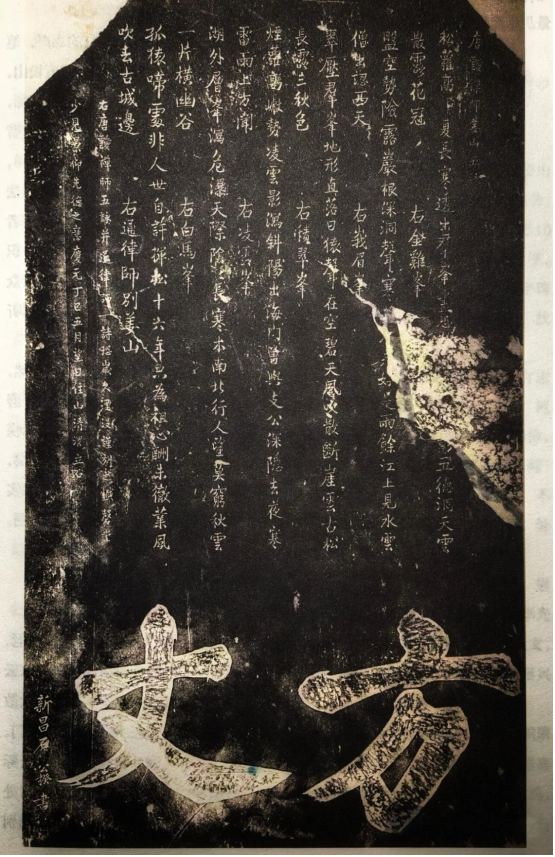
Teacher Zhang introduced that this stele is named "Abbot Stele" by the preservation department, which integrates the poetry and calligraphy of high monks and famous people. It is a "three good stele" with excellent writing, poetry, and calligraphy. The name of the monument, 'Abbot', was actually carved three times. The first time was in the year of Yimao (1135) in Shaoxing, Southern Song Dynasty, when the stele Yang was carved, which contained the inscription "Inscription on the True Statue of Pei Gong in the House of Huangbo" (hereinafter referred to as the "Huangbo Pei Gong Stele"); The second time was in May of the third year of Qingyuan in the Southern Song Dynasty (1197), with a total of six poems engraved on the upper part of the Yin side of the monument, including "Five Poems of Jiang Shan by Tang Yi Zen Master" and "Farewell to Jiang Shan by Lawyer Tong"; The third inscription is the two large characters "Abbot" at the bottom of the monument, which were written by Shi Gongkui, who was an honest official and dared to speak out, but was later forced to die by Qin Huiwei. The content is the two large characters "Abbot" inscribed for the Abbot's Office of Jiangshan Jingning Jiaozhong Temple, which were moved to this monument to commemorate Shi Gongkui.
Beiyang's Huangbo
The "Fangzhang" Stele Yang is the "Huangbo Pei Gong Stele", written by Li Guang, who served as the Minister of Personnel, Counselor of Political Affairs, and Grand Secretary of the Zizheng Hall, and was posthumously honored with the title of "Zhuang Jian". The scholar Zou Dejiu was a talented young man who had no intention of taking the imperial examination and entered the officialdom in plain clothes. He rose to the rank of censor and served as a guard on the rooftop. Li Guang gave high praise to Zou Dejiu's calligraphy in the inscription on the monument, calling it the number one of the dynasties. This article advocates the parallel practice of Zen and Vinaya in Buddhist studies, with different paths leading to the same goal, and is highly valued by the Zen sect.
The opening of "Huangbo Pei Gong Stele" tells that Guangjiao Temple in Xuancheng, Anhui was originally the residence of Pei Xiu when he was in charge of Xuancheng. Pei Xiu was appointed as the Governor of Xuanzhou and the Observer of Xuanshe in the second year of Tang Dazhong (848). During the Tang Dynasty, Xuancheng was renowned for its rich cultural heritage, and its Buddhist culture was also quite developed. During his tenure in Xuancheng, Pei Xiu invited Master Huangbo Xiyun to Xuancheng. Pei Xiu, who revered Buddhism, had already expressed his desire to convert to Master Huangbo. He bowed respectfully to Master Huangbo and allowed him to reside in his own residence, where he would meditate daily. So the "Huangbo Pei Gong Stele" refers to Xuancheng Guangjiao Temple as the "Huangbo Daochang".
Here, Pei Xiu wrote a poem to present to Master Huangbo: "Since the Great Master passed on his heart seal, he has had a seven foot round bead on his forehead; he has been hanging tin for ten years and has been living in the waters of Shu, with a floating cup crossing the shore of Zhang today; a thousand disciples of dragons and elephants follow the high steps, and thousands of miles of fragrant flowers form a victorious cause; I wish to be a disciple of Master Huangbo, but I do not know who to entrust the Dharma to." The poem clearly expresses my lifelong commitment to Master Huangbo as my teacher. And Master Huangbo replied with a poem: "The heart is like an endless sea, planting pure lotus flowers to nourish the body and mind; I have a pair of hands that do nothing, to be a compassionate person in the world. Master Huangbo's response shamelessly revealed his heart and expressed his determination and perseverance to shoulder the heavy responsibility of spreading the Dharma and not cater to the secular elites. From this, it can also be seen that Master Huangbo has a high level of self-esteem and strict self-discipline. He sits at the grand Dharma banquet and does not give up, truly possessing the dignity of a great master.
On the eighth day of the eleventh month in the eleventh year of the Tang Dynasty's Dazhong reign, nine years later, Pei Xiu wrote a preface to Master Huangbo's "Essential Techniques for Transmitting the Heart". In the preface, he expressed his admiration for Master Huangbo: "There is a great Zen master, whose Dharma name is Xiyun. He lived at the foot of Jiufeng in Huangbo Mountain, Gao'an County, Hongzhou, and was the legitimate grandson of the sixth ancestor of Caoxi and the nephew of the Dharma master who lived a hundred zhang away from Xitang. He only wore the highest seal of the departing text, but passed on one heart without any other Dharma, and his heart and body were also empty and lonely. Like the sun rising in the empty sky, the light shines on the clear and pure without fibers. The one who proves it has no new or old, no shallow or deep, and the one who speaks it does not establish a Without establishing a clan leader or opening an account, one should go straight down. One should be obedient when thinking, and then become the true Buddha. Therefore, his words are simple, his principles are straight, his path is steep, and his actions are solitary. Apprentices from all directions look at the mountains and come to understand, and there are often more than a thousand people traveling to and from the sea. In the second year of Yu Huichang's reign, Lian arrived at Zhongling and welcomed him from the mountains to the state. He rested at Longxing Temple and asked questions overnight. In the second year of the Dazhong reign, he was sent to Wanling to pay respects and was welcomed back to his troops. He settled in Kaiyuan Temple and received the Dharma overnight. After retiring, he was disciplined and received one or two out of ten. Pei is a heart seal, I dare not carry it forward
Huangbo Pei Gong Stele
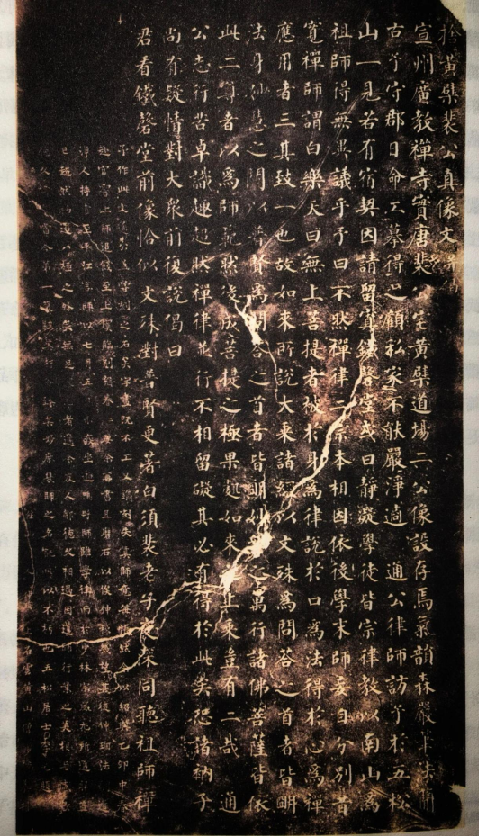
The inscription on the Huangbo Pei Gong Stele is arranged from right to left, with the main text written in large regular script of 300 words, divided into 12 columns, each column ranging from 10 to 28 words. On the right side of the main text is the inscription written in regular script, divided into 5 columns, with each column ranging from 34 to 35 words, totaling 174 words. After the inscription, 10 characters were written in small regular script, "Zhong Xun, a man living in the mountain, went to the stone and was copied by the Mount Huangshan Monk Miao Ge". The inscription has a total of 484 words. The inscription is as follows:
Xie Huangbo, Pei Gongzhen, composed a text and verse. Xuanzhou Guangjiao Zen Temple is actually the residence of Tang Pei Gong and the Huangbo Dojo. The statue of Er Gong is still in existence, with a strict aura and a simple and ancient style of writing. It was commissioned by the prefectural governor to imitate it. However, due to personal reasons, it cannot be strictly observed. Therefore, it is appropriate to have a lawyer visit to Wushan Mountain. If there is a residence contract, please keep it in the Iron Bell Hall. Or it can be said: "All disciples of Jingning are followers of the Dharma teachings, with Nanshan as their ancestral teacher. Is there no difference in agreement?" Yu said: "Otherwise, the two schools of Zen and Vinaya are closely related, and the later masters are self-centered. The former Master Kuan called Bai Letian, saying:" The supreme bodhi is regarded as the Dharma by the body, the Dharma by the mouth, and the Zen by the heart. There are three applications, and their unity is one. "" Therefore, the Mahayana scriptures spoken by the Buddha, with Manjusri as the first question and answer, all understand the gate of the Dharma body and wisdom; with Samantabhadra as the first question and answer, all understand the ten thousand actions of wisdom. All Buddhas and Bodhisattvas regard this two as their teacher, and then become Bodhi. The ultimate fruit is superior to the Tathagata, how can there be two
Tong Gong's aspirations and actions are outstanding, his knowledge and interests are transcendent, and Zen and Vinaya coexist without any hindrance. He must have achieved this. Afraid that the disciples still had doubts, he recited a verse to the public, saying: 'Look at the statue in front of the Iron Bell Hall, just like Manjusri's treatment of Samantabhadra.'. Wearing white beard, Pei Laozi listened to the Zen meditation of his ancestor at night.
The content of the inscription written by Li Guang mainly describes his views on learning Buddhism by quoting the Buddhist insights of Master Kuan (Weikuan) from Guangjiao Zen Temple in Xuanzhou, Anhui, and conversing with Tonggong Lawyer (referring to a Buddhist monk of the Vinaya school) about the interdependence between the two schools of Buddhism, Zen and Vinaya.
After the inscription, Li Guang wrote an inscription, which was four characters lower than the main text and was engraved on a small stone: "To write this text, Tong Gong has tasted the stone engraved on it. The calligraphy and painting are not well done, and the engraving is distorted. The teacher was disappointed every time. In the middle of spring in Yimao, Shaoxing (1135), Li Guang went to the official tomb (also known as Huzhou in Zhejiang), and the teacher followed the farewell to Shangyu. When they parted ways, they still loved each other and asked for more calligraphy, and the stone was polished to wait. After a few glances in the middle of autumn, his disciples Zhongjun and Fasi sent people to Pingjiang (in present-day Wu, Jiangsu) to hold the book. On the fifth day of the seventh lunar month, Yan Shi passed away due to illness. He let out a loud cry! Although he studied the law, he was particularly proficient in the Shaolin style (referring to Zen Buddhism) and had already transcended the Eight Extremes of the Divine Journey. There was no one who could deeply mourn. His friend Zou Dejiu passed by him and marveled at the beauty of the Taoist profession. Dejiu's calligraphy is truly the best in today's world, and the true practice of seal script and clerical script is each exquisite. The names of several other masters are immortalized by this. Wu Song layman Li Guang's question. Zhong Xun, a man living in the mountain, went to the stone and was copied by Miaoga, a monk from Mount Huangshan Mountain. ”
Shudan's Zou Bing
From the inscription on the "Inscription on the True Statue of Pei Gong in Shehuangbo", it can be seen that this text was carved before the death of Duke Tong, but the carving was not ideal. Duke Tong wished to rewrite it. The stele that exists today was rewritten after the death of the lawyer Qiu Tong in Yimao, Shaoxing, Southern Song Dynasty (1135). At that time, Zou Dejiu happened to pass through Pingjiang Prefecture and visited Li Guang because he was friends with him. Li Guang knew that he was a master of calligraphy, so he invited his friend Zou Dejiu to write it and hoped to use his calligraphy to make this article immortal.
So, who is Zou Dejiu? According to the "Research on the Origin and Development of the Zou Family's Tiantai Branch", Zou Bing, with the courtesy name Dejiu, was born in Piling (formerly known as Changzhou, Jiangsu). His father, Zou Hao, with the courtesy name Zhiwan, passed the imperial examination in the fifth year of Yuanfeng in the Northern Song Dynasty (1082) and was promoted to the position of Zhilongtu Ge. He was awarded the title of Baowen Ge Bachelor and posthumously honored with the title of Zhong. The deeds can be found in the original biography of the History of the Song Dynasty. Zou Bing was the eldest son of Zou Hao, born in the seventh year of Yuanfeng (1084). Zou Dejiu is a disciple of Yang Shi (Mr. Guishan). In Volume 35 of Huang Zongxi's "Song Yuan Study Case" and "Chen Zou Zhu Confucianism Case" during the Qing Dynasty, there is an article titled "The Handle of Mr. Zou, the Governor of the State", which states that "the handle has a strong father's style. Without a crown, he abandoned his son's career and traveled from Mr. Guishan to compile a volume of" Yichuan Quotations "by hand, becoming a classic work of Neo Confucianism in the Song Dynasty.
According to Volume 3 of the "Jingkang Yaolu", on March 15th, 1126, "Zou Bing, a cloth clothed official from Changzhou, was appointed as the Chengwu Lang." Zou Yixiao wrote "The Biography of Duke Dejiu's Family," describing Zou Bing's life and deeds. He said, "In the fifth year of Shaoxing (1135), after being appointed as a public official, the court promoted him to the position of censor (in charge of affairs) and went out to guard Tiantai. His death (1138) was buried there." In his "Dialogue with Duke Dejiu," Chen Yuan, the son-in-law of Yang Shi, said, "Dejiu was renowned for his heroic talent and his reputation in the sea." This shows that he had knowledge and prestige, and was a celebrity who could hold official positions from a cloth clothed background. It shows his outstanding talent, high social awareness and prestige.
Zou Dejiu learned calligraphy from Huang Tingjian. Zhu Xi evaluated him in his book "Critique of the Wise" as follows: "Zou Dejiu's regular script 'Da Xue' is written in this way today, which is also difficult. This shows that his regular script is the most solid among all styles. The monk Huihong of the Southern Song Dynasty wrote in his book "The Zen of Shimen Writing": "Zou Dejiu, the loyal Duke Haozi, traced the valley with his brushwork." The person in the valley was Huang Tingjian. He and Zou Dejiu are 'old friends'. In the fourth year of Xianchun's reign (1268), Shi Neng, the leader of Xianchun, wrote the "Record of Rebuilding Piling in Xianchun", which reads: "The handle, the characters are virtuous and long, solemn and studious, and the young bear the handsome voice. The loyal public is like two rivers. When you see Mount Huangshan Valley, you will be deeply admired, and call your little friend." It is under the influence of Mount Huangshan Valley, an old friend, Zou Dejiu's calligraphy will become unique.
The text "Sutra and Verse on the True Portrait of Lord Pei of Shehuangbo" written and inscribed by Li Guang is an important document for studying Buddhism, correctly understanding the two schools of Zen and Vinaya, and promoting the parallel practice of Zen and Vinaya. Li Guangguang wrote such an inscription, indicating that he was also a person who devoted himself to Buddhism. He had a profound understanding of Buddhism. He hung the Huangbo and Pei Gong (Pei Xiu) statues in his family temple, showing his respect for these two people. Pei Xiu was also a role model for him as an official. Shi Gongkui of Xinchang served as an official in the same dynasty as Li Guang, and became an official a few years later than Li Guang. They were both honest and upright officials, and shared similar interests and became good friends.
This stele was first erected in the Tietang Hall of the Jingning Jiaozhong Temple in Jiangshan Li Guangjia Temple. Later, it was taken by a brick kiln factory to be used as a sealing stone for a earthen brick kiln. After the kiln factory closed down, the villager surnamed Li used a hand pulled cart to drag this stele home and erected it in the courtyard. A stele pavilion was built for protection and it has been well preserved ever since.
This article's picture of the abbot's stele is sourced from the book "Yaojiang Stele". The True Portrait of Pei Gong in Shehuangbo (with Verses) can be found in Li Guang's Collection of Zhuang Jian, Volume 17.
Source: August 13, 2026, "Haidu News" in the Strait Metropolis Daily
Author: Bai Chongyu