Economic Observer Follow
2026-08-15 09:06



This year's college entrance examination enrollment season, the old meme of "984.5" universities has come up with new ideas. This folk term originally referred to industry characteristic 211 universities such as Beijing University of Posts and Telecommunications and Shanghai University of Finance and Economics, but in this year's context, it refers to new research-oriented universities without 985 titles but with admission scores exceeding some 985 universities - Southern University of Science and Technology, Greater Bay Area University, Xihu University, Fuyao University of Science and Technology, etc., all of which are included.
In the first undergraduate enrollment last year, universities in the Greater Bay Area closely followed the prestigious Sun Yat sen University with a admission threshold of 6 points. This year, it expanded enrollment by 50% in the Guangdong examination area, but the admission line and ranking did not decrease but instead increased; Fuyao University of Science and Technology also announced an expansion of enrollment this year, but its admission line in Fujian still exceeds some professional groups of Xiamen University. A Gansu candidate who had the opportunity to enter a prestigious 985 university ultimately chose Fuyao University of Science and Technology.
Of course, the admission score is only one aspect of measuring the popularity of universities. Due to differences in enrollment scale and educational positioning, it would be presumptuous to say that the comprehensive level of these new research-oriented universities has surpassed that of the old 985 prestigious universities. However, these new types of universities are indeed becoming a competitive force that cannot be underestimated with their real application enthusiasm.
Filling out college entrance examination preferences is not only an information game, but also a rational investment for candidates in their future development. The fact that candidates vote with their feet precisely reflects the reputation of universities in people's minds. It is worth questioning what kind of attraction these new universities, which do not have a profound historical background or a dazzling aura, have and have become the dream schools for candidates?
Looking at these new research-oriented universities, there are several common labels. Firstly, the school's positioning is "small yet refined". For example, West Lake University, which has a history of 8 years, is very restrained in its scale of education: it has a small enrollment but a high teacher-student ratio; There are not many majors offered, but they are highly focused on cutting-edge interdisciplinary fields; There is no quota limit for choosing a major, and you can completely rely on your own interests. A student stated that with a very small student body, ample freedom and ample opportunities eliminate the vicious competition of either or.
Secondly, the governance model is flexible. Their management structure is generally flat, allowing the administrative team to return to the core of "serving academia". In the evaluation of academic talents, quantitative indicators such as the number of papers and impact factors are not used as a single criterion, but rather long-term assessment and international peer review are promoted. This institutional environment helps attract and retain talent, and forms a highly competitive faculty matrix. For universities, faculty is undoubtedly their core competitiveness.
Thirdly, facing the market, guided by practical problems, and emphasizing the integration of science, industry, and education. Fujian Fuyao University of Science and Technology, founded last year, was founded by Mr. Cao Dewang, who understands the pain point of the disconnect between academia, research papers, achievements, and transformation. He hopes to explore a new educational path: through the joint construction of laboratories by schools and enterprises, the system of science and technology innovation leaders, and project-based teaching, students can learn and grow in real industrial scenarios. In June of this year, the news that Fuyao University of Science and Technology required each department to be responsible for its own profits and losses sparked controversy. President Wang Shuguo stated in an interview that the university is not asking departments to aim for profitability and market-oriented revenue generation, but rather forcing them to delve deeper into real problems. This response is an interpretation of the original intention of running the school.
Of course, the evaluation of the achievements of higher education needs to be observed over a longer period of time - Southern University of Science and Technology, which was the earliest to establish a university, only has a history of more than ten years; The positioning of new universities and old 985 universities is already different, and it is not appropriate to make a simple comparison. But in any case, this new force and its upward momentum are reminding us to re answer a question: what is a good university?
A good university should face the market directly and also have a long-term perspective. Young people enter university after years of hardship, and naturally hope that when they complete higher education and enter society in the future, their knowledge will not be out of touch with market demand. More importantly, university education shapes their ability for self-learning and preserves their curiosity to explore the unknown. This may be more important than specific knowledge and skills, as any skill can become outdated, and the ability to continuously learn and drive oneself is the anchor to cope with the changing times.
Freedom is always the precious spiritual core of a good university and will never become outdated. Freedom attracts talent and inspires creativity, both for professors, scholars, and young students. Only in a state of abundant and relaxed life can dreams be born and inspiration emerge. After Chinese mathematician Wang Hong won the Fields Medal, the title of a report already expressed the power of the environment: 'Go to Wang Hong's research institute and see, here is the freedom she needs'.
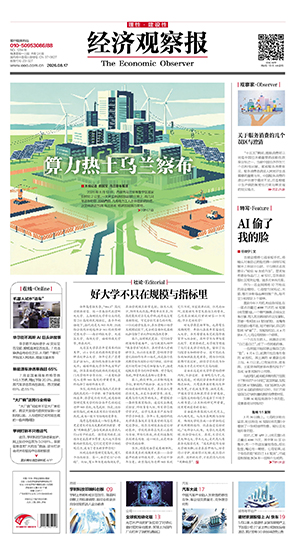
Freedom ultimately falls on the scale of human beings, and human scale is never in scale and indicators. Shi Yigong, the president of Xihu University, once refused an invitation to expand the scale. In an interview, he said, "Most people believe that the greatness of a university lies in its scale and social impact. In fact, the greatness of a university is the greatness of a master, the greatness of academia, and the greatness of human exploration today." This may serve as a footnote to a good university: allowing those who are in it to guard curiosity, encourage innovation, and promote growth. Only such universities can gain people's' foot votes'.