2026-08-13 16:00


Wen/Zhu Jiaming
Among the races on the ground, humans are the weakest.
——Translation by Chen Zhongmei of the Homeric Odyssey
Introduction
Around the 8th century BC, wandering poets in the Aegean Sea compiled a group of long circulated stories into two long poems. The Iliad tells the story of how people die, and the Odyssey tells the story of how people return home. The two works are collectively referred to as the "Homeric epics", and Homer therefore enjoys the highest honor in the world. 3000 years have passed, and the Iliad remains the highest text about war, while the nature of the Odyssey has repeatedly changed. It is no longer just a story of Odysseus' long journey back home, but has become a skeleton repeatedly used in Western spiritual history. Whenever history needs to reconsider departure and return, identity and time, cost and meaning, people will reopen this poem.
In the Odyssey, the most frequently mentioned concepts are "returning home" or "returning" (nostos), as well as "pain" (algos). In 1688, 2400 years later, in his doctoral thesis, Hofer, a medical student in Basel, combined the concepts of "returning home" and "suffering" into a new concept called Nostalgia, which was used to describe and diagnose the physical and mental symptoms of Swiss mercenaries who were far away from their hometowns. It is this belated medical term that endows The Odyssey with a deep interpretation of science, medicine, and psychology. Odysseus is actually a hero deeply trapped in Nostalgia; On the island of Calypso, when faced with the temptation of "exemption from all pain and eternal life," he voluntarily chose a path full of pain in exchange for returning home as a mortal.
(1) Every era is rewriting Odysseus
The fundamental reason why the practical significance of The Odyssey changes from generation to generation is that its protagonist Odysseus is a character that can be constantly interpreted differently. The adjective given to him in the first line of the poem is' polytropos'. The grammatical situation of this word itself is ambiguous, which can be understood as either active "multi strategy" or passive "manipulated by fate".
The Athenians of classical times did not like Odysseus. One of the three great tragic poets of ancient Greece, Sophocles, wrote "Philoctetes" in his later years, in which Odysseus was a politician who advised people to cheat. In the city-state where the rhetoric of the Sophists was rampant, wit (m ē tis) lost the praise bestowed upon it by Homer and degenerated into manipulation. The Romans, who considered themselves descendants of Trojans, were even more impolite. In the epic poem "Aeneid" by the ancient Roman poet Virgil, after replacing the Greek title "Odysseus" with the Latin title "Ulysses", he was given modifiers such as "cruel" and "ferocious". This is the first reversal of Odysseus' fate.
The great Italian medieval poet Dante completely rewrote the fate of the protagonist in the Odyssey. Dante, in Chapter 26 of his epic "Divine Comedy," places Ulysses among the deceitful strategists on the eighth level and envelops him in a flame. The key is that Ulysses, depicted by Dante, did not return home at all. Instead, he set sail again from the island of Circe, convincing his elderly companions to sail out of the Pillars of Hercules and make a "crazy flight" southwest. After five months of sailing, he saw Mount Inferno and was immediately swallowed up by a storm. Dante was not familiar with Greek, and all his knowledge of this character came from three ancient Roman writers, Virgil, Ovid, and Seneca. The brilliance of history lies in Dante, who had never read Homer's original works, transforming Odysseus from a returnee to an explorer, providing a ready-made narrative prototype for the subsequent geographical discoveries.
In the 19th century, the English poet laureate Alfred Tennyson wrote the rhyless poem "Ulysses" in 1833. The protagonist Ulysses underwent a highly modern spiritual sublimation and reshaping, becoming a pioneer who never stops and yearns to explore the unknown limits. This is not only a personal elegy for the 24-year-old author mourning his deceased friend, but also a psychological portrayal of the expansion of the industrial empire.
In the first half of the 20th century, the image of Odysseus, also known as Ulysses, underwent a transformation in two directions: being reduced and being magnified. Firstly, it has been reduced in size. In 1922, Irish writer James Joyce compressed 20 years into 18 hours in his novel Ulysses, reducing the king to an advertising salesman in Dublin. An epic hero transformed into the most ordinary mortal walking on the muddy streets of Dublin in the 20th century. Secondly, it is magnified. In 1938, Greek writer Nikos Kazantzakis went against the trend and wrote the 33333 line "Odyssey: Modern Sequel," in which the protagonist left Ithaca, traveled through Sparta, Crete, Egypt, and Africa, and ultimately died on the Antarctic ice sheet.
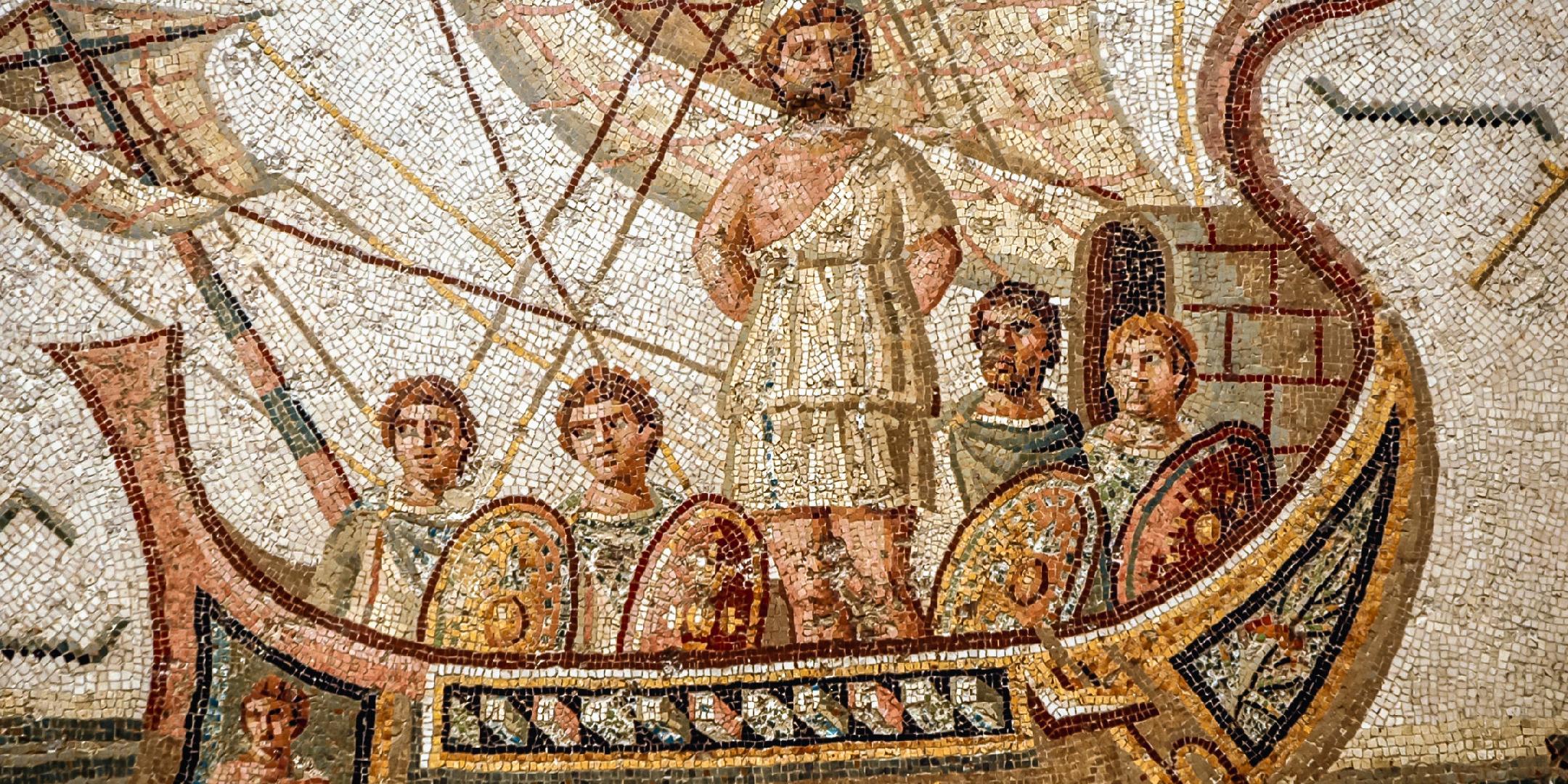
After the war, the interpretation of the Odyssey generally turned gloomy. In 1944, Europe was shrouded in the shadow of Nazi fascist concentration camps and the Holocaust. Two German philosophers, Horkheimer and Adorno, wrote a special essay titled "Odysseus, or Myth and Enlightenment" in their book "Dialectics of Enlightenment". In the text, Odysseus is read as the prototype of the bourgeois individual, who forged himself through continuous self rejection. In the original work, the Siren and Fairy section is seen as a fable of division of labor, where the scene of "the rower blocking his ears cannot hear, and the person tied to the mast can hear but cannot move" is interpreted as such.German Jewish scholar Auerbach proposed another judgment in "The Scar of Odysseus" at the beginning of "Imitation": Homeric style places everything in a uniform foreground, without background, darkness, or depth that needs to be explained. French Jewish philosopher Levinas opposed the "return of Odysseus" to the "departure of Abraham" in "The Whole and the Infinite". The former is a circular movement of identity, while the latter is an ethical action that seeks no reward. These statements are different from each other, but they all use the Odyssey as a tool for diagnosing modernity.
Entering the 21st century, the dominant reading of The Odyssey has once again shifted. In 2002, American psychiatrist Jonathan Shay completely stripped away the "mythological filter" and "philosophical filter" of this epic in "Odysseus in America," restoring it to an extremely accurate psychological medical record of veterans. He believes that the real difficulty of returning home is not on the road, but in the community's inability to receive the memories of the returnees. In 2017, British contemporary classical scholar Emily Wilson summarized the protagonist as "complex" in the first fully translated version of the Odyssey completed by a woman in the English speaking world. This translation itself is a statement of position.
In short, the protagonist of The Odyssey possesses an unimaginable tension, able to withstand various anxieties of every era, endure people redefining him according to their own needs, and transform his identity according to the times. For example, becoming the explorer needed in the Age of Discovery, the restless in the Industrial Age, the survivors needed after the two World Wars, and the silent returnees needed in the Age of Trauma.
(2) Fill in the blanks on the screen and the blanks left by epic stories
Homer has no background or three-dimensional image. In the 19th century, the camera was invented. The Odyssey, which emerged in the mid-8th century BC, became a favored subject for cameras. The camera forcefully fills in the gaps of the epic. Every adaptation of The Odyssey exposes the preferences of that era.
In the 20th century, the casting of Italian director Mario Camerini's film Ulysses in 1954 was a form of judgment. Italian actress Silvana Mangano played the role of Penelope, the virtuous wife who waits for her husband, and also played the role of the slut/sea monster Circe who uses magic to keep the hero. Allowing the seducer and his wife to share the same body, a man's wandering is nothing but hovering between two versions of the same face. In 1963, French New Wave master Jean Luc Godard's "Contempt" went even further, capturing certain imaginations that were not portrayed in "The Odyssey".For example, is Odysseus' delay in returning because he already knows that Penelope no longer loves him. This is a sharp misreading given by modernity, compressing epic into a marital crisis. In 1968, Franco Rossi filmed a television version of Odyssey for the Italian Broadcasting Corporation, which was widely recognized as the most faithful to the original work. In 1995, Greek film master Theo Angelopoulos' "The Gaze of Ulysses" transformed Ulysses into a Greek American director named A, rewriting his journey back home as a search for three rolls of undeveloped film, passing through the disintegrating Balkans and ending in the besieged Sarajevo. Nostos' object was no longer his home, but his "initial gaze".
In the 21st century: In 2000, the Coen brothers, the most advanced "genre deconstructionists" in the film industry, moved the story of Odysseus into Mississippi in 1937 through "The Three Kings of Escape," and the one eyed Bible salesman was Kukrops. The two directors claimed that they had never read the original work, which proves that epic has dissolved into cultural groundwater. In 2024, Italian director Umberto Pasolini's' Return 'was a milestone. This film only adapts the latter half of the epic, starting from Odysseus floating naked on the beach of Ithaca, removing all sea adventures and gods. The director made it clear at the Toronto Film Festival that what he wants to preserve is human emotions and psychology, the difficulties of being a person and being a good person. The consequences of this deletion are decisive. Once Athena is removed, all motives must be found in the person. Odysseus is no longer a hero favored by God, but a survivor who cannot forgive himself for losing all his companions, a person who resists becoming king again.
In 2026, the recently released film "The Odyssey" directed by British director Christopher Nolan took a completely opposite path. Nolan also relied mainly on Wilson's translation, but retained God, repositioning Odysseus' guilt on the destruction of the way of treating guests ("xenia"). The cruelest change in the film is that Odysseus concealed all the contents of Tiresias' prophecy from the crew, causing them to die from his overconfidence in his own intelligence. The ending of the entire film is that after Odysseus slaughtered the suitors, he did not return to his original position, but instead self exiled and handed over the throne to his only son Telemachus. Finally, he boarded the ship with Penelope and sailed towards the west towards the setting sun. The 'crazy flight' to the west is the invention of 'Divine Comedy' and 'Inferno', not the plot of 'Odyssey'.This ending may seem innovative, but it actually brings Dante back to Homer's position.
At this point, the division of labor between the two contemporary works closest to the audience has become clear. Pasolini filled the silence of epic on the inner world, while Nolan filled the silence of epic on the ending. They collectively marked several blank spaces that Homer had not yet opened up: his self blame after losing 600 companions, which was only covered by a disclaimer in the epic; What was he thinking while sitting on the shore crying every day for seven years on Calypso Island? There is not a single word in the epic; How he lived with the fathers of 108 suitors after killing them, the epic ended hastily with a ceasefire imposed by the goddess. In addition, Telemachus' feelings for a stranger father, Penelope's twenty year heart, were also left in the dark.
Homer would like to thank the camera, for all the work done by the camera 3000 years later is to ignite the lights in the epic darkness.
(3) As a human weakness and tragedy
Homer never wrote Odysseus as a perfect person, hiding his criticism within the structure of the plot. The deepest foreshadowing among them is the name Odysseus chosen by his maternal grandfather Otto Lucius, whose word root means to provoke resentment, inflict and endure pain. Naming is prophecy, and everything Odysseus did and received throughout his life is written in his own name. He was not a perfect life, mainly reflected in:
Ontology transformation. Odysseus, as the incarnation of the Greek word for "wisdom", was rescued when he fell into a desperate situation in the cave of Kukrops by calling himself "nobody" (Outis), which means transforming into an identity without identity or becoming. But after escaping, he couldn't bear an unsigned victory and shouted his real name across the sea. So the curse of Poseidon descended, and the following ten years of wandering and the deaths of all companions came from it. Vanity is not one of his flaws, but rather his core structure, as he cannot tolerate humility and must be the author of his own deeds. The tragedy of the entire poem lies in the fact that he no longer has any title that represents his existence, and he insists on becoming a specific person and losing everything.
Failed leaders. Aeolus, the wind god, gave Odysseus a leather bag filled with headwinds. He held the secret alone and didn't tell anyone, but fell asleep when he saw the coast of Ithaca. The crew thought the bag was his hidden treasure, untied the knot, and the wind blew the fleet back to its original position. Confidentiality was Odysseus' survival technique, which led to the failure of his governance. Concealing directly became the reason for killing all the crew members.
Addiction to lies. After Odysseus landed in Ithaca, he fabricated his identity against the disguised Athena. The goddess laughed and caressed him, saying that he couldn't change this habit in front of the gods. Afterwards, he told four or five structurally complete 'Cretan lies', each of which became his own biography. The most disturbing evidence appears in Volume 24, when facing the aging father Laertes in the estate, he still had to lie and probe first, until the old man picked up dust and sprinkled it on his white hair, crying bitterly, before willing to recognize each other. 20 years of survival skills have accumulated into personality distortion. That is no longer a strategy, but a damage.
Excessive violence. In Volume 22, Odysseus massacred 108 suitors. This is not enough. After confirmation by Odysseus' wet nurse, his son Telemachus strangled and killed 12 so-called disloyal maidservants with a boat rope. Homer gave a cruel description of this, saying that these maids were like thrushes caught in a net, twitching their feet for a moment before stopping. On this issue, Odysseus had another side, preventing the old nurse from boasting about the punishment of the deceased. This bloody massacre scene not only showcases Odysseus' twisted revenge mentality, but also shows his complete reshaping due to war, becoming a cold-blooded and arrogant ruler who internalizes violence into an absolute order.
All of Odysseus' weaknesses collectively point to his specific tragedy. As someone who had seen the underworld, rejected goddesses, and heard Sirens singing, he ultimately couldn't truly return to and integrate into the island of Ithaca, which is repeatedly described in the epic as a rocky and goat grazing homeland. In Volume 11, the soul of Achilles said that he would rather be a hired servant of the landless on earth than a king in the underworld. This sentence is both the answer of the Odyssey to the Iliad and the entire legitimacy of Odysseus' choice to live on. But the price that the surviving person has to pay for this is precisely himself.
(4) After returning and going out to sea again
The recognition scene in Volume 23 of the Odyssey is the most precise identity verification in all ancient literature. Identification cannot rely on the body, as scars were accidentally discovered by an elderly nurse; Cannot rely on language, because he never speaks the truth. The final method adopted by his wife Penelope was to order the servants to move the wedding bed out of the bedroom in front of him. And that bed was carved by himself from an olive tree that was still rooted underground and couldn't be moved at all. He was furious on the spot, and his rage was proof.
Homer's most unusual stroke in the Odyssey is: On the night of recognition, the two of them bid farewell to each other in bed, and the first big thing he told her was that he had to leave again. The return already includes departure, and upon arrival, departure has already been arranged. He had to carry an oar and head inland until he met a group of people who didn't know the sea, didn't put salt in their food, and didn't know what a boat and oar were. When someone on the road mistook the oar on his shoulder for a wooden shovel for a valley, he plunged the oar into the soil and offered a sacrifice to Poseidon before returning home to spend his remaining years.
This is fulfilling the prophecy of the blind prophet Teresias. So it's not a punishment, but a dismissal ceremony. Paddles are paddles by the seaside, but only agricultural tools inland. He must walk all the way to the place where his identity symbol is completely invalidated, to the place where the tool that defined his life is completely misread, in order to be released. To get rid of the sea god, one must reach a place where the concept of "sea" does not exist at all. What Homer gives here is the oldest and most precise solution to how identity ends: the end of identity does not come from negation, but from detachment from the context in which it is established.
The ending of the prophecy still leaves a famous ambiguity: death will descend upon him with 'ex halos'. This phrase can be interpreted as "coming from the sea" or "coming far away from the sea". The ancient commentators argued endlessly about this, and Homer did not rule on it. No one in later generations wants to keep this ambiguity silent. The lost "Telegonia" had the daughter of the sun god Helios, Circe, and the illegitimate son of Odysseus, Telegonus, mistakenly kill their father with a spear pointed at a stingray, and then marry Penelope, while Telemachus married Circe. This ending is absurd and reveals the anxiety of the ancients, who cannot stop the story of Odysseus. So, for 3000 years, almost no latecomer was willing to let him stay at home, indicating that returning home cannot serve as a narrative endpoint. So Dante arranged for him not to go home at all; Tennyson asked him to set off for the sake of departure; Kazanzakis had him travel south and die on the ice. The Greek poet Cavafus gave the gentlest and coldest version in Ithaca, saying that the destination itself has nothing to give, it only gives you this journey. Now, Nolan has exiled him and sailed towards the sunset with his wife.
In depth analysis reveals that the true enemy faced by the returnee is not the suitor, but time. During Odysseus' 20 years, he could describe the Cyclops and Sirens to Penelope, but adventures were not what he truly experienced. What he truly experienced was the deaths of 600 people under his judgment. This type of experience has nowhere to be placed. Odysseus is likely aware of this. He chose to run away again not only to fulfill Tiresias' prophecy, but also as a rational choice to face reality.
Volume 8 of the Odyssey features scenes that transcend time and space. At the court of the Phoenicians, the blind poet Demodorchus sang about Troy, and when he reached the wooden horse, Odysseus pulled up his headscarf and covered his face, crying bitterly. He became the listener of his own legend. Once a person's life becomes a story that others can sing, they no longer possess it. This may be the deepest reason why he must set sail again. The legend has been completed, yet he is still alive. To regain one's existence, one can only create parts that have not yet been sung.
(5) The ultimate meaning of suffering and humanity
Now let's return to the deepest question raised in Volume 5 of the Odyssey: the condition given to Odysseus by the goddess Calypso, who had bound him for seven years, was immortality, immortality, a goddess, and an island. She also reminded him that Penelope was not as good as herself in appearance and size. Odysseus fully acknowledges it. However, he still chose an aging mortal wife and a small rocky island. This is the most important rejection in the entire European literature. Because behind this rejection is an eternal philosophical question: the meaning of human beings depends on their limitations, and immortality will completely destroy human meaning.
Because the meaning of a person is determined by the simultaneous existence of four conditions: the finite nature of life; The irreversibility of history; Individual's solitary experience; Painful memories. Odysseus became an epic figure for 3000 years precisely because all four conditions were met by him. On June 16, 1904, Leopold Bloom, as the incarnation of Ulysses or the "modern version of Odysseus," reenacted the same thing in Dublin. Bloom knew what would happen at home at 4 pm, so he didn't go back all day. At two o'clock in the morning, he returned home, crawled in from the foot of the bed, and lay in the same position where another man had been lying. Author Joyce questioned his reaction in a question and answer format, and after jealousy and self abandonment, the final answer he gave was calm. He doesn't kill suitors, he absorbs suitors. The modern version of heroism is not about revenge. Bloom proved one important thing, epic abilities can survive in the most mediocre bodies. There is only one condition, and that body must still bear it alone.
Compared to Odysseus, the real challenge for modern humans is not the ability itself, but no longer possessing the historical environment in which Odysseus lived. Firstly, coordinate the road. Modern navigation systems eliminate the possibility of 'leaving'. Odysseus' wandering relies on the existence of an external world, and when every coordinate has been calibrated, there is no longer 'elsewhere', and therefore no nostos. Secondly, the connection between the inland and the ocean. The ceremony of paddles and dustpans cannot be held in a completely connected world. There is no more inland village that doesn't know the sea, every place knows every place.Thirdly, the geographical isolation has disappeared. In the modern world, any misfortune that occurs is shared, commented upon, or categorized by algorithms into an existing type at the same time. The silence period required for transformation is filled with immediate collective reactions. All truly valuable conversions must be completed independently. Fourthly, irreversible weakening. The world was originally irreversible and irreversible. If everything were reversible, trauma and pain would be downgraded to modifiable parameter settings.
So, Odysseus' true achievement was not surviving through countless hardships. When he left, he was a young king, and when he returned, he was an old beggar transformed by a goddess. He had become a 'nobody', a prisoner, a lover of a goddess, and a 'underworld'. Despite experiencing such a complete breakdown, he was still the same subject of the same story and could still say 'I am Odysseus'. How to maintain personality in intense discontinuity is precisely the core issue that modern and post human beings have to face. Does the subject still hold true when the body can be replaced, personality can be split, memory can be externalized, and life data can be distributed and stored in different systems?
In this sense, the Odyssey is not an ancient book unrelated to modern humans, but rather the first archive left by humanity on how the subject travels through a complete rupture and still exists. The oar that was inserted into the inland soil never marked the sea, but the end of the sea, where a person voluntarily walked to a place where their lifelong skills were no longer recognized. Odysseus never chose to suffer, he was forced, and it was precisely because of this that transformation became his achievement. When suffering becomes an option to unsubscribe, conversion becomes a hobby, and the hobby that no one practices will disappear within two generations.
Today, 3000 years later, Calypso's temptation is evolving from myth to the agenda and behavior of human technology and industry, becoming an upgraded version of immortality. However, the real issue is not whether human immortality can be fulfilled, but when the human body breaks through the limit of life and suffering is terminated by algorithms, humans will completely lose their desire for the "return path" and the pain caused by the desire. On that day, Odysseus was not forgotten, but permanently disqualified from being present. If there were such a day, without storms, storms, and unpredictable destinies, without mortals experiencing shattering, there would never be any soul worth becoming Odysseus again. This is precisely a tragedy that surpasses any human tragedy. So, Odysseus' rejection of the gods is a defense of the dignity of mortals, a painful struggle to 'become a human' rather than shedding blood.
At this moment, I can finally deeply understand the cry that Odysseus uttered when faced with Calypso's eternal temptation: "If any god breaks me in the vast dark sea, I will silently endure on the ship because I have a heart that endures hardship in my heart. I have already experienced too much tragedy and suffering in waves and battlefields before, let this new hardship be added as well